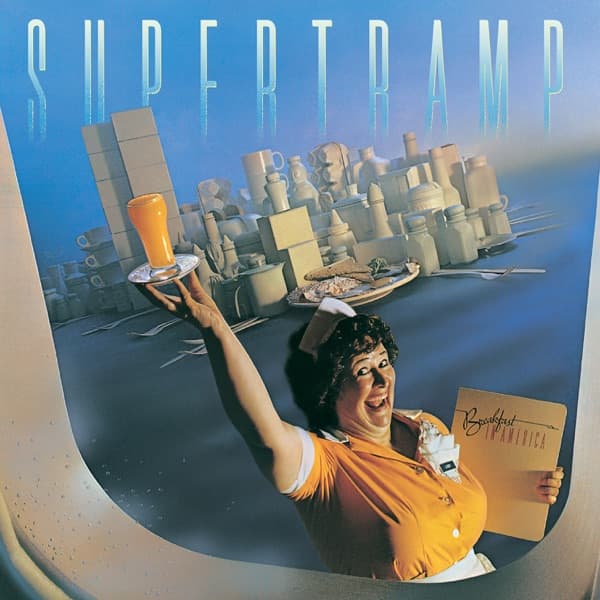
The setup is a wholesale substitution, and the eye works through it in stages. First it registers a smiling figure with an arm raised in the Liberty pose, then it clocks that the torch is a glass of orange juice on a plate and the tablet is a menu. Her warmth and heft are exactly what make the parody affectionate rather than cruel; the matronly presence keeps the joke gentle.
Behind her, what at first glance reads as the New York skyline seen from an airplane window is, on a second look, a table full of breakfast things. Two tall stacks of white boxes stand in for the Twin Towers. A cornflake box, an ashtray, salt and pepper shakers, coffee mugs, syrup and condiment bottles, egg crates, and rows of cutlery laid out as wharves all crowd the horizon. Every one of them is spray-painted a uniform ghostly white, which is the crucial move: the flat, chalky monochrome strips the objects of their grocery-store identity so the eye reads architecture before it reads breakfast. The trick only collapses into a tabletop when you look twice, and that delayed recognition is the pleasure of the whole image.
The framing is the clincher. The entire scene is boxed inside the rounded rectangle of an aircraft window, its soft curved corner visible at the lower left, so you are not simply looking at a skyline, you are arriving over it, tray-table view of America. That single device turns a still life into an approach, a landing, a first sight of the promised land rendered in condiments.
The palette splits neatly along a diagonal of temperature. Warm oranges dominate below, in her uniform, the juice, the toast tones, against the cold blues and whites above. Over it all, the word SUPERTRAMP is stretched across a graded blue morning sky in cool, chromed capital letters that catch the light like polished metal, a hard industrial gleam sitting above the soft human warmth of the waitress. The chrome type and the pastel dawn belong to a different register than the diner below, and the contrast is what gives the composition its lift.
There is a whole logic to the treatment. Haggerty called it New York seen through the eyes of someone who reads it not as a gateway to the east of America but as a gateway to Route 66, a West Coast treatment of an East Coast landmark. The affection is unmistakable: this is the immigrant's dream ordered off a menu, the skyline you can eat. Saxophonist John Helliwell felt the picture caught something true about the group, saying it expressed with wry humour their mental and physical place at that time, a British band relocated to and fascinated by America. The image works because it holds two things at once, the grandeur of the icon and the ordinariness of a plate of eggs, and lets you feel the comedy of arriving somewhere you already half-imagined from breakfast cereal.