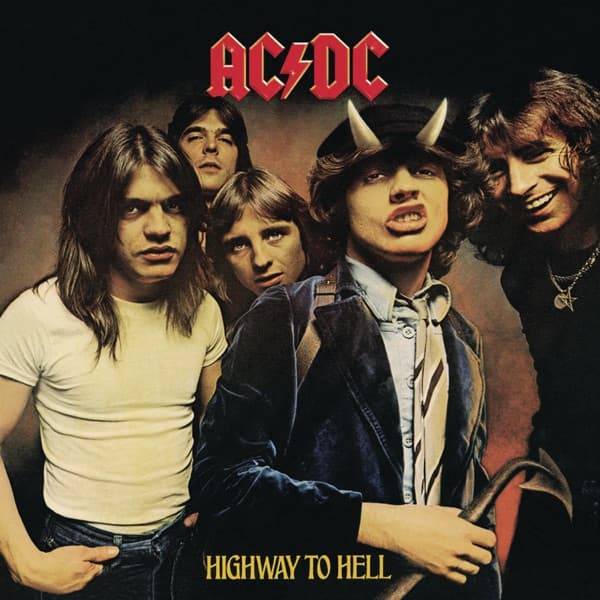

Look at the man front and center. He tilts his chin up, curls his lip into a sneer, and lets you notice, slowly, the two pale horns rising from his cap. Behind him a devil's tail, red and pointed, snakes up from the bottom edge of the frame and rests near his hands. Everyone else in the photograph looks like they just walked in off the street. He looks like he knows exactly what the title means. This is the sleeve of Highway to Hell, and it runs entirely on that one raised eyebrow.
The photograph was taken by Jim Houghton, with art direction by Bob Defrin, and it is a straight band portrait doing the work of a concept piece. Five young men are packed tight into the frame against a smoky backdrop that glows orange at the edges and drops to shadow, as if the studio itself were lit by something burning just out of view. There is no set, no props beyond the horns and the tail. The drama is entirely in faces and posture.
On the far left, a figure in a plain white T-shirt stares straight down the lens, hands jammed in his jeans pockets, long dark hair parted in the middle. His expression is flat and unimpressed, the look of someone who has been photographed a hundred times and stopped performing for it. Just behind his shoulder, a fourth member leans in from the back, younger-looking, hair falling over his forehead, half-swallowed by the group.
Center-left, another band member peers out with wide, almost startled eyes, boyish and slightly caught-off-guard, his denim collar turned up. The contrast with the horned figure beside him is the whole joke of the cover: innocence next to mischief, an ordinary kid next to a grinning imp. The eye travels naturally to that sneer in the middle, then out to the man on the far right, who breaks the mood entirely with a broad open smile, a pendant swinging at his open collar, clearly enjoying himself.
Above them all sits the band name in the red, lightning-bolt lettering that splits AC from DC, glowing like hot metal against the black top of the frame. At the bottom, in clean white capitals, the words HIGHWAY TO HELL. The typography does something sly: the logo blazes, the title states its business plainly, and between them the photograph delivers the punchline. Nothing on the sleeve is overworked. It trusts the horns and the tail and the faces to say it.
AC/DC were an Australian hard rock band, and this is a hard rock record that wears its attitude on the outside. There is no gothic imagery, no flames licking the letters, no theatrical hellscape. The menace is deadpan. A man puts on a cap with horns, adds a tail, keeps his own scowl, and lets the title do the rest. That restraint is why the image lands harder than any elaborate infernal painting would.
The album arrived on 27 July 1979, released by Albert Productions together with Atlantic Records. It was the first of three the band would make with producer Robert John 'Mutt' Lange. On the cover, that turning point is invisible; what you see is five musicians who look loose, unstudied, and completely at ease being photographed as themselves.
But the photograph carries a weight it could not have known at the time. Highway to Hell was the last studio album to feature lead singer Bon Scott. Whichever grinning, sneering, or unimpressed face you land on, this is one of the final times the full lineup was captured together for a front cover in this era. The horns that read as a gag now read as something colder in hindsight, and the title took on a shadow no designer plotted.
That is the strange power of a simple band portrait. Jim Houghton did not stage a narrative; he pointed a camera at five people and let one of them wear a costume. Bob Defrin framed it, dropped in the burning-orange background, and set the lettering top and bottom. The result is deceptively plain, a snapshot mood elevated by two small props and a lot of nerve.
Spend a moment on the composition and you see how carefully the casualness is arranged. The horned figure is slightly lower than the tall men flanking him, so the eye rises to the horns and then fans out. The white T-shirt on the left anchors the brightest point on one side; the beaming face on the right balances it. The lone back-row member fills the gap so the group reads as a solid wall of bodies rather than a lineup, crowding the viewer, leaving no polite distance.
Decades on, the sleeve still works because it never tries too hard. No elaborate illustration, no shock tactic beyond a pair of plastic horns and a red tail curling into frame. Just a band, a smirk, and a title that promised exactly what the music delivered, photographed by Jim Houghton, art-directed by Bob Defrin, and forever tied to the final chapter with Bon Scott out front.