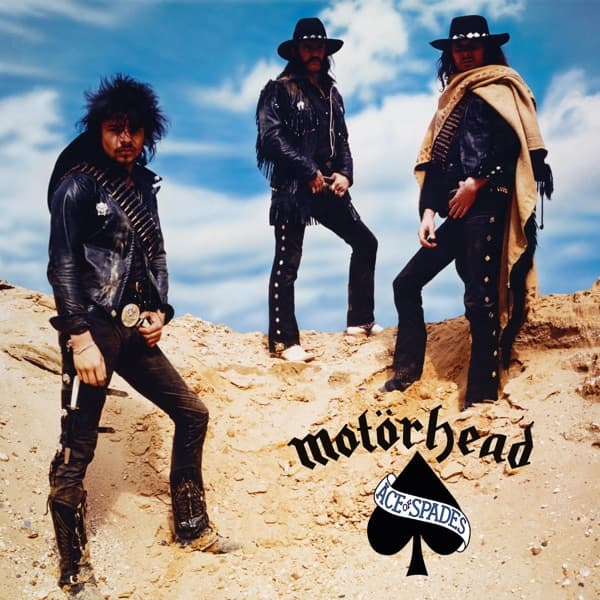

Three men stand on a crumbling sand ridge, backlit by a sky so blue and cloud-swept it could hang in a Western matinee. They are armed, black-hatted, wrapped in leather and studs, and they are glaring down at you like a posse that has already decided how this ends. This is the cover of Ace of Spades, and the desert it promises is a beautiful lie.
Your eye lands first on the figure in the foreground, crouched low and closest to the lens. He wears a black leather jacket, a bandolier of bullets slung diagonally across his chest, and a wide-brimmed hat pulled down over wild dark hair. One hand rests near a pistol; the whole coiled posture reads as a gunfighter a half-second from drawing. This is Fast Eddie Clarke, and his look was built on Clint Eastwood's Man with No Name, the squint-eyed drifter of the spaghetti Westerns.
Behind and above him, two more figures hold the high ground. In the centre stands Lemmy, legs planted wide on the sand, fringed leather catching the light, hat tipped forward so the sun cuts across his face. To the right, Philthy Animal Taylor is draped in a pale poncho over dark leather, another bullet belt crossing his body, the softer fabric breaking up the wall of black. Each man was styled as a different kind of Western protagonist, so the three of them read less like a band than like a scene lifted from a film that was never shot.
The genius and the joke of the image is the setting. It looks unmistakably like the Arizona desert: raw, sun-blasted, endless. It is actually a sandpit in High Barnet, north of London, barely ten miles from the city centre. Years later Lemmy gave the game away, laughing about "that famous desert shot, it's a sandpit in High Barnet," and asking whether it didn't "really look like fucking Arizona." It does. The lie holds.
Even the sky is a fabrication. The shoot happened on a cloudy day, all grey and flat, and that gorgeous blue expanse with its drifting clouds was airbrushed in afterwards. So the two things that sell the Western fantasy hardest, the desert and the heavens above it, are both sleight of hand. What you are looking at is a mood conjured out of a gravel yard and a paintbrush.
The photography is credited to Alan Ballard, who caught the three of them mid-pose on that ridge. But the frame around them owes a debt to another hand. Joe Petagno, the American artist who had drawn Motörhead's Snaggletooth war-pig logo back in 1976, oversaw the composition and the playing-card border that boxes the band in like figures printed on an oversized card. That border is the quiet key to the whole design: it turns a photograph into a card face, and it lets the title do its work.
Down in the lower right corner sits the payoff. The band name Motörhead is set in heavy blackletter Gothic script, spiky and medieval, and beneath it a fat black spade holds the words "Ace of Spades" across its centre. The graphic language of gambling and death, the ace and the spade, meets the graphic language of the outlaw West. It fits songs like "Shoot You in the Back," the six-gun swagger written right into the tracklist.
The concept did not arrive fully formed. An earlier idea imagined the band as sepia-toned gunfighters gathered around a card table, all smoke and shadow and green baize. That was dropped in favour of the open-air cowboy scene, and the switch surprised people. Fans expected the Snaggletooth mascot, probably hunched over a poker hand. Instead they got three men who, in the read of some, looked less like the war-pig and more like Mexican banditos squinting across a valley. It was a gamble in itself: ditch the mascot, sell the myth.
The gamble paid. Released in October 1980 on Bronze Records, with Mercury handling North America, Ace of Spades became Motörhead's biggest commercial success, climbing to No. 4 on the UK Albums Chart and going gold in Britain by March 1981. This was the fourth studio album, and it became the one that defined them: raw rock and roll and heavy metal, a cornerstone of the New Wave of British Heavy Metal and an early marker for what would soon be called speed metal.
Its reach kept widening. In 2020 it landed at No. 408 on Rolling Stone's ranking of the 500 greatest albums, and the band's shadow stretches across everyone from Metallica to Megadeth to the Foo Fighters. The music earned that; but the cover, that fake desert and its three armed silhouettes, became just as fixed in the memory. So fixed that when the 2005 Sanctuary reissue swapped in a new design by Curt Evans, it felt like a substitution, and the 2020 BMG box set eventually put the original Barnet desert back where it belonged.
Stand back and look at it once more. Three men on a ridge, guns and leather and bullet belts, hats down against a sun that was painted on later, on ground that was a London sandpit. The Western is invented, the desert is invented, the sky is invented. Only the glare is real, and that turned out to be enough.