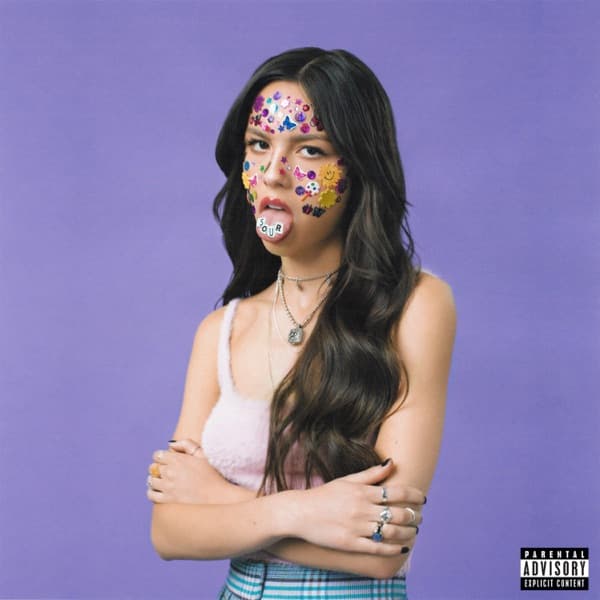


The first thing that hits you is the purple. Not a moody purple, but a loud, saturated, almost candy-store lilac that floods the entire frame, wall and floor and shadow all soaked in the same tone. Against it stands a young woman with her arms crossed, her tongue stuck out, and her face colonized by stickers. It should not work. It works completely.
That woman is Olivia Rodrigo, and this is the cover of SOUR, her debut album, released on May 21, 2021 through Geffen Records. Look closer at what covers her: butterflies scattered across her forehead, a cluster of daisies and flowers blooming over one cheek, a tiny yellow smiley face, colorful dots and hearts and shapes spilling down toward her jaw. And then the punchline, the reason your eye keeps returning to the center of her face: on her outstretched tongue, four small letter-stickers spell out S-O-U-R. The album titles itself from inside her mouth.
There is a deliberate joke buried in that palette. For a record called SOUR, everything here is sweet: bubblegum purple, a rainbow of stickers, the fuzzy pastel-pink knit top she wears, the plaid skirt just visible at the bottom edge in soft blue and white. The color scheme reads like a birthday party, not a breakup. The tension between the bitter title and the sugary picture is the whole point, and it primes you for songs that swing between sugar rush and raw nerve.
Her expression is the counterweight to all that prettiness. She is not smiling behind the stickers. The tongue is out, yes, but the eyes above it are level and unimpressed, a look that lands somewhere between a dare and a shrug. Her arms are folded tight across her chest, hands wrapped around her own forearms, rings on several fingers and dark polish on her nails. Delicate chains layer at her throat, one holding a small pendant. Long dark hair falls in a loose wave over one shoulder. The body language is closed off; the face decoration is playful. That contradiction is exactly the adolescent register the album lives in.
The photograph is the work of Grant Spanier, who shot the cover and also served as art director, providing creative direction for the album's entire global campaign. But the concept came from Rodrigo herself. She knew precisely what she wanted, giving direction on the set-ups she was after, including a bedroom scene and a staged 'party gone wrong.' The stickers on her tongue were real stickers, not added afterward, which explains the slightly imperfect, hand-pressed way they sit on the wet surface.
What ties the whole visual identity together is a homemade, cut-and-paste sensibility. Rodrigo pushed for a 'zine' feel across the packaging: she wrote out all the lyrics by hand, personally picked every sticker and photo, and had each element individually ripped, cut, laid out and scanned so the finished product would carry that DIY texture. The stickers on her face are the front-cover proof of that ethos, the same aesthetic you would find annotating the margins of a school notebook. That scrapbook logic reappears throughout the campaign, reinforcing the diaristic, teenage themes running through the songs.
Turn the package over and the purple carries on. The back cover keeps the color and scatters more stickers across it, with the track listing printed on a pearlescent balloon. Rodrigo's hand hovers at the edge of that balloon holding a safety pin, poised to pop it, a small held-breath gesture that fits an album about things about to burst. It is a witty way to present a tracklist, turning a list into a moment of suspense.
There is also a quieter version. An alternative cover, issued for a Target exclusive and certain vinyl pressings, keeps the dominant purple scheme but strips away the sticker elements entirely, offering the same defiant portrait without the confetti of decoration. Seeing the two side by side underlines how much the stickers do: they are not garnish but the whole personality of the front image.
Musically, the cover's push and pull mirrors what is inside. SOUR is at heart an alternative pop record that reaches into pop-punk, bedroom pop, indie pop and alternative rock, the sweet and the abrasive living in the same tracklist just as they do in the sweet colors and sour title. A small black Parental Advisory badge sits in the lower right corner, a plain reminder that the sugar coating covers some sharp edges.
The world showed up fast. SOUR was the most pre-added album on Apple Music in the week before its release, and it set a then-record for the biggest opening streaming week for an album by a female artist on Spotify, pulling 385 million streams. The recognition kept coming: it won Best Pop Vocal Album at the 64th Grammy Awards, and in 2023 it landed on Rolling Stone's 500 Greatest Albums of All Time list.
What lingers is how much of the album's spirit is legible in a single glance. A teenage girl, arms crossed, tongue out, face plastered with stickers she chose herself, spelling out a title that argues with its own color palette. It is a self-portrait built from diary margins, at once guarded and goofy, sweet and sour, and it tells you everything about the record before a single note plays.