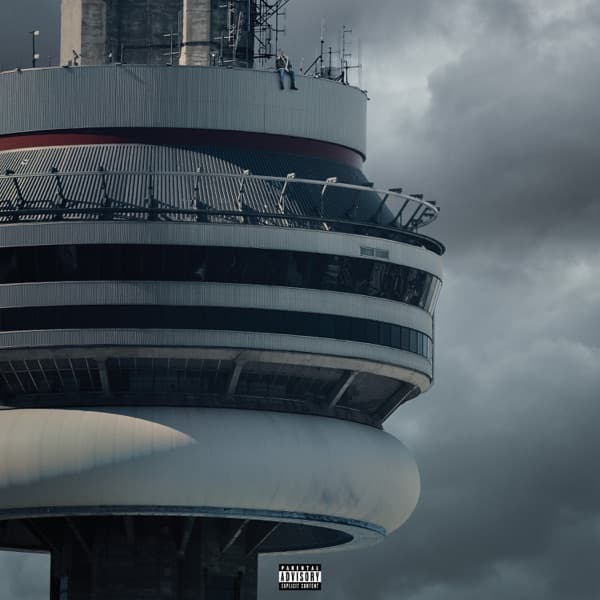

The eye lands on cold metal and colder weather. Filling nearly the whole frame is the upper bulge of the CN Tower, its observation pod photographed close and low, so the ribbed concrete and banded windows curve away like the hull of a spaceship parked in the clouds. Above it a forest of antennas and a red-striped collar climb out of the crop; below it the tapering shaft plunges toward the bottom edge, where a single white Parental Advisory Explicit Content label sits like a stamp. The sky behind is all wet slate, layered storm cloud in grays and faint blue, the kind of overcast that makes steel look wet. It is a portrait of a building, and that plainness is the trick.
This is the cover of Views, the album Drake released on April 29, 2016, through Cash Money Records, Republic Records, and Young Money Entertainment. The photograph is the work of Toronto-based photographer Caitlin Cronenberg, and the whole thing reads as a love letter to her city, and Drake's, told through its most famous silhouette.
The assignment did not arrive as a single tidy idea. In 2015 Drake's team reached out to Caitlin Cronenberg with a PDF of concepts and inspirations, a spread of possibilities rather than one instruction. One of those ideas was to put the rapper on top of the CN Tower. They wanted to execute all of them, so Cronenberg shot a full 12-image photo book, and only afterward did Drake's team pick the tower shot as the official face of the record.
Look again at the top of the pod, where the structure meets that heavy sky, and you understand what made the image travel. On the finished cover Drake sits up there, perched on the crown of the tower, rendered so large that a human being dwarfs a landmark that rises hundreds of meters over Toronto. The scale is impossible, and it was meant to be felt rather than believed. Against this monochrome, weather-beaten backdrop, a giant seated figure turns a real skyline into something closer to myth.
The impossibility was engineered. The final cover is a composite. Cronenberg's team went back to the studio and shot Drake on a table in front of a blank wall, matching the angle to the tower photograph, then combined the two in post-production. The seated pose that looks like it was captured at a terrifying altitude was actually built at ground level, a man on a table stitched onto a skyscraper. That is why he ends up far larger than life-size, a deliberate distortion baked into the image.
The art direction and design that framed all of this are credited to Nicky Orenstein, and the flowing Views wordmark, the loose hand-drawn lettering that appears with the title, is the work of Filip Pagowski. Together the elements sell the fantasy without a wink: sober documentary photography, a moody real sky, a landmark rendered with total fidelity, and one detail scaled into surrealism.
Drake unveiled the artwork himself, posting it to his Twitter account on April 24, 2016, days ahead of the release. The reaction was immediate and merciless in the best way. The oversized Drake became a viral sensation and was heavily memed, and the conversation quickly zeroed in on the obvious question of scale. The joke got its official punchline when the CN Tower's own Twitter account confirmed that the image had been photoshopped, the landmark cheerfully outing the album that had used it. Media outlets then built dedicated 'Views' meme generators that let anyone drop a giant Drake onto any photo they liked, turning the cover into a template the whole internet could remix.
What makes the picture work as a meme is exactly what makes it work as an image. The composition is patient and almost austere: the pod's horizontal bands of glass and concrete create a rhythm of stripes, the antennas break the top into spiky verticals, and the muted palette refuses any easy warmth. There is nothing playful in the photography itself. All the play is in the single figure and the impossible scale, so the humor and the grandeur sit right on top of each other. It is a self-portrait as skyline, ego and hometown fused into one silhouette.
The absence of Drake from the tighter view, just the tower, the clouds, and that lone advisory sticker, is a reminder of how much the composite carried. Strip away the giant figure and you have a striking piece of architectural photography of a specific, beloved structure. Add him back and the same frame becomes a statement about a man's relationship to the place that made him, blown up until the metaphor is literal.
The image did not stay a meme. Nearly a decade later, Cronenberg's Views portrait was exhibited at the Art Gallery of Ontario as part of 'The Culture: Hip Hop and Contemporary Art in the 21st Century,' a show that treated it as a marker of hip hop's imprint on visual culture. The same picture that spawned a thousand jokes now hangs as evidence of how one photograph, a studio table, and a doctored skyline can lodge themselves in the culture. Caitlin Cronenberg, whatever else she has shot, is best known for this: a rapper made larger than a tower, over a Toronto sky that never once cleared.