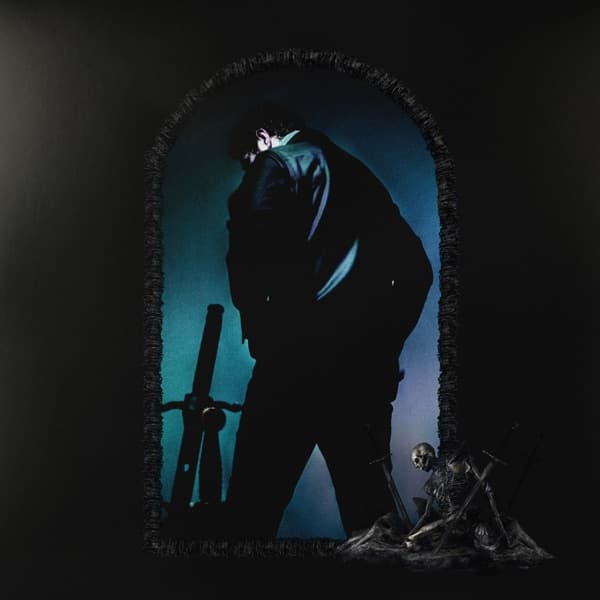
Almost the entire cover of Hollywood's Bleeding is swallowed by black, so dark it reads as void, and floating within it is a tall pointed archway that glows teal at its center and fades toward cold violet at its edges. The arch is framed by a rough, fringed border that looks stitched or torn, like the mouth of a cave or the frame of a tapestry, and the light inside it seems to come from nowhere and everywhere at once.
Standing inside that arch, and dominating it, is a man in a leather jacket with his back to us. It is Post Malone, but he gives you nothing: his head is bowed and turned, his face lost in shadow, his shoulders hunched forward as if under a weight. He is rendered as near-silhouette, the blue light catching only the ridge of a shoulder and the curve of his jacket, so that the figure feels more like a presence than a portrait. You lean in expecting a face and are refused one.
Look lower and the scene turns stranger. At the bottom left, planted point-down in shadow, is a sword, its crossguard clearly readable against the glow. At the bottom right, a skeleton slumps among more blades, a huddle of bone and steel collapsed at the giant's feet. This is the swords-and-sorcery flourish that makes the cover so unusual for a chart-topping pop and hip-hop album: it belongs more to fantasy illustration than to a rap release, and Exclaim! read it exactly that way, calling it 'very swords and sorcery-type art' and tying it to the aesthetic of Malone's 'Circles' video.
The image is a commissioned digital illustration by Eve Ventrue, and the story of how it came to exist is refreshingly simple. Malone was a fan of her work. His management reached out to tell her so, and asked whether she would like to be involved in creating the cover for his new album. On her own ArtStation portfolio she described the finished piece as her 'illustrative contribution' to the record, and in her thanks she nodded to 'Travis and Bryan, Post's Graphic Gods, and Bobby,' while noting that all rights belong to Republic Records.
Those names line up with the credits. Eve Ventrue is listed for the illustration, Brandon Bowen for photography, and Travis Brothers and Bryan Rivera for art direction. That pairing of illustration and photography credits is worth sitting with: the figure has the specificity of a real body, the drape of a real leather jacket, while the archway, the swords, and the skeleton belong to an invented, painted world. The cover lives at the seam between a photographed man and a drawn myth.
That seam is the whole mood. The palette is almost entirely two temperatures, the black of the surrounding dark and the sickly, beautiful teal-to-violet glow of the arch, and the effect is eerie rather than triumphant. There is no smiling star, no bright logo shouting the hits. The composition instead builds a stage of shadow and drops a lone, faceless figure into the center of it, flanked by symbols of death and battle. It reads as a portrait of isolation dressed in fantasy armor.
The title itself, Hollywood's Bleeding, gives the picture its subtext. A colossal figure turned away from us, standing over spent swords and a fallen skeleton, plays like a fable about fame and its casualties. The music underneath it refuses easy categorization in the same way the cover refuses a clean genre: it has been filed as pop rap and pop and hip-hop, and critics heard a blend of country, rock, hip-hop and modern soft soul riding a trap-pop vibe. A record that slides between so many sounds gets a cover that slides between photograph and illustration, pop star and fantasy hero.
What is striking is how little the cover does to sell itself as a commercial product, and how much that restraint paid off. Released on September 6, 2019 through Republic Records, Hollywood's Bleeding debuted at number one on the Billboard 200 with 489,000 album-equivalent units, and it went on to a nomination for Album of the Year at the 2021 Grammy Awards. The image that carried it to those numbers is one that hides its own star's face and hands the visual center of a mainstream release to a fantasy artist's imagination.
Spend more time with the frame and the fringed border begins to feel deliberate, less like decoration than like a threshold. The arch is a doorway, and the figure stands just inside it, neither coming toward us nor fully departing, caught mid-turn on the boundary between the lit world within and the black world without. The swords below mark the ground as a place where something has already been fought and lost.
It is a cover that rewards patience. On a phone thumbnail it is a blue smear in a black square, easy to scroll past. Held and studied, it resolves into a small, sombre scene: a bowed man, a glowing gate, a broken skeleton, a planted sword. Eve Ventrue was asked to be involved because someone admired what she made, and what she made turned Post Malone into a shadowed giant in his own myth, standing guard over the wreckage at his feet and offering the viewer his back.