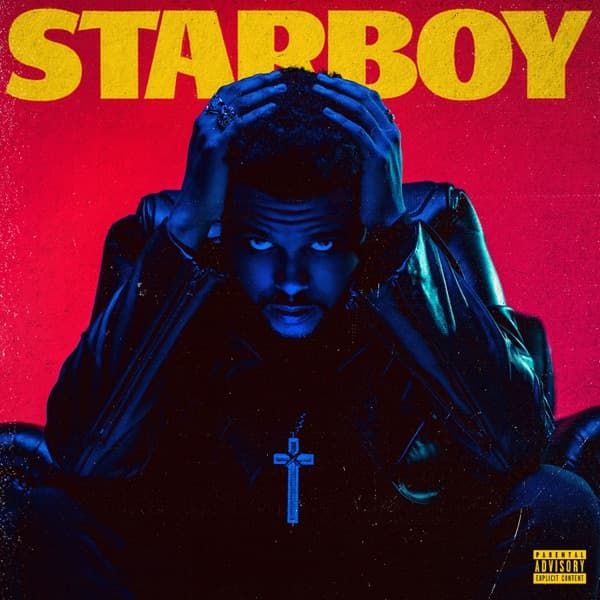

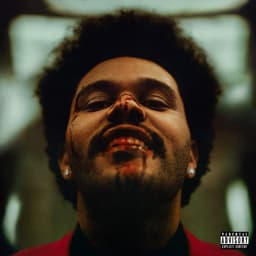
The first thing you notice is the color: a red so saturated it feels less like a background than a warning light. Against it kneels a figure drenched in cold blue shadow, head bowed, both hands clamped to his skull as if bracing against something. Above him, spanning the full width of the frame in blocky yellow capitals, one word: STARBOY. The clash of hot red and electric yellow is deliberately jarring, a caution-tape palette that grabs the eye before you even register the man beneath it.
That man is The Weeknd, the Toronto singer, and in September 2016 this image did something a photograph rarely does anymore: it shocked people. When the cover and title were formally revealed on September 21, 2016, the biggest talking point was not the music. It was his hair. Gone were the signature towering locks that had defined his silhouette for years. In their place sat a dramatically shorter, cropped cut, a visual amputation of the persona fans thought they knew.
Look closely at how the photograph is lit and you understand why the reinvention landed so hard. Nabil Elderkin, who both photographed and designed the cover, bathes almost the entire figure in a moody blue, so that the leather jacket, the shoulders, the hands, all read as one sculptural mass. Only the eyes catch a cold highlight, staring straight out from the shadow with an unsettling calm. The pose, hands gripping the head, could read as anguish or as a man reckoning with a decision. The image invites that ambiguity rather than resolving it.
Hanging at the center of his chest, catching just enough light to stand out against the dark jacket, is a crucifix on a chain. It is a small detail, but it anchors the composition and gives the eye a resting point below the intense gaze. That cross is not incidental to the era. In the accompanying Starboy music video, released alongside this cover, The Weeknd opens by killing his own long-haired self, then uses a glowing neon cross to smash a case full of his awards before emerging with the new cropped look. The pendant on the cover is the quiet cousin of that violent gesture: the same symbol, the same theme of destroying the old to make room for the new.
The cropped head was more than a style change; it was a thesis. The title Starboy is an homage to David Bowie's 1972 song 'Starman', and The Weeknd said the album was inspired by both Bowie and Prince, two artists who treated reinvention as their native language. Seen through that lens, the haircut is a Bowie move, the shedding of one skin to reveal another. The cover is less a portrait than an announcement that the character has changed.
Fans read it that way in real time. The new short haircut set off significant reaction on Twitter, with many speculating that the visual overhaul signaled a return to his 'old' sound. The drama had been building for days. The evening before the announcement, The Weeknd had blanked his Instagram page entirely, wiping the slate clean after posting cryptic tweets, so that when the red-and-yellow image finally arrived it felt like a curtain lifting on a deliberately staged mystery.
Elderkin's role went beyond this single frame. The CD booklet that accompanied the album features eleven portraits of The Weeknd, all shot by Elderkin, making the cover the opening statement of a fuller photographic essay on the new look. That context reframes the front image: it is the establishing shot, the one designed to hit hardest and be understood at thumbnail size, which explains the ruthless simplicity of the composition. One figure, one word, two colors, one gaze.
Musically, the reinvention was just as pointed. Starboy was released on November 25, 2016, through XO and Republic Records, with the release credited to The Weeknd XO, Inc. and manufactured and marketed by Republic Records, a division of UMG Recordings. Reviewers heard R&B threaded through with synth-pop, dance-pop and electro-funk, exactly the kind of genre-crossing that the Bowie and Prince invocation promised. The cold electronic sheen of that sound finds its visual echo in the blue-lit, synthetic glow of the photograph.
What makes the composition work is restraint. There is no clutter, no elaborate set, no secondary imagery. The PARENTAL ADVISORY EXPLICIT CONTENT label sits in its usual black-and-white box in the lower right corner, and even that reads almost as a design element against the flat red field. Everything funnels attention toward the tension at the center: a star at the moment he is remaking himself, caught with his hands on his own head as if physically reshaping who he is.
That is the quiet genius of the frame. It captures a threshold. The old self is being destroyed, as the video makes literal, and the new one has not fully arrived; he exists here in the blue-shadowed in-between, watched over by a single crucifix and crowned by a word borrowed from Bowie. Elderkin freezes reinvention itself, the exact hinge between two versions of a person, and prints it in the loudest colors he can find. You come for the haircut everyone was arguing about, and you stay for the stare.