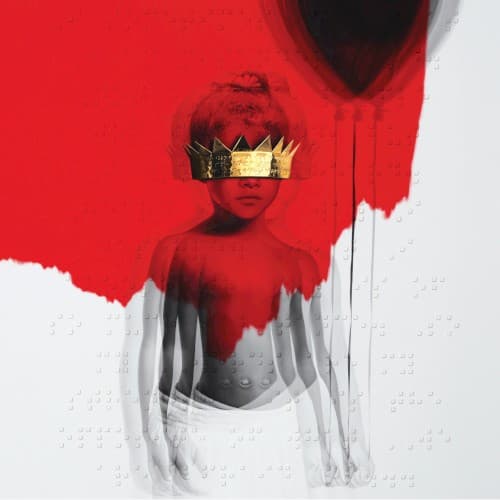
Roy Nachum blindfolded Rihanna in his New York studio and watched her trace three white canvases covered in Braille poetry while her new album played. Where her fingers touched the burnt charcoal frames, she left smudged fingerprints that became part of the final ANTI artwork - an unprecedented collaboration between sight and touch.
The concept originated when Rihanna saw Nachum's work in Jay Z's private art collection and immediately knew that's what she wanted for her album. The Israeli-born, Cooper Union-educated artist had been creating experimental Braille artwork for seven years, even spending a week with his eyes closed to understand blindness before developing his signature style of burning frames to charcoal.
For the ANTI cover, Nachum painted "If They Let Us, Part 1" - a photorealistic interpretation of Rihanna as a young girl in Barbados on her first day of daycare. He depicted her holding a black balloon ("a metaphor of escaped reality") with a gold crown covering her eyes ("a symbol of power and success, which blinds people to the real values"). The majority of the artwork is black and white with strategic smattering of red paint.
Poet Chloe Mitchell, who had previously worked with Kanye West on "Blame Game," wrote five Braille poems specifically for the album packaging. Rihanna and Mitchell met in New York, where they "drank" and collaborated on the main poem "If They Let Us" - addressing themes of being misunderstood while standing out and doing what's right for yourself.
The interactive element came when Nachum created three white monochrome paintings with Braille poetry set in wood frames burned to charcoal. He brought blind visitors to his studio to experience visual art through touch, their fingerprints staining the canvases with charcoal residue. Rihanna participated in this same process while blindfolded, creating collaborative "group self-portraits" that were always evolving.
Nachum described his artistic mission as opening "people's eyes to the real things in life" by closing his own eyes. The technique involved painting oil over sculpted Braille poetry on canvas, creating artwork that could be experienced both visually and tactilely. Rihanna chose him because "he sees things beyond the surface."
The album cover was unveiled at an invite-only exhibition at MAMA Gallery in Los Angeles on October 7, 2015. Guests received red blindfolds and were encouraged to explore the tactile aspects of Nachum's seven Braille paintings while touching the burnt frames and canvases, leaving their own fingerprints as part of the evolving artwork.
Critics initially struggled with the album's unconventional approach. Many reviews described ANTI as "adrift," "confused," or "not what we expected," reflecting broader challenges with understanding Rihanna's artistic departure from commercial pop formulas. The Braille inclusion sparked important conversations about accessibility in music packaging.
Visually, the cover balances photorealism with abstract elements. The young Rihanna figure occupies the center against a split background of white and bright red paint. The gold crown creates a striking focal point while the black balloon adds symbolic weight. The Braille dots create texture across the entire composition, functioning both as text and visual pattern.
The typography choices were deliberately minimal - the album relied entirely on Braille for text, making it the first major-label release to use no traditional text in packaging. This radical decision reinforced Rihanna's statement that "sometimes the ones who have sight are the blindest," challenging industry norms about visual communication.
ANTI changed album artwork history by proving accessibility could be artistically compelling rather than merely functional. The Braille integration influenced other artists like Kendrick Lamar, who included hidden Braille in "To Pimp a Butterfly." Billboard ranked it among 2016's best album covers, calling it "one of the most intoxicating albums of any genre in 2016, with an equally indelible lead image to match."
The cover's cultural impact extended beyond music into discussions about representation, accessibility, and the intersection of high art with popular culture. Nachum's collaboration with Rihanna brought Braille poetry to millions, making tactile art visible to mainstream audiences while providing actual accessibility for blind music fans.
Ten years later, the ANTI cover remains timelessly striking - a testament to Rihanna's artistic vision and Nachum's innovative techniques. The fact that Rihanna declared "This is my favorite album cover ever" speaks to the profound personal connection achieved through this unique creative process that literally left her fingerprints on the final artwork.