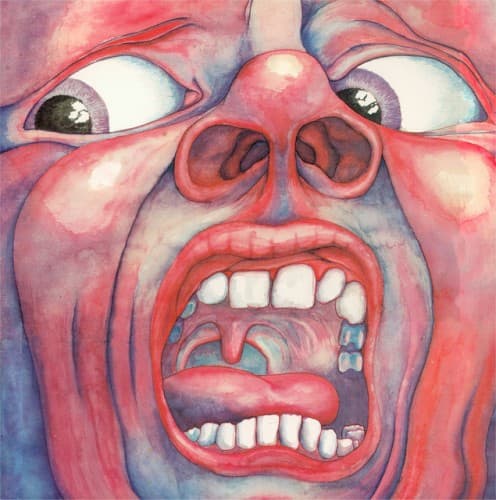
The composition refuses the viewer any place to stand. The face is cropped so tightly that it fills the whole square and pushes past its edges, with no background, no border, and no negative space to rest in. That decision does the emotional work before any single feature registers: there is nowhere for the eye to escape, so the terror surrounds you rather than sitting at a safe distance.
Start at the top and the eyes read as two separate panics. One stares off in one direction, the other rolls away, both bulging from sockets stretched to bursting, so the gaze never settles and the face seems to be coming apart. Below them the nose flares into cavernous nostrils, and then everything surrenders to the mouth. The jaws are wrenched apart, blunt white teeth bared along the top and bottom, a tongue curling against the lower lip. The focal path runs downward, eyes to nose to open mouth, and gathers speed as it falls, so the picture feels like a scream in motion.
Colour carries the fever. The skin is worked in pink, raw red and bruised lavender-purple, tones of flushed heat and near-bruising that make the flesh look inflamed rather than healthy. The medium is watercolour, and its texture is left visible: the cheeks are mottled and feverish, the lips swollen, the skin stretched too tight over the bone beneath. Nothing is smoothed into a poster surface. The result is a face that looks less painted than raw.
The absence of any type is its own statement. Handing the entire cover to one expression of shock, with no words to soften or label it, forces the image to carry the whole meaning alone. It works because the face is not generic horror but something specific and uncanny.
Part of that specificity comes from how it was made. Barry Godber painted himself, working from his own reflection in a mirror, so the panic frozen on the sleeve is a self-portrait pushed to the edge of hysteria. The face you see on the outside is the Schizoid Man; the gatefold opens onto a second face inside, the Crimson King, so the object holds two portraits and two moods in one design.
Robert Fripp later offered a key to reading the outer face. Cover the screaming mouth, look only at the eyes, and an incredible sadness rises to the surface. That instruction changes the whole picture. The same features that read as horror when the mouth dominates read as grief when the mouth is hidden, so the terror and the sorrow turn out to be the identical face seen two ways. This is why the image outlasts a simple shock effect. It is not just a man frightened; it is a man who is frightened and bereft at once, and the viewer is left holding both readings without being able to settle on one. A young man held up a mirror, painted what he saw, and froze a scream that has not stopped echoing.