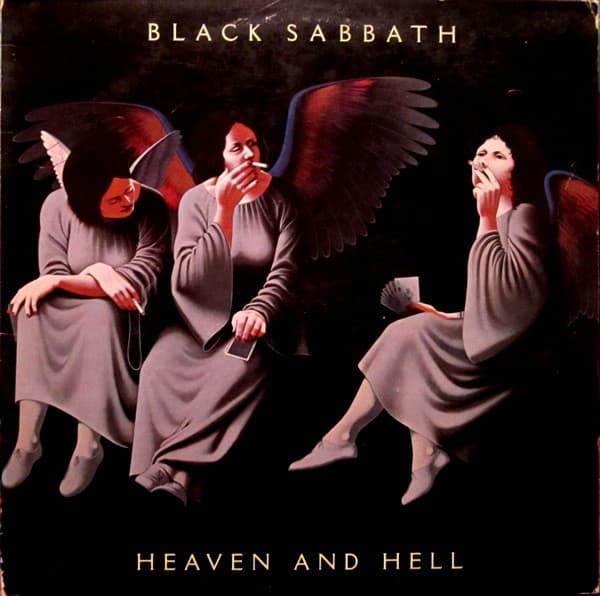
The most memorable image from Black Sabbath's Ronnie James Dio era began as something completely separate from heavy metal. In 1979, artist Lynn Curlee had just moved from New York to Los Angeles and was making a series of paintings called Masque, centered on people in costumes. One of those works was Smoking Angels: three winged figures seated around a table, smoking and playing cards as casually as office workers on a break.
Curlee later explained that the painting was inspired by a photograph of people backstage at a small-town Christmas pageant. It had already been shown at the Dunaway O'Neill Gallery in Santa Monica before Black Sabbath entered the picture. The band's management, scrambling because other cover art was not working out, contacted Curlee after knowing his earlier work for Blue Öyster Cult. Rather than commission a new image, they chose the finished Smoking Angels painting.
The fit was almost accidental, but it was perfect for an album built around contrasts. Heaven and Hell introduced Ronnie James Dio as Black Sabbath's singer, and the image places sacred figures in a distinctly ordinary, slightly disreputable setting. The angels are not ascending, praying or fighting demons. They are smoking, leaning into a card game, and taking a break.
Dio later said the band liked precisely that tension: the angels seemed relaxed, doing the kinds of things normal people might do. He also pushed back on fan theories that the three figures represented band members or hinted at internal trouble. They were simply characters in Curlee's pre-existing painting.
The album sleeve cropped the original artwork on the right, cutting off part of one angel's wing to fit the format. That small practical change helped turn a gallery painting into one of Black Sabbath's defining images, and the band continued using it decades later in connection with the Dio-era material.