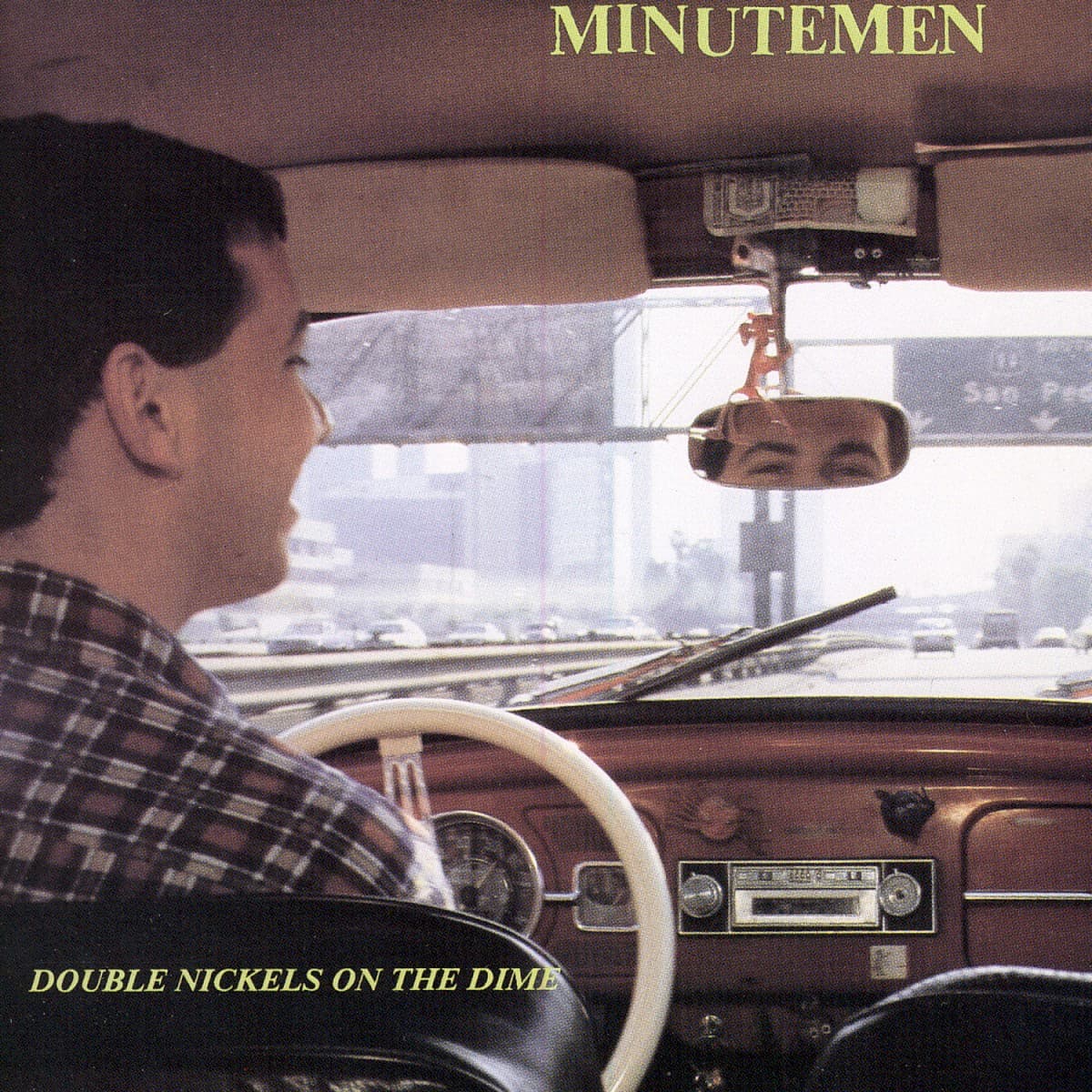
The cover of Double Nickels on the Dime looks like a quick photograph from the back seat of a car. It was anything but. Mike Watt conceived it around a very specific joke, and photographer Dirk Vandenberg had to solve a moving three-part puzzle to get the picture.
The title was the Minutemen's answer to Sammy Hagar's "I Can't Drive 55." Watt has explained that the band did not consider speeding much of a rebellion. Their response was deliberately contrary: they could obey the 55-mph national speed limit and put the real rebellion into making their own music, words and images. That idea became both the album title and its cover concept.
Watt drove while his friend Dirk Vandenberg photographed from the back seat. In Watt's own account, the frame needed three things at once: his eyes visible in the rearview mirror, the speedometer precisely at 55 mph, and a freeway sign for San Pedro visible through the windshield. San Pedro mattered because it was home. The port community was central to how Watt, D. Boon and George Hurley understood the Minutemen; the band constantly connected punk's do-it-yourself philosophy to their actual working-class surroundings rather than inventing a detached rock-star world.
The location was the freeway system through downtown Los Angeles on the route toward San Pedro. Watt recalled the difficulty of timing the shot in the film era: Vandenberg could not check a digital screen after every exposure, so getting the mirror, needle and road sign together involved repeated attempts. LAist's interview with Watt preserves his description of the image as a deliberate "trifecta," not a photograph whose meaning was invented later.
That makes one of the cover's oddities especially fitting. The original printed crop cuts off part of "Pedro" on the road sign. Accounts of the sleeve describe that as a production crop rather than Vandenberg failing to capture the sign. The photograph itself contained the information Watt wanted.
The front image is only part of the physical package. Original-release credits identify Vandenberg with front, back-cover and insert photography, while other insert photographs were contributed by A. Peak and Marty Lyon. Raymond Pettibon supplied drawings used within the package; the Museum of Modern Art catalogs the 1984 double LP as a Minutemen/Raymond Pettibon work and identifies Pettibon as a collaborating cover artist. That distinction matters: Vandenberg made the famous driving photograph, while Pettibon's contribution belongs to the broader visual package.
There is another visual ancestor. In 2020 Watt identified Kraftwerk's Autobahn as an inspiration for the front-cover idea. Both sleeves make driving and the road central, but the Minutemen version is stubbornly local and handmade: a friend in the back seat, Watt's Volkswagen, Los Angeles freeways and a sign pointing home.
The result is almost a manifesto disguised as a snapshot. Watt is not breaking the speed limit. He is following it exactly. The band's independence lies somewhere else—in deciding that they could make their own songs, construct their own meanings and turn an ordinary drive back toward San Pedro into the image for one of American punk's defining records.