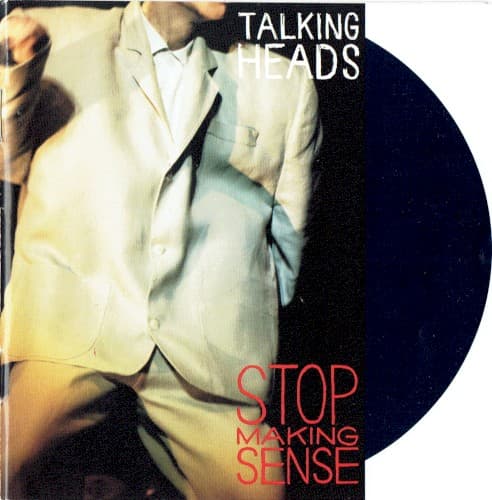


The first thing you notice is what you cannot see: there is no face. A man stands in a pale, oversized suit, arms raised, body twisted in motion, and where his head should be the frame simply ends. A large black semicircle eats the right side of the cover like a record sliding halfway out of its sleeve, swallowing one shoulder and most of the background into shadow. Your eye lands on the wrinkled cream jacket, too big through the chest, sleeves bunching, the fabric catching a wash of warm light against cooler blue-grey shadows.
This is the cover of Stop Making Sense, released in 1984 on Sire Records. The suit belongs to David Byrne, though you would never know it from the image alone, because the body has been turned into a kind of abstract gesture, a figure caught dancing or flinching, anonymous and electric at the same time.
The typography splits the difference between order and chaos. Top left, in tidy white capitals, sits the band name: TALKING / HEADS, clean and stacked. Bottom right, the title fights for attention in jagged red letters of mismatched sizes, STOP large and assertive, MAKING small and tucked, SENSE swelling again, the words almost stumbling over each other. It reads like the cover is doing exactly what the title warns against.
The photograph came from Adelle Lutz, whose camera caught that twisting, headless pose. The package around it was designed and written by Byrne together with Jeff Ayeroff and Michael Hodgson, a collaboration that turned a single frame of a man in a baggy coat into a complete graphic statement. The result is deceptively simple, a body, a black curve, two blocks of text, and yet it refuses to settle.
Much of its power lives in that cropping. By cutting off the head and pushing the figure against a void, the design forces you to read the body as pure energy. The oversized jacket exaggerates everything, making the shoulders broad and the gesture larger than life, a frozen instant of movement that still feels like it is happening. The half-circle of darkness is the masterstroke, both an elegant compositional device and a sly nod to the round black disc inside.
The art world agreed. The artwork now lives in the permanent collection of the Museum of Modern Art, catalogued as a lithograph, twelve inches square, acquired through the Committee on Architecture and Design Funds. MoMA credits the design to Byrne, Hodgson, Ayeroff, Lutz, and Sire Records, a rare instance of an album sleeve treated as a museum-worthy object. Lutz is credited for the cover photo, with other photography inside the package by Dave Friedman and Hugh Brown.
The image earned its staying power the hard way: by becoming the shorthand for the record. When the fortieth-anniversary Rhino reissue arrived, it reached for a different, more neutral cover option rather than this Byrne-in-white-suit-in-motion half-sleeve, and commentators immediately reached back, pointing to the original 1984 big coat half-cover as the one that mattered. Four decades on, the headless figure in the too-large suit still says everything the band wanted to say, without ever showing a face.