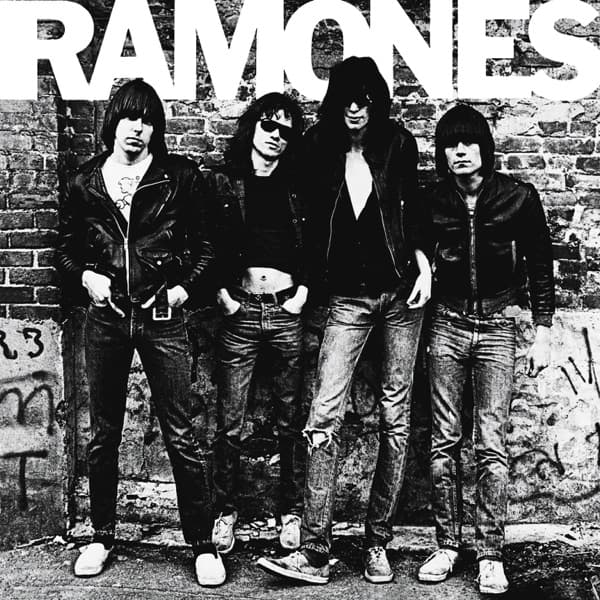
Look at the faces first. Four young men press against a graffiti-scarred brick wall, and not one of them is selling you anything. No smiles, no swagger for the lens, just flat, deadpan stares aimed straight at you. The eye lands on those expressions before it registers anything else, and the refusal to perform is the whole point.
The photo is stark black and white, all hard texture: the rough mortar lines of the brick, the dull shine of cracked leather, the pale scuffed sneakers lined up along the bottom like a row of evidence. Low on the wall, scrawled tags and a faint "73" sit near their knees, grounding the shot in a real, grimy corner of New York City rather than any studio. Above their heads, in fat black sans-serif capitals, a single word hangs: RAMONES. No song titles, no taglines, just the name, big enough to leave no doubt who these four are.
They stand shoulder to shoulder, almost identical and yet not. From left to right it runs Johnny, Tommy, Joey and Dee Dee Ramone, every one of them in a black leather motorcycle jacket and ripped, faded blue jeans. Hands jam into pockets, knees poke through torn denim, postures slouch into the same bored line. The uniformity reads like a gang, a unit, a single idea wearing four bodies. Joey, the tallest, lets his jacket fall open over a bare chest; one of them shields his eyes behind dark glasses. The differences are small, and that is what makes the sameness feel deliberate.
The woman behind the camera was Roberta Bayley, a photographer for Punk magazine, and this image had already run in the pages of that magazine before anyone thought of putting it on a record. When Sire Records wanted a cover for the band's debut, they reached for the photo that already existed and paid a grand total of $125 for it. For the founding document of a whole genre, the front cover cost less than a decent guitar.
That thrift turned out to be perfect. There is nothing expensive or art-directed about the picture, and that is exactly why it works. It looks like what it is: four guys against a wall, photographed by someone who knew them. The honesty of it, the complete absence of gloss, became the visual grammar that punk would speak in for decades.
Ramones, the band's debut studio album, arrived on April 23, 1976. Commercially it went almost nowhere, crawling only to number 111 on the US Billboard Top LPs & Tape chart, a disappointment by any sales ledger. The critics, though, heard something the cash registers did not, and the reviews came back glowing. Over time the album settled into its place as one of the most influential punk records ever pressed, the sound of a new movement caught on tape.
And the photograph outran the record entirely. That plain shot of four bored kids in leather and torn denim has become one of the most imitated album covers ever made, restaged and parodied and saluted more times than anyone can count. Bands line up against brick walls to this day, hands in pockets, faces blank, chasing the same effect. The miracle is how little it took: no concept, no budget, no smile. Just a wall, a word, and four people who looked like they had somewhere better to be.