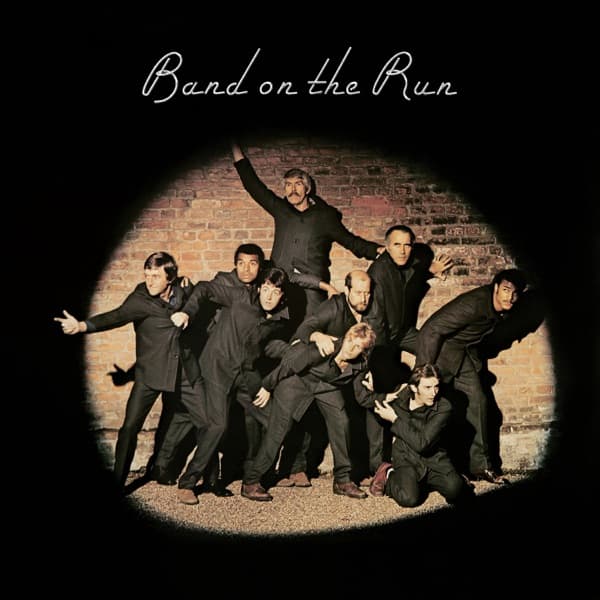
Paul McCartney faced a creative crisis in 1973, three years after the Beatles split. His last album, Red Rose Speedway, had received lukewarm reviews, and critics still questioned his artistic credibility. The Band On The Run cover would become his comeback statement, featuring one of the most striking celebrity lineups ever assembled for an album cover.
The concept emerged from a late-night bedroom conversation between Paul and Linda McCartney. They discussed how bands, particularly because of drug use, were made to feel like outcasts - criminals on the run. The album's title track drew inspiration from George Harrison's phrase "if I ever get out of here" during tense Beatles business meetings. McCartney later explained the prison break theme: "At the beginning of the album, the guy is stuck inside four walls and breaks out."
Clive Arrowsmith, a Welsh photographer who knew Paul and John Lennon from art school days, received the commission despite having limited experience. He met with McCartney and art director Storm Thorgerson from Hipgnosis to develop the visual concept. They agreed on an "old-fashioned Hollywood prison break movie" aesthetic, complete with convicts caught in a spotlight against a prison wall.
The shoot took place on October 28, 1973, at Osterley Park in West London, a Georgian estate near Heathrow Airport. Arrowsmith hired a spotlight from a lighting company, but it proved insufficiently powerful for the job. This technical shortcoming meant everyone had to remain perfectly still for two full seconds to achieve proper exposure - a challenge complicated by the "substance haze" following McCartney's party the night before.
The famous celebrity lineup included six figures alongside the three Wings members. Michael Parkinson, Britain's premier talk show host, joined actor James Coburn, comedian Kenny Lynch, writer and broadcaster Clement Freud, boxer John Conteh, and horror icon Christopher Lee. Arrowsmith later recalled his surprise at discovering Lee was "a huge music fan and knew about records and stuff."
Arrowsmith shot only two rolls of film - just 24 exposures total. The assembled celebrities struggled to maintain focus, with Denny Laine falling over several times while laughing hysterically. The photographer positioned himself on a ladder next to the spotlight, barking instructions through a megaphone until he finally screamed "Stay Still!" and began shooting.
The cover's distinctive warm yellow cast resulted from Arrowsmith's mistake - he used regular daylight film instead of tungsten film suited for night photography. When the film returned from processing, only four shots showed everyone reasonably sharp. Arrowsmith worried he had failed, but McCartney loved the golden hue when shown the results years later during the Wings At The Speed Of Sound sessions.
Storm Thorgerson of Hipgnosis oversaw the overall design concept, while the album's typography was created by Hipgnosis in-house designer George Hardy (though sources sometimes refer to him as George Hardie). The title appears in white 1940s film noir-style lettering above the photograph. Since the band name didn't appear on the cover, Capitol Records added stickers to identify Wings.
The back cover features another Arrowsmith photograph depicting a police officer's desktop with evidence trying to track down the fugitive McCartneys and Laine. Three black-and-white mugshot-style photos are rubber-stamped with circular passport stamps reading "London" at top, "Sep 1973" in the center, and "Lagos" at bottom, referencing the album's Nigerian recording sessions.
Critics initially dismissed Wings' earlier work as lightweight, but Band On The Run changed everything. Jon Landau's Rolling Stone review called it "the finest record yet released by any of the four musicians who were once called the Beatles," with the possible exception of John Lennon's Plastic Ono Band. The album topped charts in multiple countries and spent 124 weeks on the UK charts.
The cover photograph perfectly captured the album's theme of escape and freedom. The nine figures are caught in a circular beam of light surrounded by darkness, creating a dramatic spotlight effect that suggests both imprisonment and liberation. The composition draws the eye immediately to the center, where the three Wings members stand alongside their celebrity "fellow convicts."
Visually, the cover broke new ground in rock album art. The film noir aesthetic, combined with the unexpected celebrity appearances, created a sense of theatrical drama rare in album covers. The sepia tone, initially viewed as a technical mistake, gave the image a vintage Hollywood quality that perfectly matched the prison break movie concept.
The Band On The Run cover influenced countless album designs that followed, particularly in its use of conceptual photography and celebrity cameos. It demonstrated how album art could function as both visual pun and artistic statement, elevating the medium beyond simple band portraits or abstract designs.
Decades later, the cover remains celebrated as one of rock's most iconic images. Christopher Lee later recalled looking the opposite direction from everyone else in the shot, while Arrowsmith's technical "mistake" created one of music's most distinctive visual signatures - proof that sometimes the best art emerges from happy accidents.