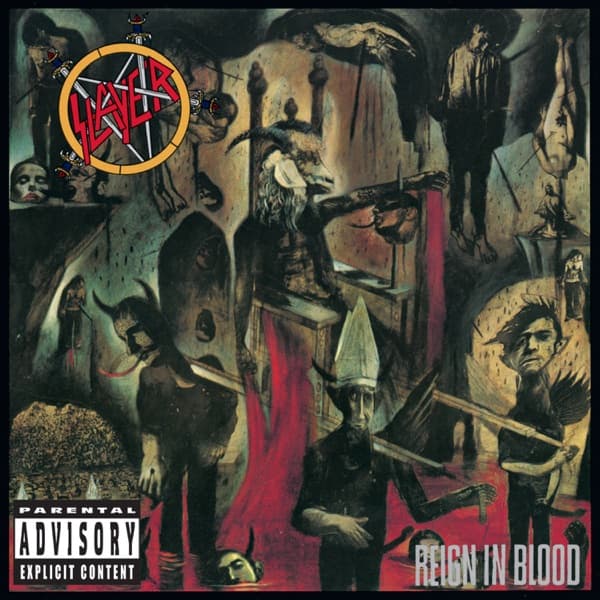

A goat-headed beast sits enthroned at the top of the frame, horned and bearded, borne aloft on a slab carried by faceless attendants. A river of red spills down from him like a carpet unrolled from a throne, pooling toward the bottom of the picture where a discarded horned skull lies in the dirt. This is the first thing your eye finds on Reign in Blood, and it was exactly the impression Rick Rubin was chasing when he made the phone call that started it all.
Rubin had just signed Slayer, and rather than reach for a stock demon he called a man who spent his days drawing political illustrations for the Village Voice, The Progressive and The New York Times. Larry Carroll was not a metal artist. Rubin was drawn to the dark, creepy quality of his work, and that instinct is all over the finished sleeve: this is a hell built by someone who drew for newspapers, dense and editorial, less a poster than a nightmare packed corner to corner with incident.
The two met at New York's Café Figaro to talk it through, and Rubin gave Carroll almost nothing to go on beyond an advance cassette of the album. What came back was not one painting but two, and the band asked him to amalgamate them into a single image. That origin story explains what your eye does when it travels across the cover. It never settles. Bodies hang from poles like carcasses on the right. Small tormented figures crowd the shadowy panels behind the throne. A masked, mitred figure in a tall pointed hat stands dead center at the bottom, arms crossed, presiding over the carnage like a bishop of the damned.
The original was three feet by three feet, triple the size of an album cover, worked in a blend of oils, acrylics and collage, with a photocopier used to resize images and paste this teeming population together. You can feel that mixed-media roughness in the texture: the muddy olive and brown tones, the smeared reds, the sense of scraps and figures layered rather than cleanly composed. It reads as hell precisely because it looks assembled from many horrors rather than designed as one tidy scene.
The goat-headed ruler at the summit invites easy naming, but Carroll has said it is not Baphomet or any specific demon. There is a claim floating around, made in The Art of the LP, that the figures shouldering his throne are the band members themselves, a flourish Carroll never verified. Left unconfirmed, it hangs over the image like everything else on it: suggestive, grotesque, unresolved.
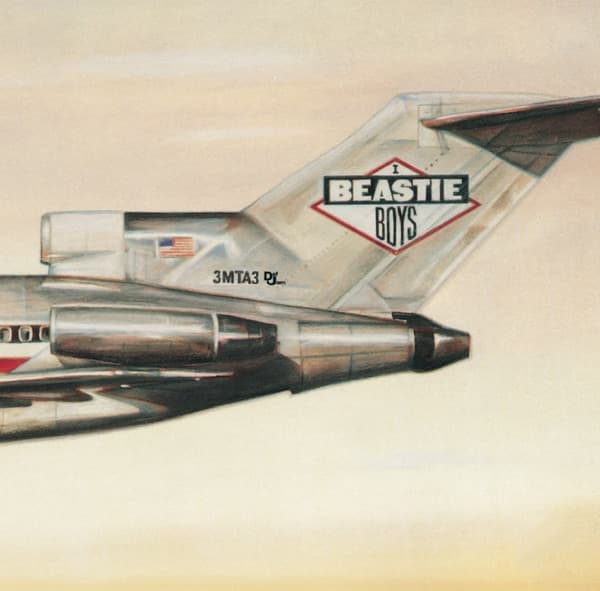
Giving all this its final shape was designer Steve Byram, a New York artist who had just finished the Beastie Boys' Licensed to Ill sleeve. His layout is what turns a painting into a record cover. The Slayer logo sits top left, the pentagram and the sword-crossed lettering punching through the gloom in white and red so it registers instantly against the murk. Bottom right, in a jagged blood-red font, sits the title Reign in Blood. And in the lower left corner, the black-and-white PARENTAL ADVISORY EXPLICIT CONTENT sticker, a small institutional rectangle that only sharpens how transgressive everything around it looks.
Not everyone at the label shared Rubin's enthusiasm. Columbia, which distributed Def Jam, was not keen on the cover, and the record's release was postponed while Def Jam hunted for another distributor, eventually settling on Geffen. A painting held up a landmark thrash album. The band's own reaction was hardly warmer at first. In 1987 Kerry King told Metal Hammer, "We were stuck with it. Some warped demented freak came up with the cover." Years later he reversed himself entirely, calling it a work that "redefined metal artwork."
That about-face captures how the sleeve grew into the music. Tom Araya framed the brief plainly: the cover had to reflect the band and be striking. "We weren't after our version of Iron Maiden's Eddie," he said, "but it needed to be striking." They got something better than a mascot: a whole cosmology. King later put it in the terms a fan would: "One of the reasons why Reign In Blood became a classic is the impact of the cover. It screams metal."
The partnership outlasted the argument. Carroll went on to paint South of Heaven, Seasons in the Abyss and the controversial Christ Illusion, until his hand became as bound to Slayer as Derek Riggs' is to Iron Maiden. The Eddie comparison Araya wanted to avoid ended up describing Carroll's legacy instead, only without a single recurring character: just an ongoing vision of dread.
The original three-foot canvas met a sadder end than the album it fronted. Carroll gave the piece to someone who pretended to be thrilled to own it, then quietly sold it off. The painting that helped make Reign in Blood one of the finest thrash records ever cut slipped out of the artist's hands, while its photocopied, layered image, throne-borne goat, hanging bodies, blood-red carpet, and all, kept screaming metal from record racks. Look again at that mitred figure planted at the center, arms folded, waiting. He has been standing guard over this hell since 1986, and he is not going anywhere.