Before Licensed to Ill became one of the defining albums of the 1980s, Rick Rubin wanted the Beastie Boys to have the visual language of absurd rock-star excess: their own private jet.
Rubin has said the idea came while he was reading Hammer of the Gods, Stephen Davis's Led Zeppelin biography, and looking at the band's famously extravagant aircraft. The joke was to give three young New York rappers the same oversized mythology — and then destroy it.
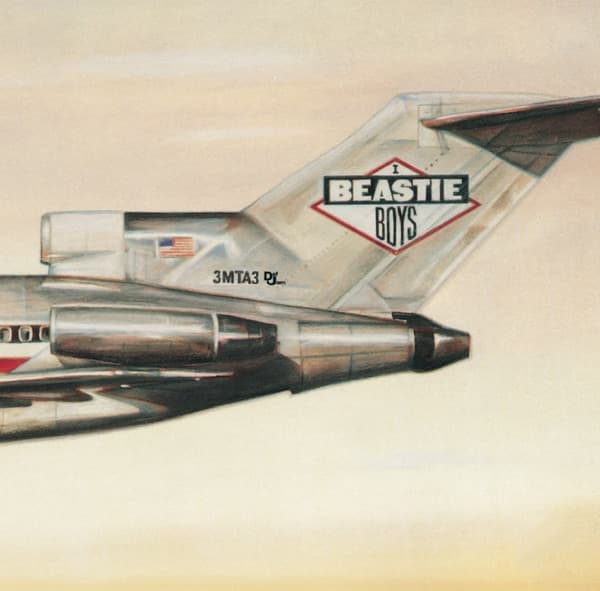
The front of the 1986 sleeve withholds the punchline. You mostly see the rear of the aircraft: metallic fuselage, engines, a U.S. flag, the Beastie Boys logo and the registration-like marking 3MTA3. Open the gatefold and the fantasy collapses. The plane has plowed nose-first into a mountainside, its crushed body curling into a shape widely compared with a spent joint.
The tail number carries another joke. Read in a mirror, 3MTA3 becomes EATME. It is exactly the kind of small, juvenile provocation that fits the record, but it works because it is embedded inside a much more elaborate physical package than BTC's old description suggested.
Stephen Byram handled the art direction. David Gambale — working as World B. Omés — created the cover artwork. Sotheby's documentation for surviving original concept art shows that the image was not a simple typographic layout: the finished cover was built from an intricate collage of airplane parts and then illustrated over and hand-colored. Byram's production notes survive on the concept board, including markings for the front and back of the sleeve.
That makes the gatefold itself part of the idea. The front presents rock-star fantasy; the full package reveals the crash. Rubin later described the concept as a sarcastic way of embracing and distinguishing the larger-than-life rock-and-roll lifestyle. The sleeve's humor comes from letting the fantasy run all the way into destruction.
The real Licensed to Ill cover therefore has almost nothing in common with the black-background, white-type anti-cover BTC previously described. It is narrative illustration, physical-package design and visual joke operating together.