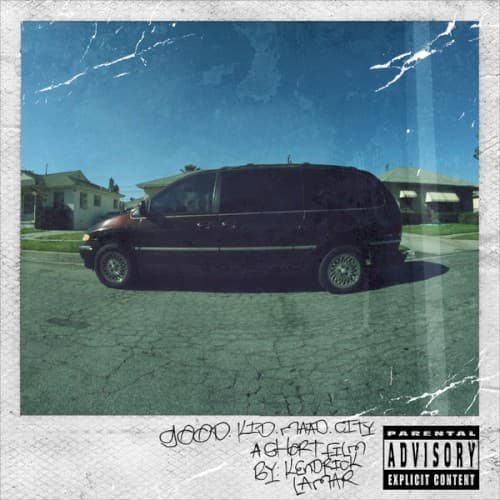
The deluxe image is built on withholding drama. A burgundy, boxy 1990s minivan is parked at the curb, its body curved at the edges by a fisheye lens that makes the whole block bulge like a memory you cannot quite flatten out. The asphalt is cracked and sun-bleached; the sky above is a flat, cloudless blue, almost too clean for the worn pavement below. The whole picture sits inside a creased white Polaroid border, scratched and folded as if it has lived in someone's pocket. Nothing is staged. A parked van, a cracked street, a bright sky and a worn border are simply the everyday scenery of one childhood, offered up as evidence rather than spectacle.
Scrawled across the bottom in loose, hand-drawn graffiti letters is the title, lowercase and uneven, with the subtitle billing the project as 'A Short Film by Kendrick Lamar.' To the right sits the small black-and-white Parental Advisory box. The handwriting refuses polish on purpose: it reads like something tagged on a wall rather than typeset, matching the homemade Polaroid framing.
The standard family snapshot says the same thing more bluntly. Around the kitchen table, two uncles sit on the left and the grandfather is seated on the right, with a young Kendrick in his uncle's lap. The censored bars run across every grown face while baby Kendrick's eyes stay open to the lens, so the whole scene reads as though it is being witnessed through his eyes. Then the objects begin to speak. A 40-ounce bottle of liquor stands next to a baby bottle. One uncle throws up a gang sign with his left hand. On the wall behind them hangs a photograph of Kendrick and his father.
AIGA Eye on Design compared the layered symbolism to Holbein's painting The Ambassadors, where ruin hides in plain sight among the everyday objects. Lamar narrated the frame just as plainly: a baby bottle next to a 40 next to a gang sign, holding a kid. He called the image 'really just like a self-portrait,' not a posed or styled one but the room he was raised in, Compton seen, as he put it, through innocent eyes. 'That photo says so much about my life and about how I was raised in Compton and the things I've seen,' he said. The power of both covers is that they never dramatize any of it. They ask you to look at an ordinary frame and see the whole story folded inside.