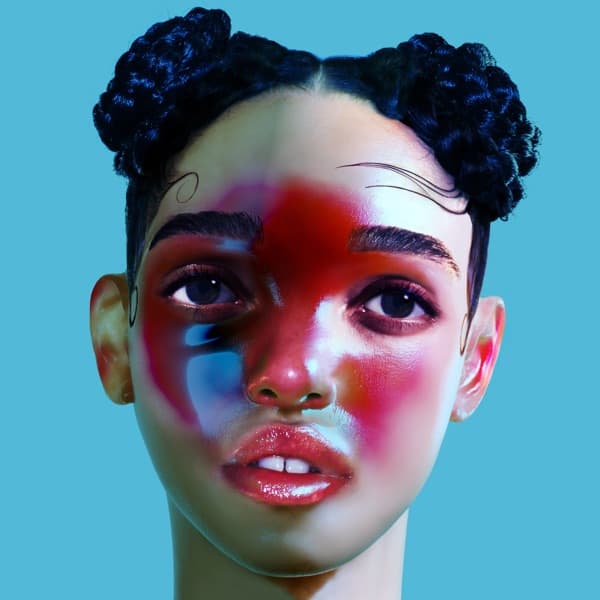

The cover of LP1 is not a photograph of FKA twigs coated in liquid latex, and it was not made by Matthew Stone. The documented creator is visual artist Jesse Kanda, whose collaboration with twigs produced one of 2014's most recognizable digitally altered portraits. When the album was announced in June 2014, The FADER identified the new cover as artwork Kanda had created and specifically described the image as a digital manipulation of twigs' face.
D&AD's award archive gives the clearest account of the process. Kanda and twigs began with photographs of the musician's head. Those images were taken into a 3D process, where the form was sculpted and the texture and lighting were manipulated, before the image was painted over. That sequence explains the cover's peculiar mixture of photographic recognition and synthetic smoothness: twigs is plainly the subject, but her face no longer behaves like an untouched portrait.
The release credits also separate the roles more carefully than the old entry did. MusicBrainz's release data credits FKA twigs and Phil Lee with design/illustration and Jesse Kanda with photography. The visual result is therefore best understood as a collaborative album package built around Kanda's transformed portrait imagery, rather than as a conventional studio photograph with practical makeup effects.
On the front cover, the face fills almost the entire square. The eyes, skin, hair and color treatment remain recognizable enough to read as a portrait, yet the changes to proportion, surface and light push the image toward an uncanny digital object. The absence of a busy setting or narrative scene makes that tension the whole point of the composition: the viewer has almost nothing to look at except a familiar human face made subtly impossible.
That approach was visible immediately when LP1 was announced. The FADER's June 2014 report led with the strange digital treatment, while D&AD later recognized the work in graphic design. Pitchfork also selected LP1 among its best album covers of 2014, describing Kanda's manipulated images as central to the package's surreal effect. None of that history requires the unsupported latex story that had found its way into this archive.
Correcting the credit matters because LP1 sits at the intersection of record design, photography and digital image-making. Naming Kanda, twigs and Lee accurately also makes the album connect to the broader visual network around the release: the person in the image, the artist shaping the imagery and the designers assembling the package are not interchangeable roles. The strongest version of the story is the one the surviving credits and Kanda's documented process actually support.