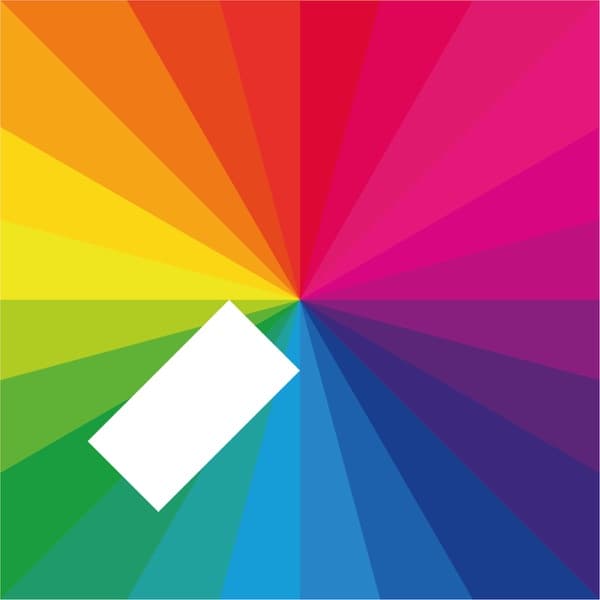

In Colour does not begin with typography. It begins with a mark. Saturated wedges of colour radiate toward a shared point while a tilted white rectangle cuts into the spectrum. That white bar is not arbitrary geometry: Jamie Smith explained in 2015 that Romy Madley Croft had designed The xx's X and that, for his solo artwork, he took one leg of that X.
Smith also said he designed the In Colour cover himself. He wanted a spectrum that could represent the records he had already released and the many different shades inside the album. Black and white remained part of the visual system as a link back to The xx, but the solo sleeve deliberately opened that restrained vocabulary into a much brighter field. Release-level credits also name Phil Lee for artwork, so the finished package should be understood as Smith's concept and design working within a credited artwork collaboration rather than as an unnamed label-team exercise.
The important correction is that the cover is not led by clean sans-serif lettering. The canonical front is overwhelmingly image and geometry: radial colour wedges plus the white X fragment, with essentially no conventional front-cover typography driving the composition. Earlier BTC copy built an entire formal analysis around type that is not actually the central visual element.
The same care is needed with the colour story. Jamie xx spoke repeatedly about tracks and the record having colours and shades, but BTC should not turn those statements into a clinical claim that the sleeve is a diagram of synesthesia or chromesthesia. Contemporary interviews frame the spectrum as a consciously constructed visual system for the album. That distinction keeps the story grounded in what Smith actually described rather than converting an artistic association into a neurological diagnosis.
Seen this way, the cover links Jamie xx's solo identity to The xx without simply copying the band's mark. One leg of the X survives, but it is isolated and surrounded by a full spectrum. The image says continuity and separation at the same time: the source symbol remains recognizable, yet the visual world around it has changed completely.