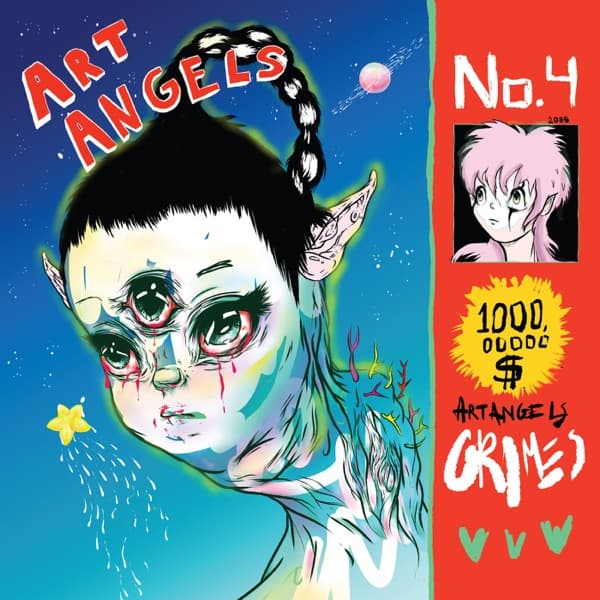
The eyes come at you first, and they are weeping. Two enormous anime orbs dominate the face on Art Angels, ringed in red, streaming thin trails of what reads as blood down pale cheeks. The pupils are cartoon-huge, catchlit, and yet the expression is not distress so much as a fixed, otherworldly calm. Above them sits a blunt black fringe of hair; from either side of the head sprout long, veined, pointed ears, half elf and half creature. This is the portrait Claire Boucher, who records as Grimes, chose to put between the world and her record.
She drew it herself. No outside illustrator, no photographer, no art director stands behind this image. The whole thing is her hand, and it looks like it, in the best sense. The linework is loose and slightly wobbly, the color laid down in flat, saturated blocks that occasionally overshoot their outlines. That deliberate roughness is the signature: a hand-drawn, anime-inspired portrait that trades polish for personality.
Look at how the frame is divided. The left two-thirds is a deep midnight blue scattered with tiny white stars, and floating in it, up near the top right of that field, is a pale pink orb ringed like a small planet, trailing a faint arc as if mid-orbit. In red bubble letters climbing the upper left corner, the words ART ANGELS sit at a jaunty diagonal. A rope of hair, drawn like a thick braided cord in black and white, loops up and over from the figure's head almost like a handle, connecting the title to the skull.
The right edge of the cover is a separate vertical strip of tomato red, and it behaves like a magazine cover or a trading card. At the top, in heavy black type, it announces No. 4 (with a tiny 2099 tucked beside a little inset panel). That inset is a small framed drawing of a second pink-haired character, a different creature entirely, glaring out in miniature. Below it, a scribbled yellow starburst reads 1000,00000 $, the zeros tumbling as though hand-counted. Then ARTANGELS again, and beneath it the name GRIMES in fat white brushy capitals, followed by a row of three green heart shapes and, lower still, three little green sprouts or check marks. Even to the left of the face, tiny colored plants and a small yellow star with water spraying from it creep in from the margins. The whole composition feels stuffed with private symbols, a doodled diary page blown up to LP scale.
That impulse ran far past the front cover. Boucher didn't just make one image; she created a custom original illustration for every single track on the album and shared them through her Tumblr. The cover is the flagship of a whole hand-made visual universe, one drawing per song, all issuing from the same pen. By crafting all of it herself she pushed the idea of the musician as a complete creative entity, someone who authors the sound and the world it lives in.
And she authored the sound just as totally. Boucher wrote, recorded, produced and engineered every track on Art Angels alone. She also directed its videos, including those for "Flesh Without Blood" and "Life in the Vivid Dream." So the weeping elf on the front is not a marketing face slapped onto someone else's music. It is drawn by the same person who played it, mixed it, and filmed it. The crude confidence of the illustration is a statement of authorship.
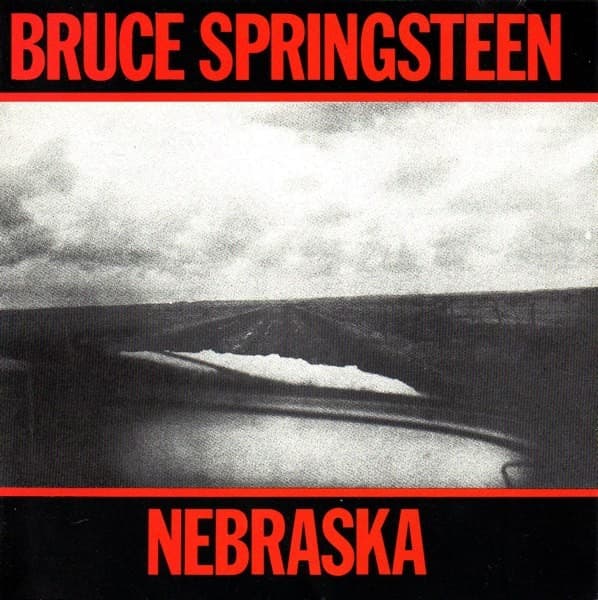
She unveiled it all on October 19, 2015, posting the title and the artwork to her social media accounts. The digital album followed on November 6, 2015, with physical formats arriving December 11, all through 4AD. Around that reveal she described the record as shaped by what she called "bro art," a lineage she traced from Al Pacino to Bruce Springsteen. It is a funny, provocative frame for a cover this pink and tearful and pointy-eared, and the tension between those references and this image is part of the fun.
The portrait itself resists easy reading. Is she crying? The red streaming from the eyes suggests grief or violence, yet the mouth is small and neutral and the whole face is lit like a cartoon idol. The pointed ears and the trailing plants pull it toward fantasy, the planet and stars toward science fiction, the trading-card sidebar toward pop kitsch. That refusal to settle into one genre mirrors an album that itself blends pop with everything it can grab. The picture is doing what the songs do: colliding cute and unsettling until you can't tell which is winning.
Critics responded to that ambition with near-unanimity. Art Angels landed an average score of 88 on Metacritic across 32 reviews, the kind of consensus that turns a self-produced, self-drawn record into a defining one. The acclaim landed on a package where the drawing hand and the composing hand were the same, where nothing had been outsourced.
Spend enough time with the face and the small choices start to feel intentional in their imperfection: the color bleeding past the ears, the counted-out dollar zeros, the second creature glaring from its little box, the water-spraying star. It looks like something made fast, privately, for the pleasure of making it. That is exactly why it holds. Boucher put her own unfiltered handwriting on the outside of the record, and it tells you, before a note plays, that everything inside came from one person's imagination and no one else's.