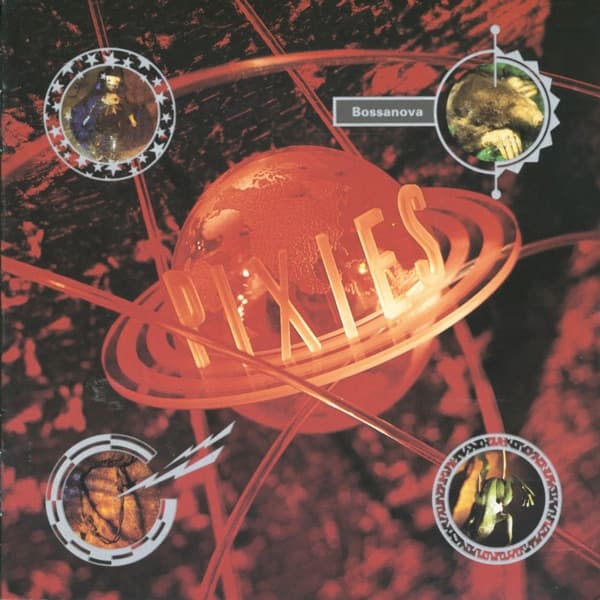
The background is a churning field of deep red and charred black, like a photograph of some rocky, molten terrain pushed toward abstraction. It reads as heat and distance at once, giving the amber sphere something to glow against and turning the whole sleeve into deep space. Across it, thin looping lines trace elliptical orbits, the way old textbook diagrams draw the paths of electrons or planets. Those orbits knit the whole composition together, sending the eye spinning from the central sphere outward and back, so the sleeve keeps you circling, exactly as a good solar system should.
The glowing orange sphere dominates because it is the brightest thing on a dark, hot-colored field, and because it doubles as the band's mark. The word PIXIES bent around its rings does the work of a logo, curved to follow the sweep so that the name and the planet become a single object. This is the sleeve's central trick: a title that is also a world, identity fused with image.
Each of the four corners holds a circular window framed by its own ornate border, and each holds a strange, close-up photograph. Top left sits what looks like a glass vessel or bulb glinting with color, ringed by a band studded with tiny star-shapes. Top right, framed in cool grey, is a soft golden mass, furred or fibrous, almost organic. Bottom left, a dark curled form behind glass, flanked by little arrow-marks like a diagram calling out a specimen. Bottom right, ringed by rows of small repeated figures, sits a cluster of greenish, budding shapes with a star pinned among them. They read like exhibits in a cabinet of curiosities, mysterious objects photographed as if for a catalogue no one will ever explain. Set inside the diagrammatic frames and orbit-lines, they stop being mere pictures and become evidence, samples brought back from wherever this amber planet is spinning.
Up near the top, in a neat little rectangular plaque with rounded corners, the word Bossanova appears in plain type, almost clinical against all that cosmic drama. It is the one calm, labeled thing on a sleeve otherwise given over to glow and orbit and specimen, and it lets you know exactly which world you have entered.
What makes the cover last is how completely the design commits to its conceit. The typography does the work of a logo, the orbit-lines do the work of a diagram, and the corner specimens do the work of mystery. It is a solar system with a ringed central world and its orbiting satellites, and it takes the band's science-fiction daydreams entirely seriously, right down to the star pinned among the green buds in the corner. The image works because every element pulls toward the same fiction, an astronomy chart for a band whose songs kept drifting toward outer space.