Pixies

3 album covers in our archive

The Pixies covers in this archive show one of alternative rock's most distinctive artist-designer partnerships at work. Surfer Rosa and Doolittle both pair Vaughan Oliver's art direction with Simon Larbalestier's photography, but the results are radically different: one turns a staged dancer, a crumbling wall and Catholic imagery into a sepia relic; the other transforms a macaque and fragments of visual information into something closer to a strange scientific document. Together they show how 4AD built a recognizable visual world without repeating a single cover formula.

Cover evolution

Pixies · 19881990

  1. 1988
    Surfer Rosa by Pixies — 1988
    Surfer Rosa
  2. 1989
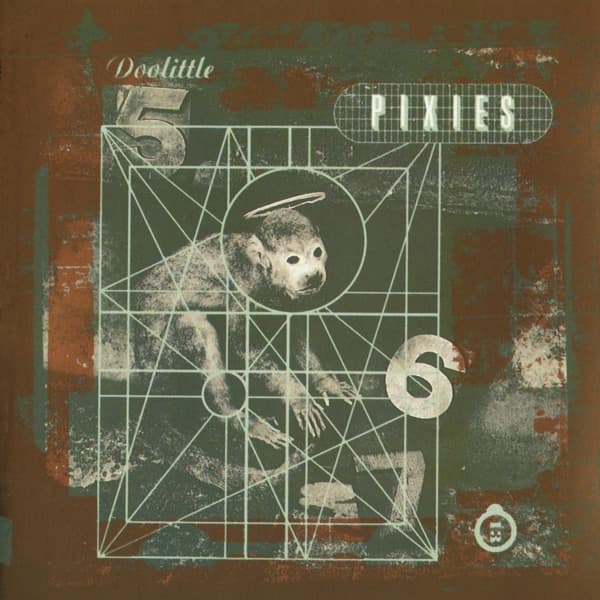
    Doolittle by Pixies — 1989
    Doolittle
  3. 1990
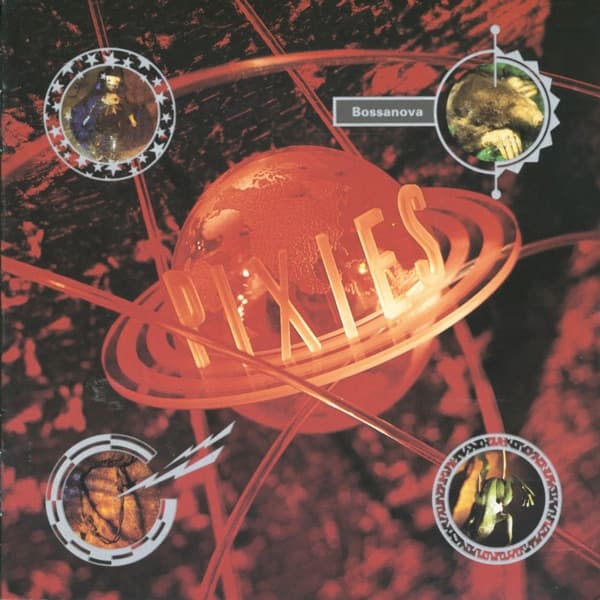
    Bossanova by Pixies — 1990
    Bossanova

Visual history

How Pixies album covers evolved

Surfer Rosa is physical and theatrical. Simon Larbalestier photographed a flamenco-costumed model — widely identified in secondary sources as Isabel Tamen — against a distressed set filled with a crucifix, a torn film poster and a broken guitar neck. Vaughan Oliver then framed the photograph like an aged devotional object, letting the image carry almost all of the sleeve's identity.

Doolittle moves away from the staged human figure toward a manipulated animal image. Larbalestier's macaque, the halo-like form above its head, floating numbers and diagrammatic marks make the sleeve feel simultaneously biological, religious and surreal. The visual vocabulary changes, but the appetite for ambiguity does not.

Vaughan Oliver and Simon Larbalestier

The continuity across the Pixies' classic 4AD artwork comes less from a logo or fixed color palette than from the working relationship between art director Vaughan Oliver and photographer Simon Larbalestier. Oliver described his process as beginning with the music, lyrics and conversations with the band, then choosing imagery and collaborators that could create an atmosphere rather than simply illustrate a song.

Larbalestier's experimental photographs gave Oliver material that could be cropped, toned, layered and surrounded with typography until the package felt like an object from its own world. Their collaboration extended beyond these two albums across the Pixies' original 4AD visual identity and later returned for the Minotaur retrospective box set.

A 4AD visual language without band portraits

Neither Surfer Rosa nor Doolittle sells the Pixies with a conventional photograph of the band. Instead, the sleeves treat the album as a self-contained visual problem: a charged scene on one record, a distorted specimen on the next. That approach fits the wider 4AD design culture Oliver helped establish, where packaging could be mysterious enough to stand on its own while still responding to the music.

That is why the two covers feel related even when their subjects are not. The shared signature is mood, texture and indirection: images that invite interpretation before they explain themselves.

Questions about Pixies's album covers

Who designed the Pixies' classic album covers?

Vaughan Oliver directed the Pixies' classic 4AD visual identity and worked closely with photographer Simon Larbalestier. Behind the Covers currently documents that partnership on Surfer Rosa and Doolittle.

Who is the woman on the Surfer Rosa cover?

The woman is widely identified in secondary sources as Isabel Tamen, a Portuguese dancer and friend of photographer Simon Larbalestier. The strongest primary and archival sources Behind the Covers found confirm Larbalestier's shoot and the staged flamenco/Catholic imagery but do not independently establish the model's name, so we preserve that uncertainty.

Read the cover story →

What animal is on the Doolittle album cover?

Doolittle centers a heavily manipulated photograph of a macaque by Simon Larbalestier, surrounded by numbers and geometric markings that make the image feel part specimen, part surreal diagram.

Read the cover story →

Why do Pixies album covers look so surreal?

Oliver's approach was to work from the music, lyrics and themes and build an atmosphere rather than make a literal illustration. Combined with Larbalestier's experimental photography, that produced sleeves that feel connected by mood and visual ambiguity rather than by a repeated template.

Bossanova by Pixies — album cover art

Bossanova (1990)

A glowing orange planet spins at the center of Pixies' third album, ringed by the band's name and orbited by four strange specimen-photos. Vaughan Oliver turned the record's sci-fi lyrics into a solar system you can hold in your hands.

Label
4AD
Designer
Vaughan Oliver
Photographer
Simon Larbalestier
Genre
Alternative, Rock
Decade
1990s
Read the full story →
Doolittle by Pixies — album cover art

Doolittle (1989)

Vaughan Oliver and Simon Larbalestier turned the Pixies' 'Monkey Gone to Heaven' image into Doolittle's bronze-toned cover: a monkey specimen beneath a halo, the numbers 5, 6 and 7, and a Golden Section grid inspired by Black Francis telling Oliver that successful music was mathematical.

Label
4AD / Elektra
Designer
Vaughan Oliver
Photographer
Simon Larbalestier
Genre
Rock, Alternative
Decade
1980s
Read the full story →
Surfer Rosa by Pixies — album cover art

Surfer Rosa (1988)

A topless flamenco dancer stands against a peeling wall hung with a crucifix and a torn poster for a Spanish film—an image born in a 'topless Spanish bar' and 'loaded with Catholicism.' This is the cover that helped launch a band, fed Kurt Cobain's blueprint for Nevermind, and now sits in the V&A.

Label
4AD
Designer
Vaughan Oliver
Photographer
Simon Larbalestier
Genre
Alternative, Rock, Indie
Decade
1980s
Read the full story →

Browse related design themes

More album cover stories from the 1990s