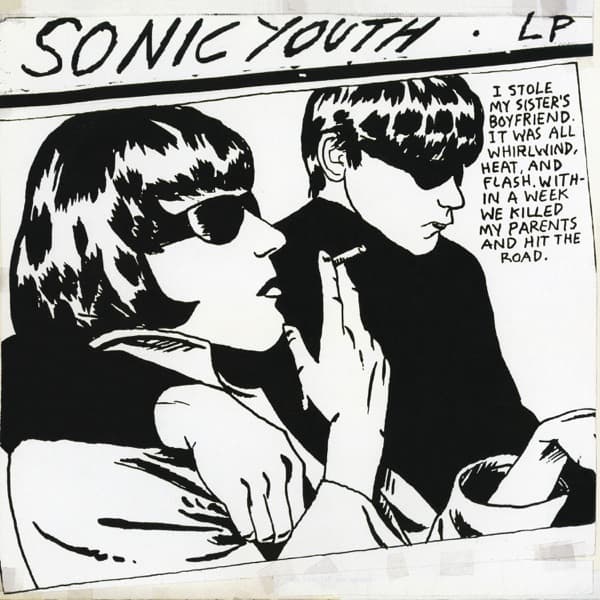
The image is drawn in stark black ink on white with no grey in between, all hard contour lines and high contrast. It is the kind of confident hand-drawn linework that does not need color to feel loud, and the eye moves along those bold contours before it settles on anything specific. The absence of a middle tone is the first choice that matters: every shape is either lit or in shadow, which flattens the couple into something poster-like and immediate.
Composition places the two figures so close that they crowd the frame, heads occupying nearly the whole panel. The woman in the foreground dominates, her leopard-spotted fringe reading as a field of scattered dark marks against her pale face, her lips parted around a cigarette. The man behind her tilts in, his slicked hair a solid black mass, a single white glint on his lens the only spark in an otherwise sealed expression. Both sets of dark glasses act as blank voids where eyes should be, which is precisely what makes the pair unreadable and magnetic. They give away nothing, and that withheld gaze is what keeps a viewer looking.
The typography does its own work. Across the top, in shaky hand-lettered capitals, runs SONIC YOUTH . LP, scrawled as if with a marker, casual and off-kilter against the crisp figures below. To the right sits the confessional caption, boxed into the corner like a comic's narration. Its voice, first-person and matter-of-fact about murder, supplies a whole plot the picture only hints at: runaway lovers, blood, a getaway car.
The genre reference is the crux of the reading. By quoting the visual grammar of noir and pulp comics, the drawing frames its subjects as disposable cool, the runaway couple of a hundred cheap thrillers. That surface flirtatiousness sits over a genuine menace the caption confirms in words. The tension between throwaway glamour and real horror is exactly what makes the cover work: it is both seductive and faintly criminal at once.
Equally telling is what the sleeve refuses. There is no band photo, no polished logo, no color. Just a borrowed snapshot redrawn, plus a name and an invented confession, which together become the entire personality of the cover. Stripping away the usual furniture of a major-label release forces all the meaning onto the drawing itself, and the drawing carries it. The couple keep sharing their cigarette behind their black lenses, and the image reads as flirtatious, hard, and unknowable, which is why the eye cannot let it go.