


Computer World looks prophetic now, but its cover is more interesting when seen from 1981. Personal computing had not yet become an ordinary household fact, screens were not carried in pockets, and the visual language of digital life was still being invented. Kraftwerk put that emerging object directly on the front of the record. The sleeve shows a beige terminal against a dark ground, its screen occupied by the four members' heads. Instead of posing the band beside a computer, the design puts them inside it. Emil Schult, Kraftwerk's longtime visual collaborator, is credited with the album's graphics; exhibition documentation from the Bauhaus Imaginista project likewise identifies him as the cover designer. The machine on the front is often identified as resembling a Hazeltine 1500 terminal, but the safest description is exactly what the image gives us: a stylized terminal whose proportions and keyboard evoke contemporary business computing. That distinction matters because the cover's power does not depend on identifying a specific model. Its subject is the interface itself. Human identity has been converted into screen information. The band's faces are simplified, repeated and contained within the monitor, continuing Kraftwerk's long project of turning its members into images that sit somewhere between people, mannequins and machines. The typography reinforces the idea. Letterforms associated with machine-readable and technical printing make the title look less like expressive album lettering than information produced by a system. Inside, the concept expands. Günter Fröhling's photographs show mannequin-like representations of the four members engaged with studio equipment, continuing the controlled artificiality of The Man-Machine. The result is not a simple celebration of computers. The songs address calculation, communication, data and surveillance as parts of the same new world. The cover captures that ambiguity beautifully: the computer is clean and inviting, but the people have already been absorbed by its display.
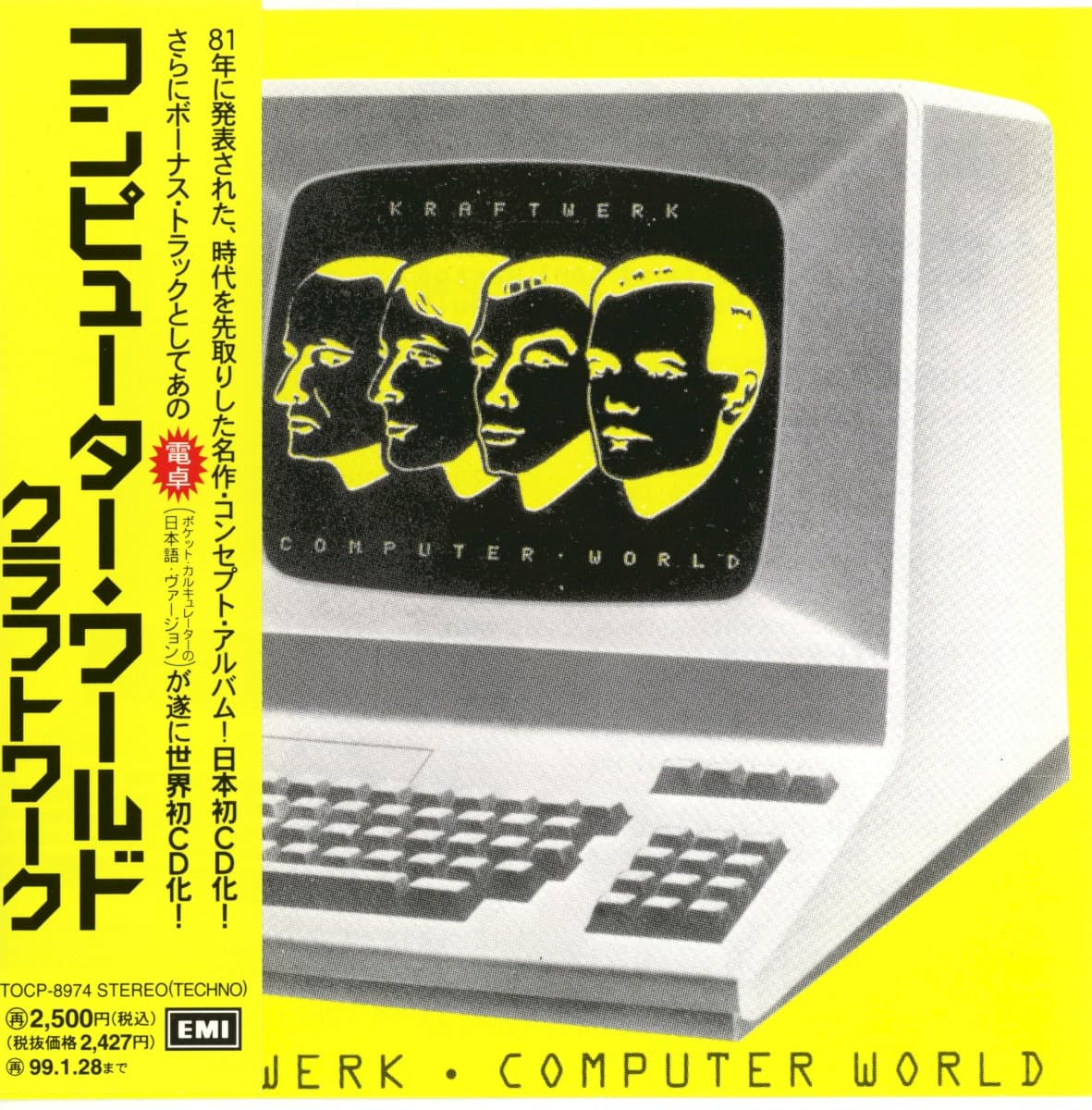
Design Emil Schult · Photo Günter Fröhling · EMI · © respective owner · fair use
Computer World
Kraftwerk's Computer World puts an old computer terminal at the center of the sleeve and places the band's four faces inside its screen. Emil Schult's design made computing look simultaneously domestic, bureaucratic and uncanny years before the personal computer became ordinary.
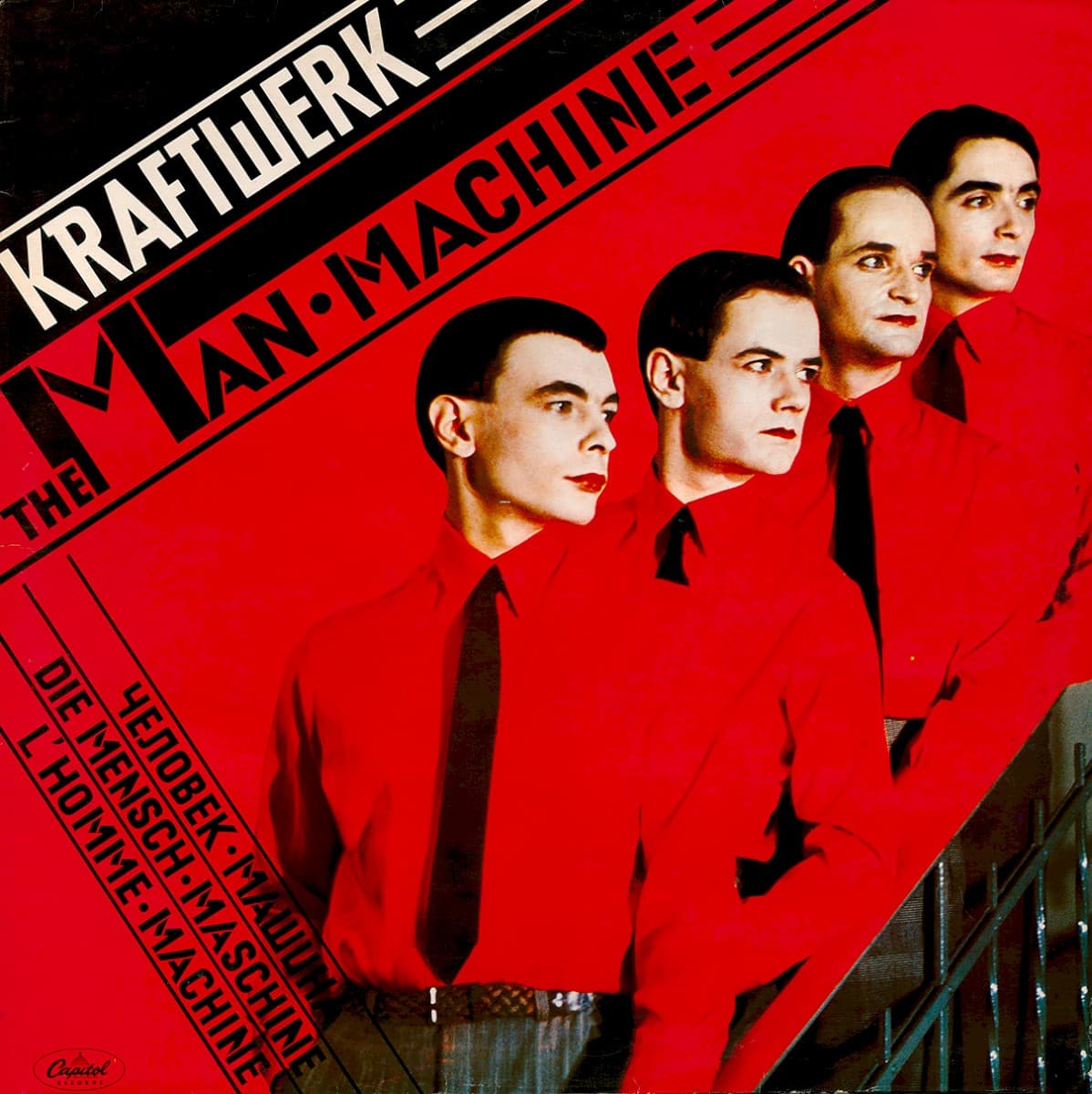
 Read nextThe Man-MachineKraftwerk turned themselves into a graphic system on The Man-Machine: four musicians in matching red shirts and black ties, arranged with the hard geometry of modernist propaganda. Karl Klefisch shaped the sleeve and Günther Fröhling supplied the photography, creating one of the clearest visual statements of Kraftwerk's human-versus-machine identity.
More from Kraftwerk
Quick Facts
- Album
- Computer World
- Artist
- Kraftwerk
- Released
- 1981
- On the cover
- A beige computer terminal displaying simplified images of Kraftwerk's four members on its screen, surrounded by stark computer-age typography.
- Label
- EMI
- Design
- Emil Schult
- Photography
- Günter Fröhling
- Genre
- Electronic
- Decade
- 1980s
Inside the design
Visual analysis
The terminal dominates because almost everything else has been removed. Its pale casing floats against a dark background, making the machine feel like both a product photograph and an icon. The screen is the true focal point. Four faces occupy the glowing rectangle in a compact grid, transforming the conventional band portrait into data presented by hardware. That is the sleeve's central visual joke and its most durable idea. Kraftwerk are present, but only through the computer. The palette is restrained and functional rather than spectacular. Beige and yellow-brown tones evoke the physical plastics and phosphor displays of early computing, while the dark surrounding field isolates the terminal. Technical-looking type completes the transformation from record sleeve to interface. Nothing needs to look like cinematic science fiction. The future is represented by an office machine.
Why it matters
Why this cover matters
Computer World captured a cultural transition before its visual language became ordinary. By placing Kraftwerk inside a computer display, the cover turns the band's recurring human-machine theme into a remarkably simple image of digital identity.
Historical context
Historical context
Released in 1981, Computer World arrived just as microcomputers and home computers were beginning to move from specialist environments toward wider public life. Kraftwerk's album addressed computers, pocket calculators, communication and data while being produced with largely analogue electronic equipment—a useful reminder that the record was imagining a computerized society rather than simply documenting one already in place. Schult had been part of Kraftwerk's creative circle for years, contributing graphics and lyrics, and the sleeve continued the band's unusually integrated approach to sound and visual identity. The inner photographs by Günter Fröhling also connect Computer World to the mannequin-like presentation of The Man-Machine.
Legacy & influence
Legacy and influence
The cover has aged in two directions at once. Its bulky beige terminal is unmistakably of its period, yet the idea of people reduced to faces on a screen now feels ordinary in a way it could not have in 1981. That tension is why the sleeve remains so effective. It is retro-futurist as an object but contemporary as a concept. Later electronic musicians repeatedly borrowed Kraftwerk's cool interfaces, machine typography and depersonalized portraits, but Computer World remains unusually concise: one terminal, four faces, and an entire social transformation implied by the relationship between them.
About the Computer World cover
Who is on the cover of Computer World by Kraftwerk?
A beige computer terminal displaying simplified images of Kraftwerk's four members on its screen, surrounded by stark computer-age typography.
Who designed the Computer World album cover?
The Computer World album cover was designed by Emil Schult for Kraftwerk's 1981 release.
Who photographed the Computer World album cover?
The cover photograph for Kraftwerk's Computer World was taken by Günter Fröhling.
When was Computer World by Kraftwerk released?
Computer World by Kraftwerk was released in 1981 on EMI.
What is the story behind the Computer World album cover?
Kraftwerk's Computer World puts an old computer terminal at the center of the sleeve and places the band's four faces inside its screen. Emil Schult's design made computing look simultaneously domestic, bureaucratic and uncanny years before the personal computer became ordinary.
Shop this cover
Own Computer World on vinyl & more
As an Amazon Associate and eBay Partner, Behind the Covers earns from qualifying purchases — at no extra cost to you. See our affiliate disclosure.
Color palette
Dominant colors on this cover
#fdfd1e
#83837f
#1e211b
#e6e4df
#9f9e9b
The web behind this cover
Click any node to open the full explorer












Keep exploring
Connections across Behind the Covers
Up next
The Man-Machine
Kraftwerk · 1978 · Karl Klefisch
Kraftwerk turned themselves into a graphic system on The Man-Machine: four musicians in matching red shirts and black ties, arranged with the hard geometry of modernist propaganda. Karl Klefisch shaped the sleeve and Günther Fröhling supplied the photography, creating one of the clearest visual statements of Kraftwerk's human-versus-machine identity.
Read this story →Read more in our guides
- A History of Album Cover ArtFrom plain brown sleeves to a billion-dollar design medium: how the record cover became a canvas.
- Album Covers That Changed Graphic DesignThe sleeves whose influence escaped music entirely and rewired graphic design itself.
- Post-Punk & Indie Album Covers: Factory, 4AD, and the Independent LookWhen the label, not just the band, became the author of the look — the austere, art-school design of the independent era.
Want to explore more?
Never miss a new cover story
Get the Behind the Covers app and turn on notifications — we publish new album art deep dives every day.