

The cover of Autobahn began with a car ride through the German countryside, when Kraftwerk members Ralf Hütter and Florian Schneider became fascinated by the endless ribbon of asphalt stretching into the horizon. What started as casual observation became the visual manifesto for electronic music's relationship with modernity.
Artist Emil Schult, who had been collaborating with Kraftwerk since their early experimental days, was tasked with capturing this automotive meditation. Schult understood that the band wasn't just making music about driving - they were exploring the intersection of human consciousness and machine precision that the autobahn represented.
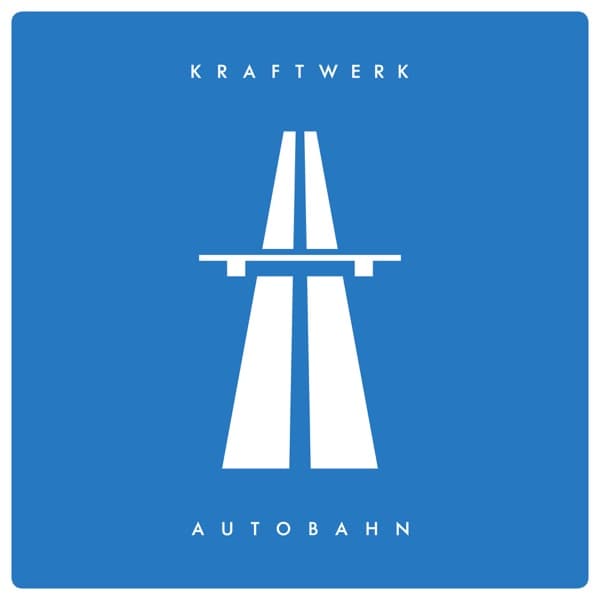
Rather than photograph an actual highway, Schult chose to paint the image, creating a deliberately artificial representation of a real experience. His acrylic painting depicts a two-lane road stretching toward a vanishing point, flanked by minimal landscape and topped by a pale sky - geometry made manifest.
The painting process was methodical, almost mechanical, mirroring Kraftwerk's approach to music creation. Schult used precise brushstrokes to create clean lines and flat color fields, avoiding any romantic or expressionistic flourishes that might contradict the band's aesthetic philosophy.
Emil Schult brought fine art credentials to Kraftwerk's visual identity, having studied at the Düsseldorf Art Academy. His background in conceptual art perfectly complemented the band's systematic approach to sound, creating covers that functioned as extensions of their musical concepts rather than mere decoration.
Philips Records initially worried the cover was too stark and uncommercial for international markets. Some executives suggested adding the band's photograph or more colorful graphics, not understanding that the minimalism was the entire point of Kraftwerk's artistic statement.
When Autobahn became an unexpected hit, reaching number five on the Billboard Hot 100, the cover's austere beauty suddenly looked prophetic rather than commercial suicide. Music journalists began describing it as the perfect visual representation of Kraftwerk's "machine music."
The cover's influence on electronic music artwork was immediate and lasting. Countless techno, ambient, and synth-pop albums would adopt similar minimal geometric approaches, understanding that Schult's design had established a visual vocabulary for electronic music.
Schult's highway painting helped establish the idea that album covers for electronic music should look as precisely engineered as the music sounded. The organic brushstrokes were there, but organized into such rigid compositional structures that the humanity almost disappeared into the machine.
The original painting now hangs in the Rock and Roll Hall of Fame, where it's recognized as one of the most influential album covers in popular music. Schult continued designing Kraftwerk covers for decades, but none matched the pure conceptual clarity of that endless German road.
Decades later, Emil Schult revealed that he painted the cover while listening to early versions of the album's title track on repeat, letting the music's hypnotic rhythms guide his brushstrokes across that infinite highway.
Color palette
Dominant colors on this cover
#247cc4
#94bcdc
#175181
#1c74be
#135185
This cover reads predominantly as blue. Explore more covers with the same palette:
Inside the Design
Visual analysis
Schult's composition employs classical one-point perspective with surgical precision, drawing the viewer's eye inexorably toward the central vanishing point where road meets sky. The highway divider becomes a literal and metaphorical lifeline, bisecting the canvas and creating perfect bilateral symmetry that mirrors the mechanical precision of Kraftwerk's musical arrangements. This geometric rigor transforms what could have been a romantic landscape into something closer to a technical diagram.
The restrained color palette of pale blues, muted greens, and asphalt gray creates an emotional temperature that perfectly matches the album's cool electronic textures. Schult avoided any warm colors that might suggest human comfort or natural beauty, instead choosing hues that feel filtered through industrial processes. The sky's wan blue suggests neither dawn nor dusk but an eternal artificial daylight, as if the entire scene exists in some climate-controlled environment.
The complete absence of typography on the front cover was radical for 1974, when most albums featured prominent band names and titles. This typographic silence forces the image to carry the entire conceptual weight, making the painting itself into a kind of logo. When text does appear on the spine and back cover, it's rendered in simple, sans-serif letters that echo the cover's geometric restraint.
This cover established the visual DNA for electronic music artwork, proving that technological music required an equally systematic approach to visual design. Its influence can be traced through decades of techno, ambient, and synth-pop covers that adopted similar minimalist geometries, understanding that Schult had created not just an album cover but a visual philosophy for the machine age.
Get notified when we publish new cover stories. Download the Behind the Covers app and turn on notifications — a new album art deep dive, every day.
Loved the story behind Autobahn? Hear the album or add it to your collection.
More “minimalist” covers
More Electronic Covers
More from the 1970s
Keep exploring
Connections across Behind the Covers

Up next
Low
David Bowie · 1977 · Uncredited
The stark orange and black profile on Bowie's Low came from a film still of the artist in The Man Who Fell to Earth, creating one of rock's most minimalist and emotionally devastating covers through pure color saturation and negative space.
Read this story →Want to explore more?
Never miss a new cover story
Get the Behind the Covers app and turn on notifications — we publish new album art deep dives every day.