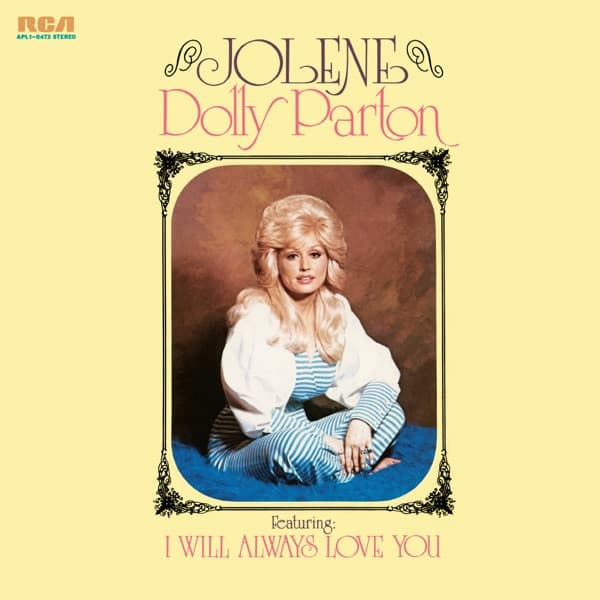
Start with the framing, because it dictates everything else. The whole cover is built as a picture within a picture: a rectangular portrait sits centered inside a broad field of pale, buttery yellow, and each corner of that inner rectangle is finished with a delicate engraved scroll, like the border of a locket or a Victorian carte de visite. That decorative edging does real work. It tells you to treat the photograph as a keepsake, something precious and framed rather than a candid snapshot, and it flatters the sitter by presenting her as an object worthy of ornament. The yellow surround is generous, giving the portrait air on all sides, and the effect is less like a record sleeve than a page from an album of portraits.
Inside the frame, the eye lands immediately on the face, and specifically on the hair. The teased blonde pile is the brightest, highest-contrast mass in the image, catching the studio light so that it almost glows against the darker brown backdrop. It functions as a halo, drawing the gaze up and holding it there before the eye drifts down to the eyes and the slight, knowing set of the mouth. The lighting is soft and warm, with no hard edges, so the skin reads smooth and the shadows fall gently under the chin and along the arms. This softness is a choice about mood: it makes the portrait intimate and idealized rather than documentary, closer to a beauty portrait than a country publicity still.
The pose is worth reading closely. She is seated low, on a pool of deep blue cloth, knees drawn up and to the side, hands resting quietly near her lap. It is a compact, grounded posture that keeps the whole figure inside the frame and creates a stable triangular shape, wide at the base of the folded legs and tapering up to the face and hair. Nothing juts or strains. The composure of the pose says self-possession, a woman comfortably settled and looking directly out at you rather than performing for you.
Colour is doing quiet, deliberate work across the sleeve. The blue-and-white vertical stripes of the outfit are the only sharp, repeating pattern in the whole design, and they pull the eye down from the face to the body, then the solid blue fabric beneath anchors the lower half. That cool blue is the complement to the warm yellow border and the golden hair, and the two temperatures play off each other so the portrait feels both warm and crisp. The white of the loose blouse over the shoulders brightens the upper body and echoes the white stripes, tying the costume together. Against all this, the pink lettering above sits in the same soft, feminine register as the skin tones, so the type does not fight the photograph.
The typography reinforces the keepsake idea. JOLENE runs across the top in an ornamented display face, its capitals flanked by small flourishes, sitting above the name Dolly Parton set in a flowing pink script. Both are handled as decoration rather than information, curling and genteel, consistent with the engraved corners of the frame. At the lower edge, in small dignified capitals, the line announcing the featured song sits quietly in the yellow field, understated so it does not compete with the portrait. Up in the top left corner the compact RCA logo and the catalogue code are the only strictly functional marks, and they are pushed to the margin where they read as a label imprint rather than part of the picture.
Notice the negative space. The pale yellow is not empty so much as protective, isolating the framed portrait so it reads as the single event on the cover. There is no location, no props, no narrative scene, nothing to distract from the figure. That emptiness is a statement of confidence: the woman alone, framed and lit, is presented as sufficient to carry the entire cover.
Put the parts together and the image argues a specific idea about its subject. The ornamental frame and script lettering claim old-fashioned prettiness and value; the soft focus and glowing hair claim glamour; but the direct, level gaze and the settled, grounded pose claim control. It is a portrait that wants to be looked at and is entirely aware of being looked at. The striped, casual outfit keeps her approachable while the framing elevates her, and that tension, homespun and glamorous at once, is exactly what makes the picture hold together. The cover reads as a woman presenting a polished new version of herself and daring you to find it anything less than composed.