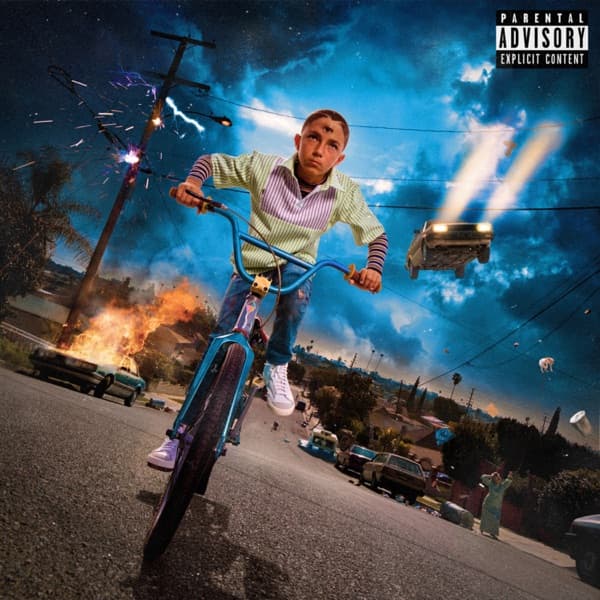


The first thing you notice is the eye you were not looking for. A boy leans hard over the handlebars of a turquoise BMX, coming straight at you down a suburban street, and just as your gaze settles on his ordinary face, it snaps to the extra eye set dead center in his forehead. That single detail rewrites the whole picture. Everything else on the YHLQMDLG cover is arranged to make you feel what he can already see coming.
And plenty is coming. Behind the boy, the sky has gone the deep electric blue of a storm about to break, streaked with clouds and a bolt of lightning crackling into the power lines on the left. A wooden utility pole throws off a shower of orange sparks. Lower down, a house is on fire, flames licking bright against the dusk. And there, floating impossibly in the middle distance, a boxy old car hangs in the air with headlights blazing, nose tilted up as though it has just lifted off the asphalt.
This is exactly the scene Bad Bunny described: boys steal the kid's hat, uncover his third eye, and then, in his words, the cars start to fly and the sky darkens. The cover freezes that instant. The child at the center is bareheaded now, the protective cap gone, and the world has begun bending around his secret. "He's just different," is how Bad Bunny summed him up, and difference is the whole engine of the image.
Look at the boy himself. He wears a striped, pastel-collared shirt over a purple-and-white long-sleeve, jeans, and clean white-and-lavender sneakers, one foot planted firmly on the pedal. His expression is not frightened but flat, almost resigned, the face of someone who has watched this happen before. The low camera angle puts you down at street level, forcing you to look up at him as he barrels forward, the front wheel and handlebars looming huge in the foreground.
Around the edges the neighborhood keeps living its normal life, oblivious. Parked cars line both sides of the road, palm trees stand black against the horizon, and off to the right a figure in pale clothing stands small on a lawn near a fence. A stray dog and scattered debris dot the pavement. It reads like a specific place at a specific time, and it is: in the album's music videos the clairvoyant boy cruises the suburbs of mid-2000s Puerto Rico on his bicycle, wearing a bunny-eared balaclava pulled over his face to hide the third eye.
That boy has a name. The clairvoyant kid is played by 12-year-old actor Adam Blasco Monrouzeau, who carries the character across the record's accompanying videos. He is not a one-off cover model but a recurring figure, the visual thread that stitches the album and its films into a single world. The third eye itself goes back further still, a motif Bad Bunny has used as his calling card since 2018.
The whole look was conceptualized by Bad Bunny and executed by his longtime visual collaborator, Colombian American director Stillz, credited here as art director. Together they built something closer to a comic-book panel than a photo shoot: the flying car, the lightning, the burning house, the small-town street all pushed toward the sci-fi register of shows like Stranger Things. It rewards a second and third look the way a good comic frame does, tiny events happening in every corner while the hero charges the camera.
Up in the top-right corner sits the one flatly ordinary element, the black-and-white Parental Advisory Explicit Content sticker, its blunt bureaucratic type clashing with the fantastical scene it labels. There is no big artist name splashed across the front, no floating title. The image is left to do the talking, trusting that the third eye and the flying car will stop you before any words could.
Bad Bunny unveiled all of this on YHLQMDLG, released on February 29, 2020, through Rimas Entertainment, and he did the reveal on television, showing the cover during an appearance on The Tonight Show Starring Jimmy Fallon. The music underneath leans hard into old-school reggaeton with strong currents of Latin trap, a throwback impulse that pairs neatly with the mid-aughts suburban setting the videos and cover conjure.
The gamble on a single strange image paid off in a way few covers do. YHLQMDLG landed on Rolling Stone's list of the 100 Best Album Covers of All Time, keeping company with records many decades older. What earns it that place is not spectacle for its own sake but the discipline of the concept: every burning window, every stray spark, every hovering headlight exists to sell the moment a hidden eye is exposed and reality tips over.
So the cover works like a held breath. The boy is still pedaling, the car is still hanging, the sky is still darkening, and nothing has landed yet. You are frozen with him in the second before whatever comes next, staring into three eyes instead of two, and that is precisely the trick. It makes you want to know what he sees, which is another way of saying it makes you want to press play.