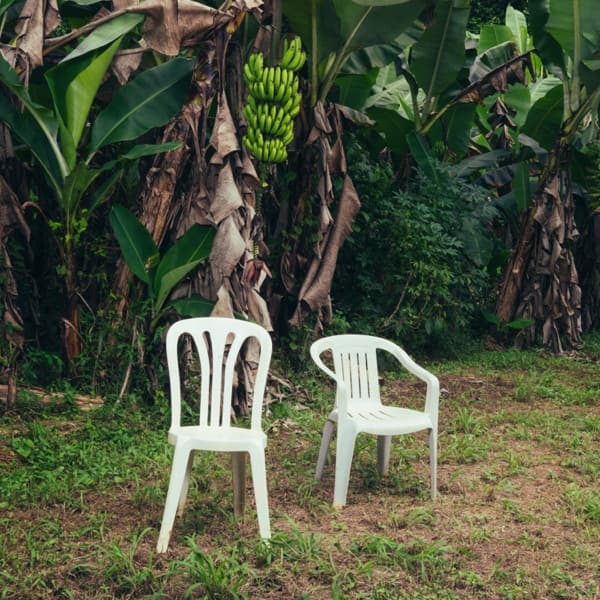



The cover of Debí Tirar Más Fotos presents one of the most deliberately understated images in recent album art history. Two mismatched white plastic chairs sit in what appears to be someone's backyard, bordered by banana trees and tropical foliage. The photograph feels intentionally ordinary, captured in soft natural light with no stylistic flourishes or digital enhancement.
The concept emerged from Bad Bunny's desire to create his most personal and Puerto Rican album to date. The artist explained that the title itself reflects his evolution from someone who initially hated taking photos to understanding their power in preserving memories. The cover serves as a visual manifestation of this philosophy, asking viewers to pause and consider what deserves to be remembered.
While specific photographer and designer credits were not revealed in available sources, the image's execution demonstrates careful attention to composition and cultural symbolism. The chairs are positioned at slightly different angles, suggesting they've been used for actual conversations rather than posed for aesthetic effect. The background vegetation creates natural framing without overwhelming the central subjects.
The setting appears to be an authentic Puerto Rican residential space, complete with the kind of plantain trees found in countless island backyards. This wasn't a studio creation but rather a documentation of lived experience. The lighting suggests either early morning or late afternoon, times traditionally associated with family gatherings and community conversations in Caribbean culture.
No known designer or art director has been publicly credited for the cover's creation. The absence of elaborate production credits aligns with the image's emphasis on authenticity over commercial polish. The photograph's straightforward presentation suggests either Bad Bunny himself or a close collaborator captured this moment.
The album's release on January 5, 2025, was met with immediate critical acclaim and commercial success. Critics praised both the music and visual presentation as Bad Bunny's most cohesive artistic statement. The cover became a talking point for its rejection of typical reggaeton imagery in favor of intimate domesticity.
Musically, the album won Album of the Year at both the Grammy Awards and Latin Grammy Awards, making it the first Spanish-language album to achieve this distinction. The cover's understated approach perfectly complemented the album's exploration of traditional Puerto Rican musical styles like bomba, plena, and salsa.
Visually, the composition employs a centered, symmetrical arrangement that draws immediate focus to the chairs. The color palette consists primarily of natural greens and whites, creating a calming, nostalgic atmosphere. The absence of text or graphic elements on the front cover allows the photograph to speak entirely for itself.
The typography treatment maintains this minimalist approach. The album title appears in a simple, clean typeface that doesn't compete with the photographic imagery. The back cover features a small sticker of a coquí, a frog native to Puerto Rico, further emphasizing the album's cultural specificity.
Culturally, the cover has been interpreted as both a celebration of Puerto Rican identity and a subtle form of protest against gentrification. Critics noted how the plastic chairs represent fixtures of immigrant and Caribbean households, symbols of community gathering that risk disappearing as neighborhoods change. The image functions as a quiet archive of cultural memory.
The cover's influence extends beyond music into broader conversations about representation in visual culture. By elevating everyday objects to album cover status, Bad Bunny challenged conventional notions of what constitutes compelling imagery. The photograph became widely shared on social media as fans recognized their own family experiences reflected in the simple scene.
The album's promotional campaign cleverly incorporated the cover's themes, with coordinates replacing song titles on Spotify, leading fans to discover track names hidden throughout actual Puerto Rican locations. This geographic treasure hunt reinforced the connection between the music, the imagery, and the island itself.
Perhaps the most remarkable aspect of this cover is its confidence in simplicity. In an era of maximalist visual design and digital manipulation, two plastic chairs in a backyard became one of 2025's most discussed and meaningful album covers, proving that authentic emotion often requires no embellishment beyond honest observation.