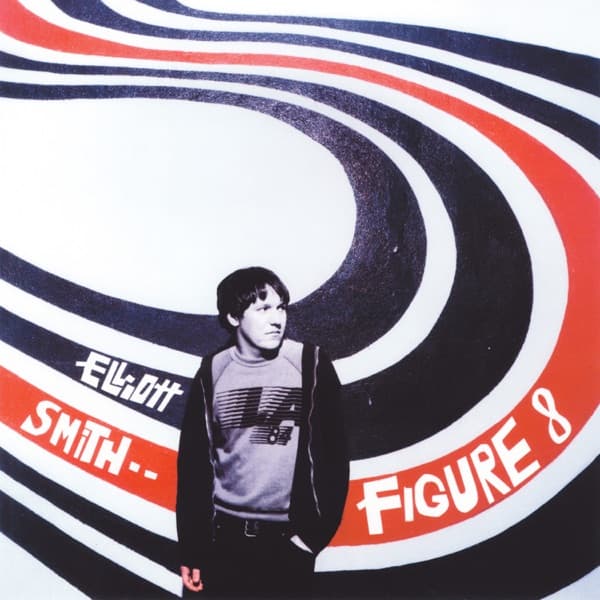


The first thing your eye does is spin. Concentric bands of black, red, and white curl outward from a dark vortex, an optical whirlpool painted across a wall, and only after the swirl releases you do you notice the small human figure standing at the center of it. Elliott Smith is planted there in a gray patterned sweater and dark jacket, hands tucked away, chin turned slightly, looking off to the side rather than at you. He is dwarfed by the design behind him, a lone person against a hypnotic tide.
That wall is real, and it sits at 4334 Sunset Boulevard in the Silver Lake neighborhood of Los Angeles, just east of where Sunset meets Fountain Avenue, on the front of a shop called Solutions Audio Video Repair. It was not built as a set. It was a mural that photographer Autumn de Wilde had known her whole life, because she grew up in that Sunset Boulevard neighborhood, and the swirling wall was a local landmark she had fixated on since childhood. She once called it the ugliest mural she'd ever seen, and eventually the most beautiful.
De Wilde shot the photograph and also handled the art direction, sharing design credit with Dale Smith. She had been taking Polaroids of the murals along Sunset, working out a concept built around them, and drew inspiration from a photograph of Nick Drake leaning against a brick wall. You can feel that lineage in the finished frame: a solitary songwriter set flat against a wall, letting the surface behind him do the talking while he simply exists in front of it, unglamorous and still.
The hand-lettered typography leans into the mural rather than fighting it. The name reads in white brushy capitals stacked at left, ELLIOTT over SMITH with two trailing dashes, riding along one of the pale bands. Down in the lower right, FIGURE 8 sits large across a red stripe, the numeral 8 doubling neatly as a nod to the endless looping shape of the design itself, two joined circles, a figure that never resolves. The letters look painted on, informal, as if they belong to the wall.
The album carries a quiet backstory in its name. It was first going to be called Place Pigalle, after the square in Paris, before it became Figure 8, a title thought to come from a song. Released on April 18, 2000, through DreamWorks Records, it was Smith's second major-label record, credited in the packaging to SKG Music L.L.C. and DreamWorks. Its songs sit in singer-songwriter and chamber-pop territory, ornate and melancholy, the work that would later be counted among the defining indie records of its decade.
De Wilde was already an established music photographer, someone who would go on to shoot The White Stripes and Beck. Here her instinct was to strip the frame down to one man and one overwhelming pattern, no props, no drama, just Smith's guarded posture against a geometry that seems to be either pulling him in or spitting him out, depending on how long you stare.
What neither Smith nor de Wilde could have known is what the wall would become. Figure 8 turned out to be the last album released in Elliott Smith's lifetime. He died on October 21, 2003. Almost immediately the mural on Sunset Boulevard changed meaning. Fans began covering it with his lyrics and personal messages, and at one point someone stenciled an image of Smith himself onto it, mimicking the very pose he holds on the cover. It became a de facto memorial, repeatedly graffitied over and then restored, a living wall that keeps rewriting itself.
The most elaborate of those restorations came for the ninth anniversary of his death, in October 2012, when a group calling themselves the Punk Rock Marthas rebuilt the mural out of recycled paper. They hand-wrote every line from every one of his songs onto the red section, filled the black with maps and a thousand paper cranes, and covered the white with messages from fans. The swirl you see behind him on the cover had, by then, absorbed the grief of everyone who loved the music.
The wall's story kept moving. In 2017 a portion of it was removed to let a business open inside the building, but the specific stretch of mural that appears on the album cover survived largely intact, the part everyone came to see. The image on the sleeve had become a pilgrimage site, the flat photograph now a place you could actually stand.
Critics have kept circling back to the record too. Pitchfork placed it at number 190 on its list of the 200 greatest albums of the 2000s. Rolling Stone ranked it 42nd among the decade's 100 best, calling it Smith's haunted high-water mark. The Guardian put it 86th on its 100 best albums of the 21st century. The praise tends to reach for that same word, haunted, and the cover almost predicts it: a small figure fixed in place while the world spirals around him in hard bands of red and black and white.
Look once and it's a young musician on a sidewalk, uncomfortable, half-turned away, letting the wall be louder than he is. Look again, knowing everything that came after, and the frame tightens. That painted whirlpool is still on Sunset Boulevard, still being covered in his words and cleaned off and covered again, and the man standing in the middle of it is looking somewhere the camera never quite catches.