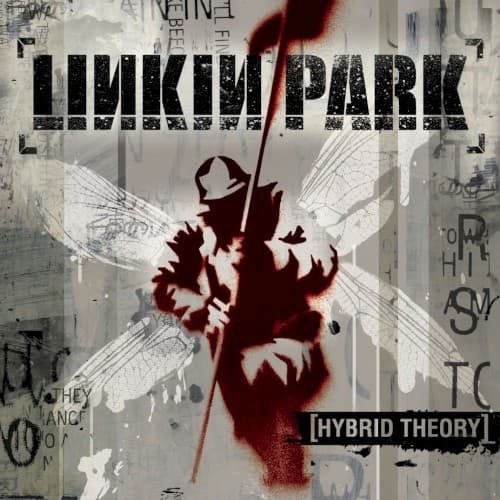

The winged soldier was born from Mike Shinoda's drawing and Frank Maddocks' stenciling technique, creating one of rock's most recognizable album covers. The image perfectly embodied Hybrid Theory's core concept—blending hard and soft musical elements.
The creation began when Linkin Park wanted stencil art for their debut. Maddocks recalls they all became interested in Banksy at the time, seeking "this kind of militant vibe" through stenciling and propaganda-style artwork. The conversations led to the concept of a soldier figure mixed with something softer.
Shinoda, who had worked as a graphic designer before becoming a professional musician, drew the original soldier illustration. Maddocks then hand-cut the soldier stencil and sprayed the image. The dragonfly wings were created separately as a second layer and superimposed digitally.
According to Chester Bennington, the soldier with dragonfly wings represented "the blending of hard and soft musical elements by the use of the jaded looks of the soldier and frail touches of the wings." The visual metaphor captured the band's musical duality perfectly.
Frank Maddocks, VP Creative Services at Warner Records, handled the art direction and design. This was his second major album cover project at Warner Bros., following his work on Deftones' White Pony. His previous Deftones work actually attracted Linkin Park to collaborate with him.
The album photos were shot on July 29, 2000, when the band was in Pittsburgh opening for The Union Underground. Mike and other band members had to borrow some of Frank's clothes for the pre-show photoshoot—a last-minute scramble that became part of the album's creation story.
The cover features scrambled lyrics from the album's songs within the background, with "One Step Closer" lyrics being most prominent. The Linkin Park logo was also executed as a hand-cut stencil, maintaining the street-art aesthetic throughout.
Critical reception focused on the cover's effectiveness in representing the band's sound. The militant imagery combined with delicate wings created visual tension that mirrored the music's aggressive-yet-vulnerable nature. The street-art influence felt authentic rather than manufactured.
The color palette draws from earth tones and muted grays, punctuated by deep crimson splatter effects. This restrained approach set Hybrid Theory apart from the aggressive, saturated aesthetics dominating late-90s rock packaging. The distressed, collage-like background incorporates fragmented typography and industrial elements.
The artwork's typography uses Helvetica Neue Condensed against a dark rectangular strip, ensuring readability while suggesting industrial manufacturing processes. This reinforced the album's meditation on identity in an increasingly mechanized world.
The winged soldier became synonymous with Linkin Park's brand, appearing in various iterations throughout their career and spawning countless fan tattoos. Maddocks notes that of all the bands he's worked with, Linkin Park probably has the most fan tattoos of his artwork.
The cover's influence extended beyond music into broader visual culture. The distressed, collage-based aesthetic anticipated design trends that would dominate the mid-2000s, from fashion graphics to video game interfaces. Contemporary artists working in similar textured styles owe debt to this template.
Interestingly, sometimes a wingless soldier appeared in promotional materials—originally by mistake. Shinoda explained that because the wings were added as a separate layer, Maddocks occasionally used just the soldier image without the wings, creating an unintentional alternate version.