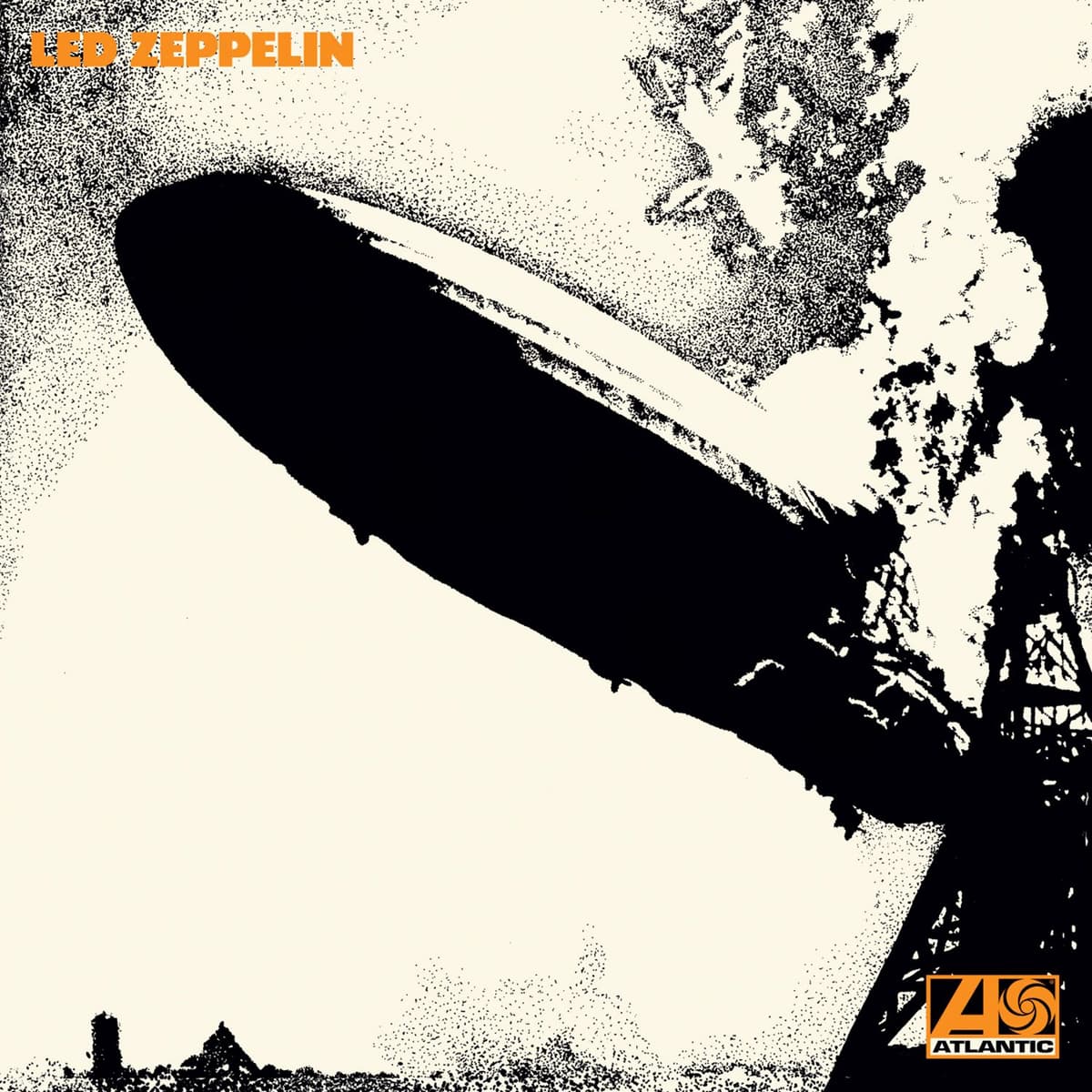
The composition is built on a diagonal. The airship enters from the upper left and drives down toward the lower right, its long dark hull cutting the frame corner to corner so that the eye slides along the descent rather than resting. The nose points at the bottom of the sleeve while the burning tail flares upward and outward, and the tension between that downward plunge and the rising fire gives the picture its sense of a moment mid-collapse.
Colour is stripped to almost nothing: black on a cream, near-white ground. There is no grey wash in the ordinary sense. Instead the tonality is manufactured entirely from stippling, dots crowded together into deep black at the hull and scattered thin at the edges of the smoke, so that shadow and vapour are made of the same marks at different densities. The effect is a grainy, low-resolution look, as if a press photograph had been blown up until its halftone screen showed. That graininess reads as documentary, like evidence, which is exactly why the drama lands as real catastrophe rather than illustration.
Cropping tightens the tension. The airship is pushed hard into the top of the frame and the flames bleed off the right edge, so the fire feels larger than the picture can contain. Below and to the left, huge areas of empty cream act as negative space, isolating the wreck and letting the smoke read against nothing. Along the bottom a faint silhouette of a mooring structure and small ground shapes anchors the scene to the earth the airship is falling toward, an easily missed detail that supplies scale: the burning form is enormous.
The rendering transforms the source into something almost cartoon-like and monochrome, a photograph flattened into pure graphic shape. Detail survives only where the dots cluster; everything else dissolves. This is what turns a specific historical horror into an emblem, a symbol that can carry meaning beyond the event it records.
Typography is deliberately understated. The band name sits top left in simple block lettering, and the Atlantic label mark tucks into the lower right corner. Nothing competes with the image; the restraint hands the entire frame to the burning shape. On later pressings the lettering runs in orange, and that warm accent both echoes the implied heat of the fire and sharpens the contrast against the monochrome field, the only chromatic note on the sleeve.
Read as a whole, the picture works because it fuses opposites: a real tragedy and a graphic joke, documentary grain and poster-like flatness, downward catastrophe and upward flame. In a retrospective assessment Rolling Stone described it as the Hindenburg going down in flames in all its phallic glory, arguing the image bundles together the music's sex, catastrophe and swagger. The airship's long dark hull, the eruption of fire, the plunge, all of it gives the eye a single unmistakable event and lets it stand in for the noise inside. The blankness around it is not emptiness but confidence: the design trusts one shape to say everything.