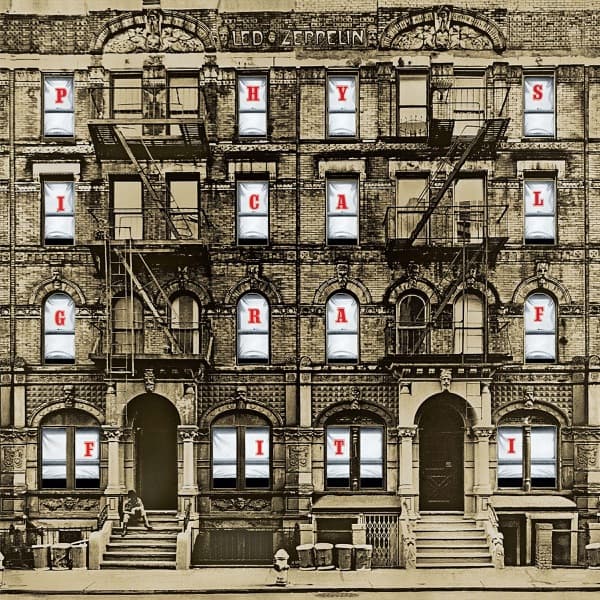

Look at the building and your eye climbs it floor by floor, reading the windows like a vertical crossword: P-H-Y-S, then I-C-A-L, then G-R-A-F, then F-I-T-I, the red block letters glowing white against the warm brick. That is the trick of Physical Graffiti. The windows are not just windows. On the finished sleeve they were die-cut holes, and sliding the inner sleeves behind them changed what you saw, with one specific alignment spelling out the title across the facade.
The building is real. After being chosen to design the sleeve, Peter Corriston searched New York City for weeks, hunting a symmetrical, unobstructed tenement that could sit comfortably inside a square album frame. He landed on two adjacent five-storey buildings at 96 and 98 St. Mark's Place in the East Village, saying he 'had come up with a concept for the band based on the tenement, people living there, and moving in and out.'
There was a problem of geometry. Five storeys do not square up neatly, so the fourth floor was simply cropped out, and the cover shows four rows of windows instead of five. Stare at the arched lower windows and the rectangular upper ones and the building reads as honest, but it has been quietly edited, a whole floor vanished to make the math work.
The rest of the image is gorgeously grimy. Cast-iron fire escapes zigzag across the brick in bone-grey diagonals. Two dark doorways anchor the ground floor, flanked by carved stone faces above the arches. Garbage cans cluster at the curb, a fire hydrant squats at the right edge, and on the left a lone figure sits on the stoop, small and easy to miss, exactly the kind of person 'moving in and out' that Corriston built the concept around. The sepia tinting, credited as 'Tinting Extraordinaire' to Maurice Tate, gives the whole frontage a sun-baked, nicotine warmth.
Behind those cut-out windows lived a gallery of American ephemera. Slide the sleeves and you'd glimpse W. C. Fields, Buzz Aldrin, Lee Harvey Oswald, Marcel Duchamp and Pope Leo XIII, the window illustrations done by Dave Heffernan. The photo the final image was based on was shot by Elliott Erwitt, with cover photography also credited to B. P. Fallon and Roy Harper, the package concept coming from AGI/Mike Doud in London and Corriston in New York. The interchangeable-window idea was heavily influenced by the design of José Feliciano's 1973 album Compartments, which had let inner sleeves peek through cut-outs the same way.
That ambition cost time. The elaborate die-cut construction proved hard to manufacture, and the holdup pushed the release to 24 February 1975 in the US and 28 February in the UK. It arrived as Led Zeppelin's first album on their own Swan Song label, distributed by Atlantic, a double set sprawling across hard rock, progressive rock, rock 'n' roll and folk, the sleeve's many-windowed facade a fitting front for music that refused to stay in one room.
The design earned a 1976 Grammy nomination for Best Album Package, and Corriston, nominated five times, would later win that award for the Rolling Stones' Tattoo You. His Physical Graffiti work now sits in the Museum of Modern Art and the Library of Congress, MoMA crediting him with Mike Doud. The buildings kept their own afterlife: a basement used-clothing shop on the block was actually called Physical Graffiti, a name later echoed by a tea shop, Physical Graffitea, and in 1981 the Rolling Stones returned to 96-98 St. Mark's Place for the 'Waiting on a Friend' video, Jagger and Richards meeting on those same steps where Zeppelin's lone figure once sat.