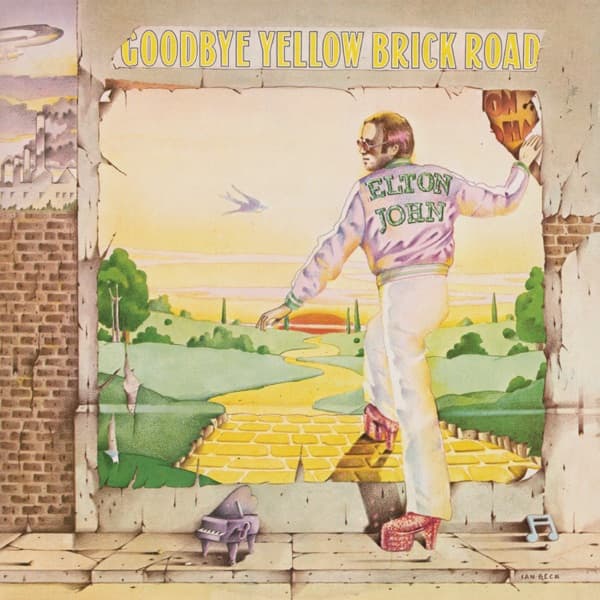
The cover is built on one exact tension: the grey paving stones where we stand, and the watercolor wonderland just beyond the tear. Beck stages the figure precisely on that seam, so the eye enters at the ruby boot on the stone, climbs the long body, and is pulled forward with the man through the rip into the picture. The pose does the argument for him. He is not looking at the dream; he is stepping into it, and his hand against the peeling paper reads as both steadying and pushing through.
Behind the tear waits a soft, sun-bleached landscape: rolling green hills, slender cypress trees, a swallow caught mid-flight, and a red sun melting low on the horizon. The yellow brick road winds toward that sun, a clear nod to The Wizard of Oz, and it functions as the composition's spine, a diagonal that leads the eye out of our world and into the vanishing point. The color logic reinforces the split. The reality of wall and paving is drab and hard; the world through the rip is hazy, warm, and gently unreal.
To the left, beyond the wall, a colder reality intrudes. Factory chimneys and a strange flying saucer hover over an industrial skyline, a grey counterweight that keeps the sunset from tipping into pure sweetness. The picture is escapism, but it knows what it is escaping from.
The typography crowns the whole thing. Across the top, in chunky letters, GOODBYE YELLOW BRICK ROAD glows yellow with a thin outline, printed on its own strip of pasted paper that mimics the torn-poster collage beneath it. The lettering looks pulled from a film marquee, fitting for a cover so deeply about make-believe and movie escapism.
Down at the figure's feet sit two small surreal touches that reward a second look: a tiny lilac grand piano resting on the stones, and a pale blue musical note floating beside the wall like a sticker. They are the only clues that this dreamer is a musician, planted quietly rather than shouted.
The surface itself tells you how it was made. Beck worked it up the slow way, beginning with pencil sketches and gradually layering color over them, coaxing the scene into its hazy warmth. That hand-drawn softness is what makes the sunset feel like a memory rather than a photograph. His signature, IAN BECK, sits tucked into the lower right-hand corner, the maker's small foothold on the stone side of the divide. Read whole, the image is a picture about entering a picture: the star, mid-stride, leaving the ordinary world for the technicolor one his music promises.