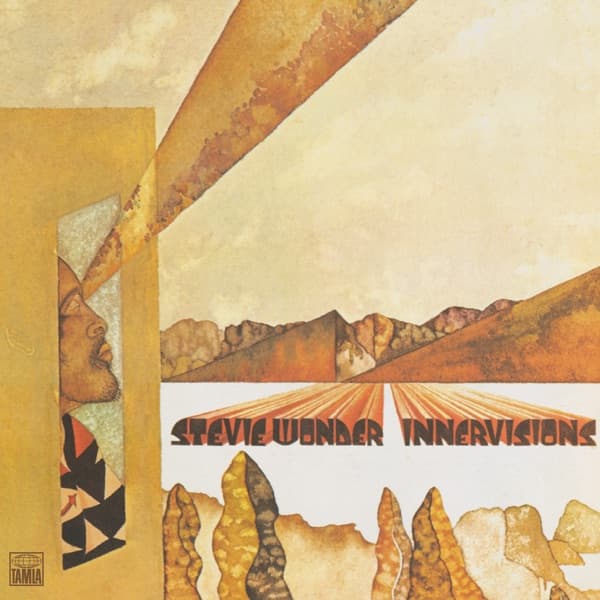
The cover of Innervisions begins with a visual contradiction: Stevie Wonder's eyes are closed, yet a beam rises from them into the sky. That image is not a trick of portrait lighting or multiple-exposure photography. It is part of an illustration by Efram Wolff.
Wonder appears within a window-like opening, his head angled upward. Around and below him, Wolff builds a stylized landscape from warm, simplified forms. Cream, ochre, gold, tan and brown replace the black void described on BTC's old page. The scene feels less like a portrait studio than a constructed inner world.
The Detroit Historical Society's physical-object record is especially useful because it describes the 1973 jacket itself. It identifies Wolff's artwork and the literal structure of the front: a man with closed eyes looking upward from a window, an earth-toned landscape and a beam extending upward from his eyes. MusicBrainz independently credits Efram Wolff for illustration.
That evidence changes the entire production story. BTC previously said an unidentified photographer used multiple exposures and careful lighting to make Wonder's face materialize from darkness. There is no need to invent an anonymous front-cover photographer or a studio-photo technique: the canonical medium is illustration.
The beam naturally invites readings about sight, insight and perception. Wonder's eyes are closed, but the picture gives him an impossible line of vision. That makes Innervisions unusually literal as a title. Still, visible fact and interpretation should remain separate. The closed eyes, upward beam, stylized landscape and illustrated medium are documented or directly observable. Ideas such as divine inspiration, spiritual awakening or one fixed theological meaning should not be presented as creator intent without first-person testimony from Wolff or Wonder.
The gatefold package also contains additional imagery and lyrics, but those interior elements should stay distinct from the canonical front rather than being folded into its description.