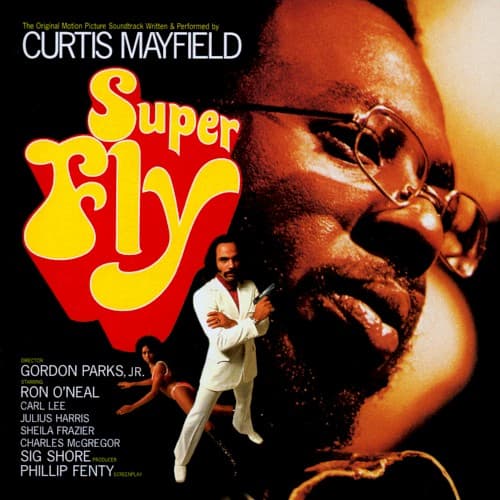

The Superfly album cover emerged from the intersection of two revolutionary cultural movements: blaxploitation cinema and socially conscious soul music. Curtis Mayfield's soundtrack to Gordon Parks Jr.'s film demanded artwork that could match both the movie's raw street energy and the music's sophisticated social commentary.
The cover concept grew directly from the film's aesthetic, with the artwork needing to appeal to both movie audiences and record buyers. The design team at Curtom Records understood that this wasn't just another soundtrack—it was a cultural statement that needed to work in record stores, movie theater lobbies, and on radio station walls.
The final cover features a stark, high-contrast photographic treatment that emphasizes the urban landscape central to both the film and Mayfield's musical vision. The imagery captures the duality of the superfly lifestyle—glamorous yet dangerous, stylish yet tragic.
The typography choices reinforced the cover's street credibility while maintaining the sophistication associated with Mayfield's artistry. The lettering style borrowed from both movie poster design and contemporary album art trends, creating a hybrid aesthetic that felt both cinematic and musical.
While the specific designer and photographer credits remain unclear in available documentation, the cover clearly emerged from the collaborative creative environment at Mayfield's Curtom Records. The label was known for maintaining tight creative control over its visual presentation, ensuring consistency with Mayfield's artistic vision.
The cover's release coincided with the film's premiere, creating a multimedia marketing moment that was still relatively rare in 1972. Record stores and movie theaters cross-promoted both products, with the album cover serving as a bridge between the two mediums.
Critical reception of the cover was overwhelmingly positive, with music journalists praising how perfectly it captured the essence of both the film and the music. The artwork became as recognizable as Mayfield's iconic falsetto, helping to establish visual standards for future soundtrack releases.
The Superfly cover's influence on subsequent blaxploitation and urban-themed album artwork cannot be overstated. Its aesthetic choices—the stark photography, bold typography, and street-level perspective—became templates for countless soul, funk, and early hip-hop releases throughout the 1970s and beyond.
The cover's cultural impact extended far beyond music, influencing fashion photography, movie poster design, and urban lifestyle magazines. Its visual language helped define how American inner-city culture would be represented in mainstream media for decades to come.
Modern reissues and tribute albums continue to reference the Superfly cover's distinctive visual approach, proving its lasting influence on album art design. The cover remains a masterclass in how soundtrack artwork can transcend its original purpose to become a standalone cultural artifact.
Perhaps most remarkably, the Superfly cover achieved something rare in album art: it became as essential to the cultural legacy of the music as the songs themselves, with many fans unable to hear Mayfield's classics without visualizing this iconic imagery.