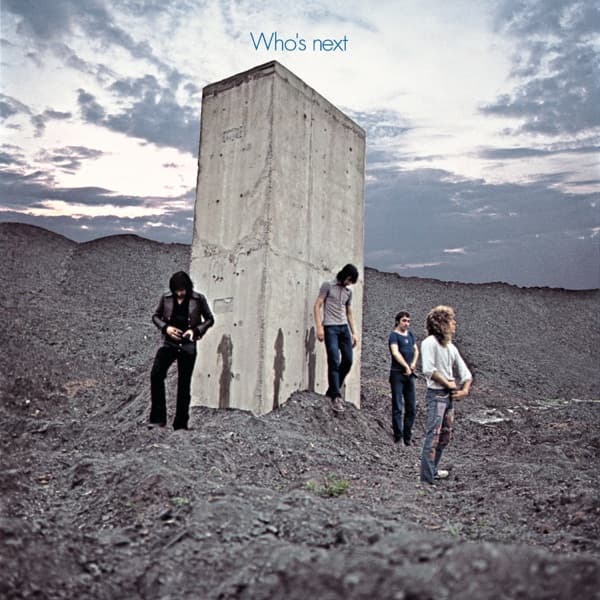

A weathered concrete pillar, stained and pocked, thrusts up out of a wasteland of black coal dross like a tombstone for something enormous. Around it, dwarfed, stand four young men in a grey-blue dusk, and the whole scene reads less like a rock photo than a moment of confrontation, small animals meeting something they cannot explain.
That was exactly the point. On 15 May 1971, driving back to London after a University of Liverpool show, photographer Ethan Russell spotted this coal slag heap near Sheffield, dotted with concrete monoliths that had been placed to stop the dross from shifting. The American Russell looked at the black expanse and thought it 'looked like the surface of the moon.' His mind went straight to the opening of Stanley Kubrick's 2001: A Space Odyssey, the scene where apes and, later, humans encounter a smooth black monolith and recoil in awe and fear.
So he directed the band to behave like those creatures. Look closely and the choreography holds up. On the far left, a figure in dark clothes and flared trousers hunches over the base of the pillar, fussing with his trousers, back half-turned. Beside the slab, a second man in a pale shirt steps down off the heap, mid-motion, as if backing away. Further right, two more stand loosely together, one glancing up and sideways with a wary tilt of the head. Nobody looks directly at the camera.
Then there is the detail that made the cover notorious. The men appear to have just urinated against the pillar, a smear of dark wet running down the pale concrete. The truth was almost entirely staged. As Russell told it, 'Nobody peed. We just filled some empty 35mm film canisters with water and poured it on the cement.' Only Pete Townshend was actually able to go. The rest of the band simply did not need to, so the trickle of 'urine' streaking the monolith was mostly rainwater dribbled from empty canisters, a small piece of theatrical fakery hiding in plain sight.
The composition earns its strangeness from the emptiness. The slag heap fills the lower half of the frame in undulating black-brown ridges, textured and lifeless, the foreground crumbling right up to the edge of the picture. Above, a wide sky opens in soft violet and grey clouds catching the last cool light, so the pillar bridges two worlds, the dead ground below and the fading heavens above. The men are pushed to the middle band of the image, tiny against both, which is what gives the scene its 2001 charge, human scale humbled by something monolithic.
Across the top, in small clean blue letters against the cloud, sit the two words 'Who's next.' No band logo dominating, no faces filling the sleeve. The typography is almost shy, letting the wasteland and the slab do the talking. It is a curiously restrained frame for a hard rock record by The Who, and that restraint is part of why it lands.
The monolith concept was a rescue as much as an inspiration. Before settling on this image, the band had chewed through and rejected other ideas, including nude women and one involving Keith Moon dressed as a whip-wielding dominatrix in lingerie and a wig. Against those, four men and a concrete pillar on a coal heap looks like the sober, weird, exactly-right choice. The back cover kept the documentary energy going, using a shot Russell had taken the day before, on 14 May 1971 at the University of Liverpool, of the band pretending to destroy their dressing room.
Where all this happened stayed a mystery for decades. The location was widely misreported as being near Easington, and only recently was it pinned down to Temple Normanton near Chesterfield. The site is now private farmland, and only the top of the pillar still pokes above the ground, the rest of that lunar wasteland long since reclaimed.
Who's Next came out on 2 August 1971, released by Track Records in the UK and Decca Records in the US. The image on its sleeve has outlived the slag heap that made it. Rolling Stone placed the album 28th on its 500 Greatest Albums of All Time in 2003, held it there in 2012, and still had it at 77th on the 2020 revision, a durability the cover mirrors.
That durability comes down to a single well-directed idea captured on one drive home. Russell saw the moon in a pile of coal waste, remembered Kubrick, and turned a stop-off into a tableau about awe, scale, and human smallness, then undercut the grandeur with a joke only he and the band were in on. The eye lands first on the slab, then on the wet stain, then on the four figures who look, from this distance, like early hominids meeting the future. A monolith, a wasteland, and a bladder gag: the whole thing is funnier and stranger the longer you look.