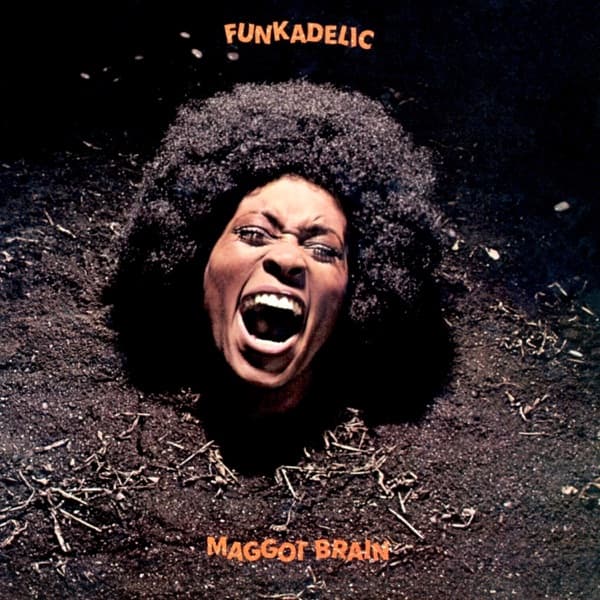

Joel Brodsky photographed the cover of Funkadelic's 1971 album in his New York studio, producing one of the most haunting images in rock history: a woman buried up to her neck in what appears to be earth or dirt, her face contorted in a scream that could express terror, ecstasy, rage, or transcendence. The model was Barbara Cheeseborough, a friend of the band, and the photograph was Brodsky's attempt to visualize the album's central metaphor: the maggot brain, a consciousness trapped between decomposition and illumination, between the body's mortality and the mind's capacity for transcendence.
Brodsky, who had previously shot iconic portraits of Jim Morrison and other rock figures, created the illusion of burial using a studio setup that concealed Cheeseborough's body below a constructed ground surface while keeping her head exposed and free to move. The earth or material surrounding her face is dark and granular, reading convincingly as soil in the photograph's dramatic lighting. Her hair fans out around her head like roots or tentacles, organic forms that blur the boundary between the human body and the ground that surrounds it.
The composition is radically simple: a single face, centered in the frame, emerging from a field of darkness. The negative space around Cheeseborough's head is a uniform, near-black expanse that could represent earth, night, the void of deep space, or the interior of a consciousness turned inward. This simplicity gives the image its power; there is nothing to look at except the face, and the face is expressing something that resists verbal description. Is she being swallowed or being born? Drowning or rising? The image holds both possibilities simultaneously.
The lighting strikes Cheeseborough's face from a single source positioned above and to one side, creating deep shadows in her eye sockets and under her cheekbones that make the face appear gaunt and skull-like. The highlights on her forehead and the bridge of her nose are blown out to near-white, creating a tonal extreme that, combined with the deep shadows, gives the face a spectral quality. The lighting is deliberately harsh, refusing the soft, flattering illumination of portrait photography in favor of a stark, interrogative brightness that reveals rather than beautifies.
The color palette of the original pressing ranges from warm sepia to near-monochrome, depending on the print run, but all versions maintain the essential binary of dark ground and lit face. Some editions carry a faintly greenish or amber tint that enhances the earth-and-decay atmosphere, while others are printed in pure black and white that maximizes the image's graphic impact. The restricted palette focuses attention entirely on texture and expression, eliminating the distraction of color and leaving only the raw confrontation between face and void.
Cheeseborough's expression is the image's enigma. Her mouth is open, her brow furrowed, her eyes intense with an emotion that shifts depending on the viewer's state of mind. After listening to the album's title track, a ten-minute guitar solo by Eddie Hazel that George Clinton instructed him to play as if he had learned his mother had died and then learned she was alive, the face reads as the sound made visible: a journey through grief to joy so extreme that the two emotions become indistinguishable.
The typography is minimal, with the band name and album title rendered in a font that does not compete with the photograph's raw emotional power. The text sits at the top of the sleeve, above the dark field, maintaining the image's compositional simplicity and allowing the face to dominate the visual experience.
Maggot Brain's cover occupies a unique position in album art history, belonging neither to the psychedelic tradition of elaborate fantasy illustration nor to the documentary tradition of band photography. It is closer to avant-garde portraiture, a single image that communicates a state of consciousness rather than a narrative or an identity. Its influence can be traced through the horror-inflected imagery of industrial and metal music, the confrontational portraiture of contemporary art photography, and anywhere that an artist has understood that the most powerful image is sometimes the simplest: a face, a scream, and the darkness that surrounds them both.