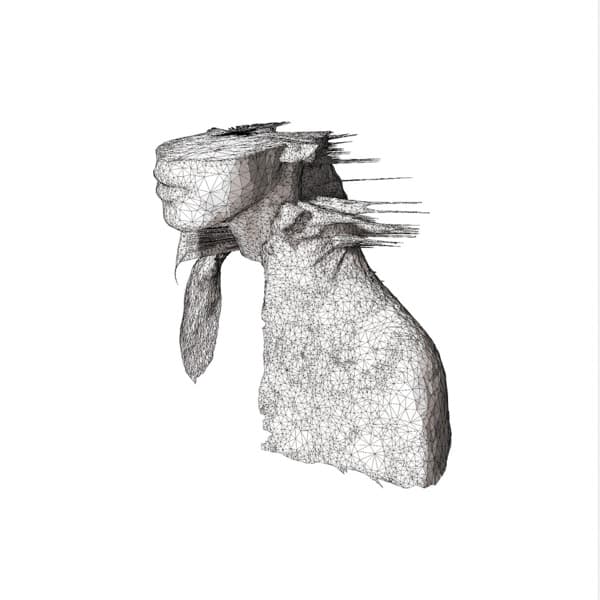

A rush to create something unprecedented led to one of the most distinctive album covers of the 2000s. Sølve Sundsbø, working for fashion magazine Dazed & Confused in the late 1990s, was commissioned to produce something "with a technological feel, something all white." The Norwegian photographer wanted to push boundaries and do "stuff that hasn't been done before," so he suggested using a three-dimensional scanning machine originally designed to measure head sizes for USAF fighter jet helmets.
The shoot was an exercise in controlled chaos. The model, named Mim, wore all-white cosmetic makeup to produce optimal scanning results and donned a colored twill cape. But the 3D scanner couldn't properly identify some colors on the cape, replacing them with digital spikes. The machine also had technical limitations—it could only scan about thirty centimeters in height at a time, which meant the head in the image was chopped off mid-skull.
Sundsbø initially had mixed feelings about the resulting image. "I thought it was so beautiful, but I was sure the magazine was never going to run it," he later recalled. He was terrified by what he'd created—a ghostly, incomplete figure with spike-like protrusions emerging from the neck and hair against a stark white background. The digital artifacts weren't bugs; they became features.
The editor at Dazed & Confused, however, absolutely loved the image and featured it in one of their publications. This single decision would change the course of Coldplay's visual identity forever. Chris Martin spotted the image in the magazine and immediately knew he wanted it for the band's second album cover.
Martin approached Sundsbø directly for permission to use the image as the cover for A Rush of Blood to the Head. The photographer agreed, and when Martin asked for ideas about the album's singles artwork, Sundsbø suggested scanning the head of each band member using the same technique—creating a visual consistency across the entire campaign.
The timing couldn't have been more perfect. Coldplay was emerging from the massive success of Parachutes and "Yellow," needing to prove they weren't one-hit wonders. The album, recorded between September 2001 and May 2002, featured a darker, more urgent sound than their debut. The fragmented, technological aesthetic of Sundsbø's cover perfectly matched the album's themes of urgency and fragmentation.
Critically, the cover was embraced as a bold departure from typical rock album artwork. The minimalist composition—featuring only the partial figure against pure white space—stood out dramatically in record stores. Music critics described it as larger, darker, and colder than Parachutes, and the cover reinforced this evolution visually.
The album became a massive commercial success, reaching number one in twelve countries and shipping over 2 million copies in its first week worldwide. The British Phonographic Industry certified it 10x Platinum, and it became the eighth best-selling album of the 21st century in the UK. The cover's stark beauty played no small part in the album's immediate visual impact.
Visually, the cover art represents a masterclass in accidental minimalism. The gray and incomplete 3D rendering creates an otherworldly quality that suggests both human vulnerability and technological alienation. The white background eliminates all distractions, focusing attention on the mysterious figure. The digital spikes add an element of danger or transformation—perfectly embodying the album's title metaphor.
The typography choices were equally deliberate. Most pressings featured minimal text, with some versions being completely textless except for spine information. This restraint allowed the image to speak entirely for itself, a bold move in an era when album covers often competed for attention through visual complexity.
A Rush of Blood to the Head's cover influenced a generation of album artwork, particularly in the alternative and electronic music scenes. Its fusion of organic human forms with digital processing techniques anticipated trends that would dominate visual culture throughout the 2000s and beyond. The cover showed that experimental techniques could create commercially viable art.
The cover's legacy extends beyond music. In 2010, it was among ten classic British album covers commemorated on UK postage stamps issued by the Royal Mail. This official recognition cemented its place in British cultural history, alongside covers by The Beatles, Led Zeppelin, and other iconic acts.
Perhaps most remarkably, the cover emerged from a complete accident of technology and timing—a fashion photographer's experiment with military scanning equipment, spotted by a musician in a magazine, becoming one of the most recognizable images in modern music history.