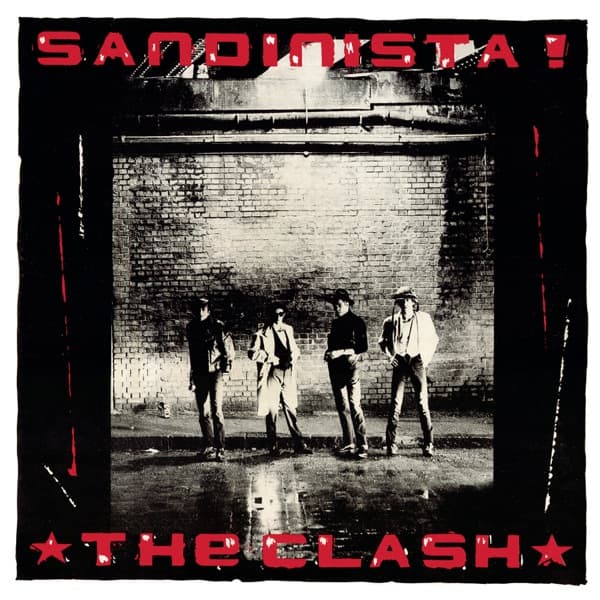
A word smeared across the top in blocky, dripping stencil letters, SANDINISTA!, printed so roughly that the ink seems to bleed down the black border like paint that couldn't dry fast enough. It looks less like a logo than like something sprayed on a wall in a hurry. At the bottom, in the same aggressive red, THE CLASH sits between two five-pointed stars, and a ragged red frame runs around the whole image, brushed and broken at the edges.
Inside that frame is a photograph, and it does almost the opposite of the shouting typography. It is quiet, grey, patient. Four men stand in a wide brick underpass, the arch of it swallowing them in shadow at the top, the wet ground throwing back their reflections at the bottom. The bricks are grimy, the mortar pale, the whole space lit like an overcast afternoon that never brightened. This is the railway underpass behind King's Cross and St Pancras Station in London, and Pennie Smith framed the group dead centre inside it, small against all that masonry.
Smith's camera catches them in a loose row, hands in pockets, weight cocked, none of them performing for the lens. They read as silhouettes as much as portraits: dark jackets, pale trousers on a couple of them, the postures of people caught between takes rather than posing. The tonal range is nearly monochrome, black coats against grey wall, the floor a mirror of standing water. There is nothing staged about the light. It is just the day they happened to be there.
And they happened to be there for a reason. The band had just finished shooting a video for 'The Call Up,' and the moment carries a small, true detail that rewards a close look: Mick Jones is still wearing the helmet from that filming. What could have been a costume prop instead becomes an accident of timing, a man who never took the thing off before the stills camera came out. The photograph is a between-worlds image, one project ending as the sleeve of another begins.
The design was put together by Julian Balme, credited simply as 'Jules,' working alongside the band themselves. Balme, who founded Vegas Design, started with The Clash in 1980 and went on to handle their last two albums plus a stack of singles. His hand is in the tension you feel here: the roughed-up red stencil and broken border versus the calm documentary greyscale of Smith's shot. It is punk framing wrapped around a photograph that refuses to be punk theatre.
The title itself points outward, past the band, past London. Sandinista! arrived on 12 December 1980 on CBS, and everything about it was outsized. It was a triple album, thirty-six tracks, a sprawl that no single style could contain. The music ranged across funk, reggae, jazz, gospel, rockabilly, folk, dub, R&B, calypso, disco and rap, an English rock and punk band throwing open every door at once. The cover's restraint is almost a joke against that maximalism inside: four ordinary-looking men in a tunnel, holding the lid on an explosion.
There was a cost to the ambition, and the band paid it themselves. To put three records out at a low price, they agreed to take a cut in royalties. It is the kind of decision that does not show up in a photograph, yet it hangs over the whole object: a group deliberately making less money so more people could afford the sprawl. The generosity of it sits oddly against the cheap-looking, spray-can crudeness of the lettering, as if the sleeve wanted to look like something you'd find, not something you'd save up for.
Something else shifted with this release. For the first time, the songs were credited not to Joe Strummer and Mick Jones individually but to The Clash as a group. The four figures standing shoulder to shoulder in Smith's frame, evenly spaced, none stepping forward, none the leader, quietly picture that change. It is a band photograph in the truest sense, a collective rather than a front man and a backing crew.
The package went further than the outer sleeve. Folded inside was a six-page insert called 'The Armagideon Times no3,' catalogued FSLN 1, carrying the lyrics and credits along with cartoons by Steve Bell. That FSLN tag is no accident either; the letters echo the Sandinista movement the title salutes, sliding the record's politics right into its catalogue number.
The afterlife of the artwork has its own strange twist. The Museum of Modern Art holds a 1981 lithographic version of the Sandinista! poster and cover, and there it is filed under 'Unidentified Designer,' the credit to Balme and the band lost somewhere between the record shop and the archive. A sleeve made deliberately cheap, its royalties surrendered so it could reach more hands, ends up in a museum with its makers' names erased.
Look back at the image one last time and the whole thing hangs together. The red screams the name of a distant revolution; the grey photograph shows four Londoners standing in a wet tunnel behind a train station, one of them still helmeted from a shoot he hadn't quite left. Between the shouting and the stillness, that is the record: enormous reach, ordinary footing, and a band standing together in the dark, credited at last as one.