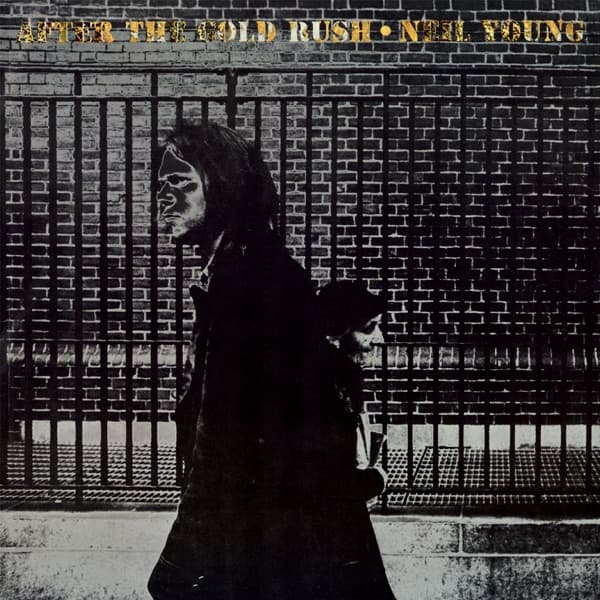
The composition sets two people moving against each other. Neil Young crosses left, coat dark and face lifted toward the lens, while behind and below him a small hooded old woman passes the other way, reduced almost to a shadow you might miss on a first glance. That counter-motion, one figure advancing and one receding, gives the still image its quiet tension: a passing presence rather than a person, a stranger going where he is not.
Behind both figures runs a brick wall broken by a row of black iron bars. The fence reads as a cage, turning an ordinary street corner into something confined, and it organizes the frame into horizontal bands that hem the walkers in. The eye travels first to Young's illuminated face, then down and back to the fainter figure, then along the bars, so the picture keeps sliding the viewer between foreground and shadow.
The defining choice is tonal. The picture has been drained of normal photographic gray and rendered in solarization, the tones partly reversed so edges are outlined in silver and the blacks go liquid. The effect makes Young look almost carved out of the brick, and it makes the iron bars glow rather than recede, so the barrier itself becomes luminous. This is where the image earns the word spooky: the reversed light gives the whole scene an unsettled, charged atmosphere that a straight print would never carry. The reversed tones also flatten depth, pressing the figures into the wall and blurring the line between person and surface.
Typography completes the reading. Across the top edge the words "AFTER THE GOLD RUSH" and "NEIL YOUNG" run in a thin script made to look corroded, flaking, oxidized to the color of rust. It is a deliberate visual pun on the title: gold gone to ruin, the gilded lettering tarnished as if it had weathered on the brick behind it. The type doesn't sit on the image so much as seem to have aged into it, echoing the metallic, oxidized quality the solarization gives the photograph itself.
Read as a whole, the cover binds its meaning to its accident. A young man walks through a city, a fence bars the space around him, an old figure slips past unnoticed, and every surface glows with an unnatural silver light. Gold and rust sit in the same breath: the promise of the title and its decay held in one frame. The softness that started as a flaw becomes mood, and the mood becomes the point.