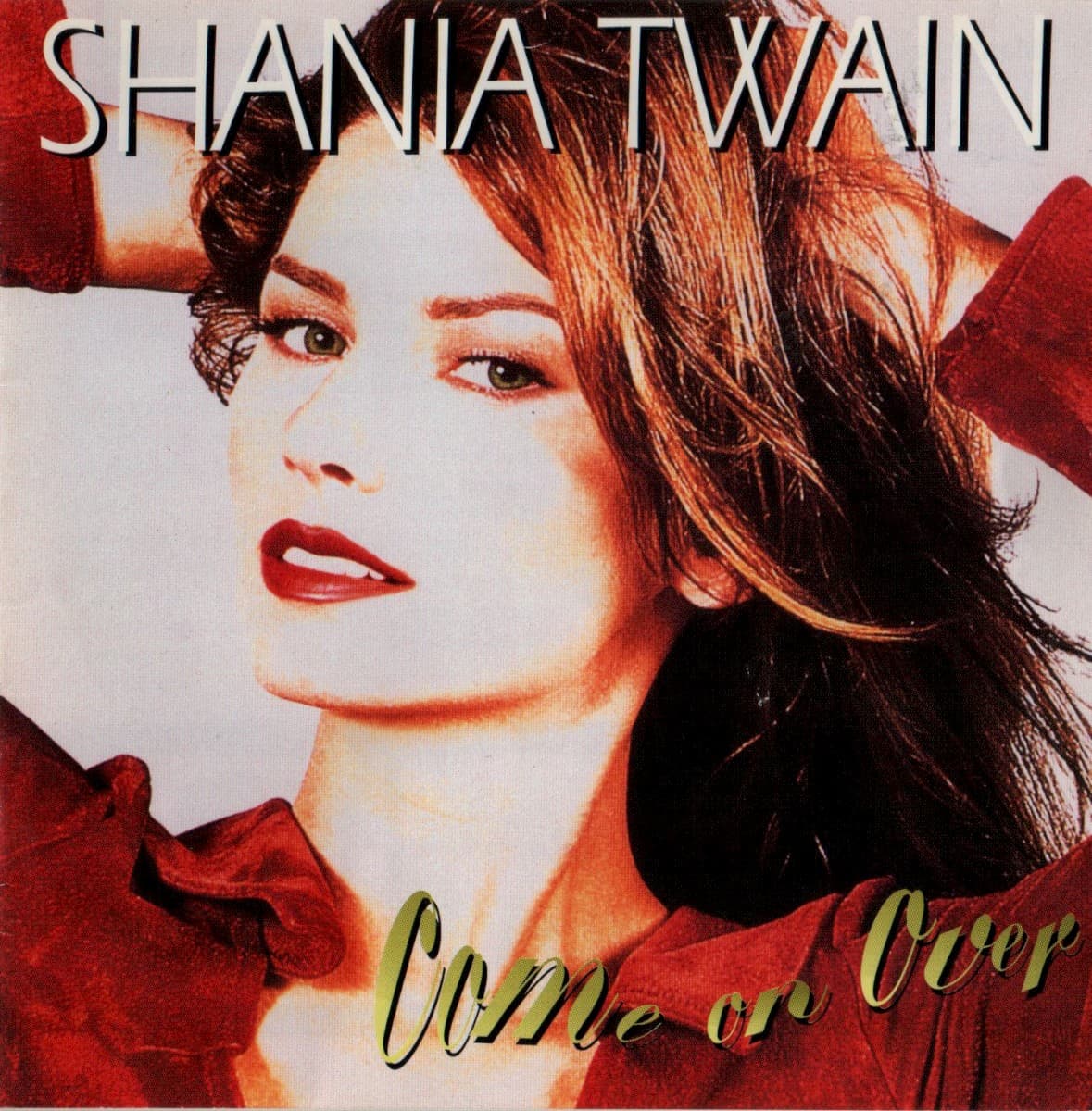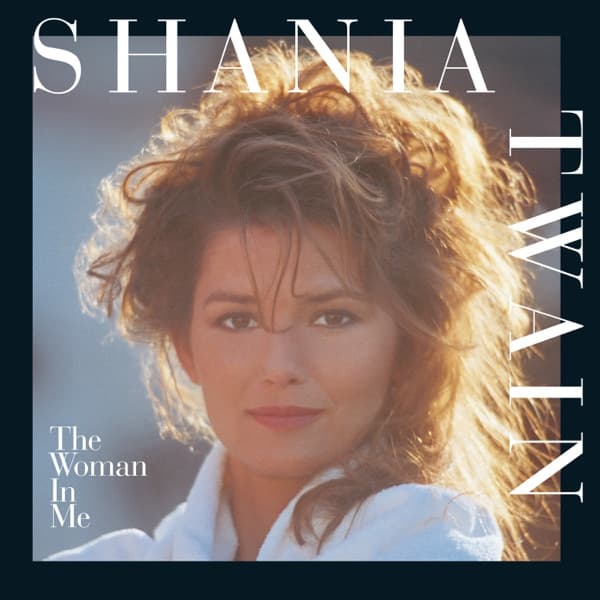


The eyes reach you before anything else does. Shania Twain looks straight into the lens, chin slightly lowered, her expression caught somewhere between a challenge and a smile she has decided not to fully give. There is no set, no props, no scenery to explain her: just a face lit by a low, warm sun and a background that dissolves into pale golden haze. It is a portrait that dares you to look away.
The light is doing the heavy lifting. It rakes in from behind and to the side, catching the loose strands of her wind-tossed brown hair and setting the whole edge of it glowing like filament. Her hair is full and unstyled in a deliberate way, falling around her shoulders as though the shot were grabbed outdoors on a breezy afternoon. She wears something soft and white at the collar, open at the neck, its brightness bounced back up into her jaw and cheekbones. Her skin is warm-toned, her lips a muted rose, and the overall palette runs amber and honey against cool blue shadow.
The typography frames her like a proscenium arch. Her name is set in tall, thin, elegant serif capitals: SHANIA stretched across the top edge, TWAIN running vertically down the right side, both in white that reads as almost architectural against the golden field. Down in the lower left, quieter and smaller, sits the title in a mixed serif, The Woman In Me, tucked politely into the corner so it never competes with her face. The eye lands on her, then rides the light through her hair, then finds the letters.
The hands behind that image belonged to an unexpected pair. Photography for The Woman in Me was credited to John Derek, the actor and film director, with his wife Bo Derek credited as photography assistant. Additional photography came from Mark Tucker. Art direction was shared by Buddy Jackson and Jim Kemp, and the styling was handled by Jill Sokolee, with additional styling by Donna Jones. That the man best known as a Hollywood leading man and filmmaker turned his camera on a rising country singer is one of the small strange facts folded into this cover.
Released on February 7, 1995, this was Shania Twain's second studio album, and the first she made with then-husband Robert John 'Mutt' Lange as producer. It came out on Mercury Records through its Nashville country division under PolyGram, and it arrived as a country and country pop record from a Canadian singer-songwriter who was not yet a household name.
The cover's restraint, one woman, one gaze, no gimmicks, matched an album that ended up doing anything but stay quiet. It became Twain's biggest-selling release to that point, moving 4 million copies by the end of 1995 alone. It kept climbing long after, eventually certified 12 times Platinum by the RIAA, with an estimated 20 million copies sold worldwide. The face on that golden field became one of the most recognizable in the genre.
The singles told the same story of dominance. Eight were pulled from the album, and four of them went all the way to No. 1 on Billboard's country singles chart: 'Any Man of Mine,' '(If You're Not in It for Love) I'm Outta Here!,' 'You Win My Love' and 'No One Needs to Know.' Each hit reinforced the confident, direct energy that the cover portrait had already set in motion.
There is a reason the styling and the light feel so central. With the background emptied out to soft focus, everything the viewer is meant to feel has to come from her, the tilt of the head, the steadiness of the eyes, the way the wind reads as freedom rather than mess. It is a portrait built to communicate personality more than glamour, and it pairs neatly with a title that plants a first-person claim right there in the corner.
The influence outlasted the sales figures. The album is widely credited with helping reshape the sound of contemporary country music, pushing it toward the polished, pop-informed direction that would define much of the decade to follow. In 2006, CMT ranked it number 8 on its list of the 40 Greatest Albums in Country Music, the highest placement by a woman on that list. The picture that fronted it, warm, plainspoken, self-possessed, became the image people attached to that shift.
Decades later, the archive around this photograph got its own second life. A 2020 Diamond Edition reissue arrived with a 48-page booklet featuring liner notes from Twain herself, a 3,000-word essay by pop-culture journalist Eve Barlow, and archival photographs from the album's shoots. The Diamond Edition booklet gathered images from John Derek, Albert Sanchez, Mark Tucker, Bo Derek and Alexander E. Harbaugh, confirming Derek's place among the photographers who built the album's look. The golden portrait, it turned out, was only one frame from a much larger session, and the reissue finally let the rest of them breathe. What began as a single, level gaze into a low sun became the anchor image of one of country music's most consequential records.