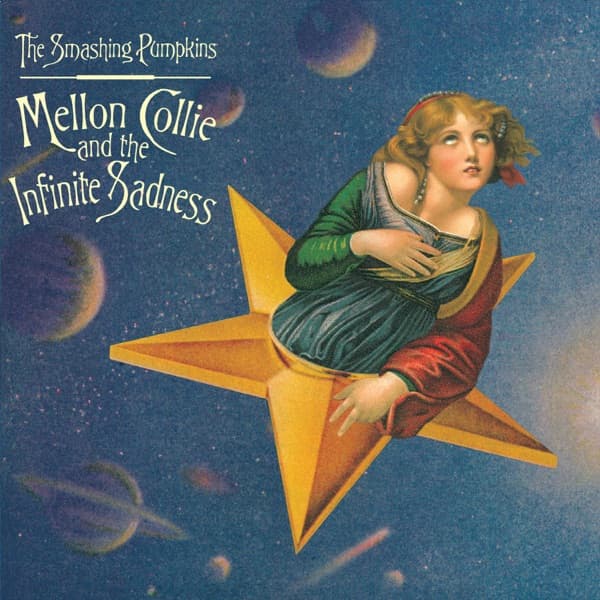


The cover for Mellon Collie and the Infinite Sadness began with Billy Corgan's obsession with turn-of-the-century imagery and his desire to create something that looked like it belonged in a museum rather than a record store. He specifically sought out photographer Yelena Yemchuk, known for her dreamlike portraits and fashion work, to bring his vision of Victorian melancholy to life.
Corgan's concept was deeply personal, reflecting his fascination with the Gilded Age and its intersection of beauty and decay. He wanted the cover to evoke the feeling of discovering an old photograph in an abandoned mansion, something that would make viewers wonder about the story behind the mysterious figures. The title itself came from a combination of words that Corgan felt captured both sweetness and sorrow.
Yemchuk staged the photograph like a Pre-Raphaelite painting, with meticulous attention to period detail. The central figures—a woman in an elaborate dress and a young person in formal attire—were positioned to suggest both intimacy and distance. Every element, from the ornate furniture to the flowing fabrics, was chosen to create an atmosphere of faded grandeur.
The shoot took place in a carefully constructed set that Yemchuk filled with antique props and rich textures. The photographer used natural lighting filtered through gauze to create the soft, ethereal quality that makes the image feel like a memory. The woman's elaborate gown, with its intricate beadwork and flowing train, became the visual centerpiece that draws the viewer's eye across the composition.
Yemchuk, a Ukrainian-born artist who had worked with fashion magazines and avant-garde photographers, brought a European sensibility to the project that perfectly matched Corgan's aesthetic vision. Her background in fine art photography helped elevate the cover beyond typical rock album artwork. The collaboration marked one of her early forays into music industry work that would later include projects with other alternative rock acts.
The band and Virgin Records immediately recognized they had something special—an image that could stand alongside the great album covers in rock history. The cover's theatrical quality perfectly matched the ambitious scope of the double album, which Corgan had conceived as The Smashing Pumpkins' masterwork. Critics and fans responded to the cover's haunting beauty, noting how it prepared listeners for the emotional journey of the music within.
The artwork became instantly iconic, influencing countless alternative and indie rock covers throughout the late 1990s and 2000s. Its success helped establish Yemchuk as a sought-after photographer in the music world, leading to collaborations with artists like Sonic Youth and The White Stripes. The cover's aesthetic also coincided with the broader cultural fascination with vintage imagery that would define much of late-90s visual culture.
The image's impact extended beyond music, appearing in art galleries and photography exhibitions as an example of commercial photography achieving fine art status. Fashion photographers began incorporating similar Victorian and Edwardian elements into their work, creating a mini-revival of period costume photography. The cover proved that album artwork could still be a powerful artistic statement in an era increasingly dominated by digital distribution.
Decades later, the cover remains one of the most recognizable images in alternative rock, frequently cited by designers and photographers as a masterpiece of music packaging. Yemchuk's photograph achieved something rare in commercial photography—it created a world that viewers wanted to enter, a visual poem that matched the epic scope of the music it represented. The fact that it was created by a relatively small team with a clear artistic vision makes it even more remarkable in an industry often dominated by committee decisions.