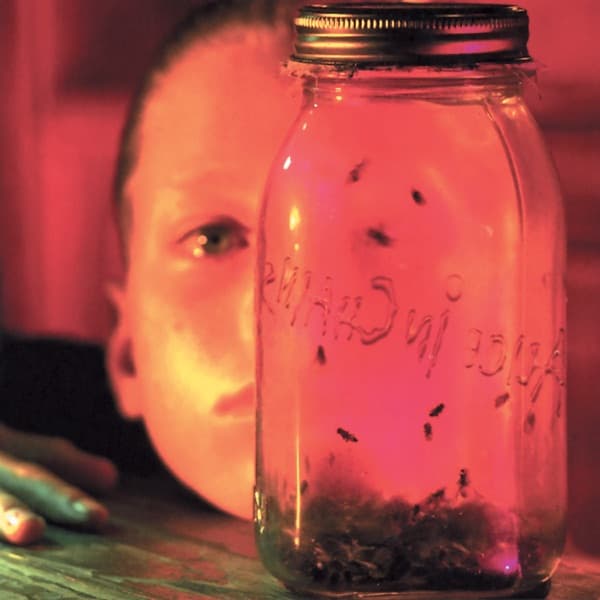
The jar dominates the frame. It is a standard wide-mouth canning jar with a screw-on metal lid, and it catches cold highlights along its ribbed shoulder while the rest of the image burns warm. That single contrast, cool glass against a red-hot room, keeps the eye pinned to the vessel before anything else registers.
Inside, the fluid glows a deep rose, lit from somewhere below or behind so the whole container behaves like a lamp. The light source hidden within the jar is what gives the picture its uncanny warmth; the glow radiates outward and pools on every surface. Floating in that glow are the flies, some drifting mid-liquid, others gathered in a sediment of tiny bodies near the base, so the jar reads at once as light source and as tomb.
The typography is the image's quietest trick. Embossed into the glass, faint and reversed, are the words Alice in Chains, less a logo than a ghost pressed into the surface. Because we read it backwards through the far wall of the jar, it looks like manufacturer's lettering rather than type laid over a photo, dissolving the boundary between design and object. Nothing here announces itself as a sleeve; the branding hides inside the scene.
Behind the jar, the child's head rests almost on the tabletop, cheek nearly to the wood, only half the face visible past the curve of the glass. The red light pools on the skin and hollows the features into something between sleepy and haunted. The cropping is severe: we get one eye and a partial face, which turns a person into another specimen under observation, as trapped by the frame as the flies are by the glass.
The eye finally leads down to the lower left corner, where a small cluster of crayons or colored pencils lies scattered on the grain of the table. That scrap of childhood innocence, set against a jar of dead things, is the whole tension of the image in one detail: a kid's drawing tools beside a container of decay. The composition stages a collision of feeding and neglect, of play and rot, and the warm domestic light makes it more disturbing, not less, because horror here wears the color of a family kitchen.
Read as a whole, the picture works by making the ordinary sinister. A canning jar, a table, a child, crayons: household objects, all of them, arranged so that the child seems less a bystander than the small authority who decides what lives inside the glass. The single red-lit eye becomes the emotional center, curious and complicit at once, and the image holds because it never resolves into either innocence or menace. It keeps both suspended, exactly like the flies.