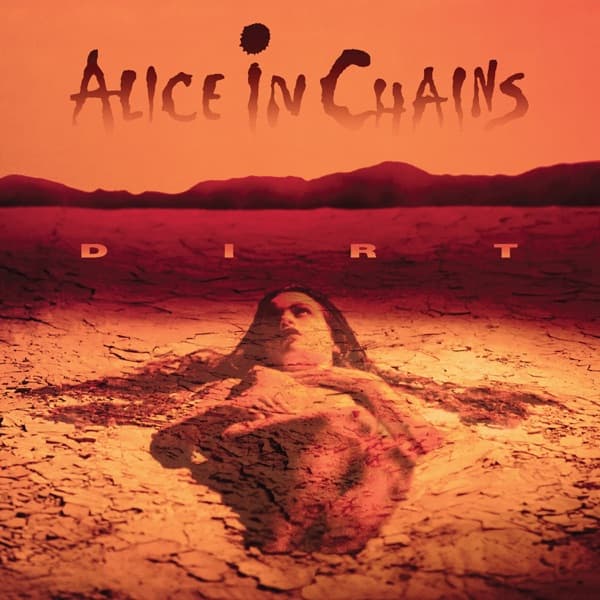


The woman on Alice in Chains' Dirt cover is Mariah O'Brien, not Demri Parrott. Photographer Rocky Schenck built the entire desert around her inside his Hollywood studio.
The familiar 1992 sleeve shows O'Brien partly buried in cracked earth, her dark hair spread around her as the orange-red landscape recedes toward miniature mountains and a painted sky. It looks like an outdoor location, but the scene was constructed specifically for the photograph. Schenck told Revolver that he wanted a hellish atmosphere and that the band's concept was a nude woman half-buried in the desert, with her condition left deliberately ambiguous: she could be dead or alive.
Schenck chose not to shoot in a real desert because he wanted control over the light. In his studio he painted the sky backdrop, constructed miniature mountains, and made the desert floor from foam core and clay. A body-shaped opening in the set allowed O'Brien to lie inside the artificial ground. The resulting image works because the fabrication is convincing enough to feel physical and oppressive rather than theatrical.
The model's identity has generated one of the cover's most persistent myths. Fans often assumed the woman was Demri Parrott, Layne Staley's girlfriend. Schenck directly corrected that story: O'Brien was the model, and although Parrott's name may have come up early, he said she was never a serious choice for the shoot. O'Brien had previously worked with Schenck on Spinal Tap's Bitch School single.
The package credits are also more layered than BTC's old single-credit version suggested. Mary Maurer is credited with art direction, Doug Erb with design, and Rocky Schenck with photography. The visual package also credits David Coleman for the Alice in Chains logo and Layne Staley for the sun logo and icons. Treating Maurer as the sole designer collapses distinct creative roles that the release credits preserve.
After the long cover session, O'Brien climbed out of the set and her wig remained embedded in the fake ground. Schenck photographed the empty scene, and Alice in Chains later used one of those images for the 1999 Music Bank box set. That later reuse makes the constructed set part of the band's broader visual history rather than a one-off photograph.
The real Dirt cover story is not about white space, pharmaceutical graphics, occult symbols or anti-design minimalism. It is about an elaborate studio illusion: a photographer and art team building a hostile landscape from ordinary materials, then placing a human figure inside it so convincingly that decades of viewers read the scene as a real desert.