Frank Zappa did not commission the photograph on Hot Rats. He found it.
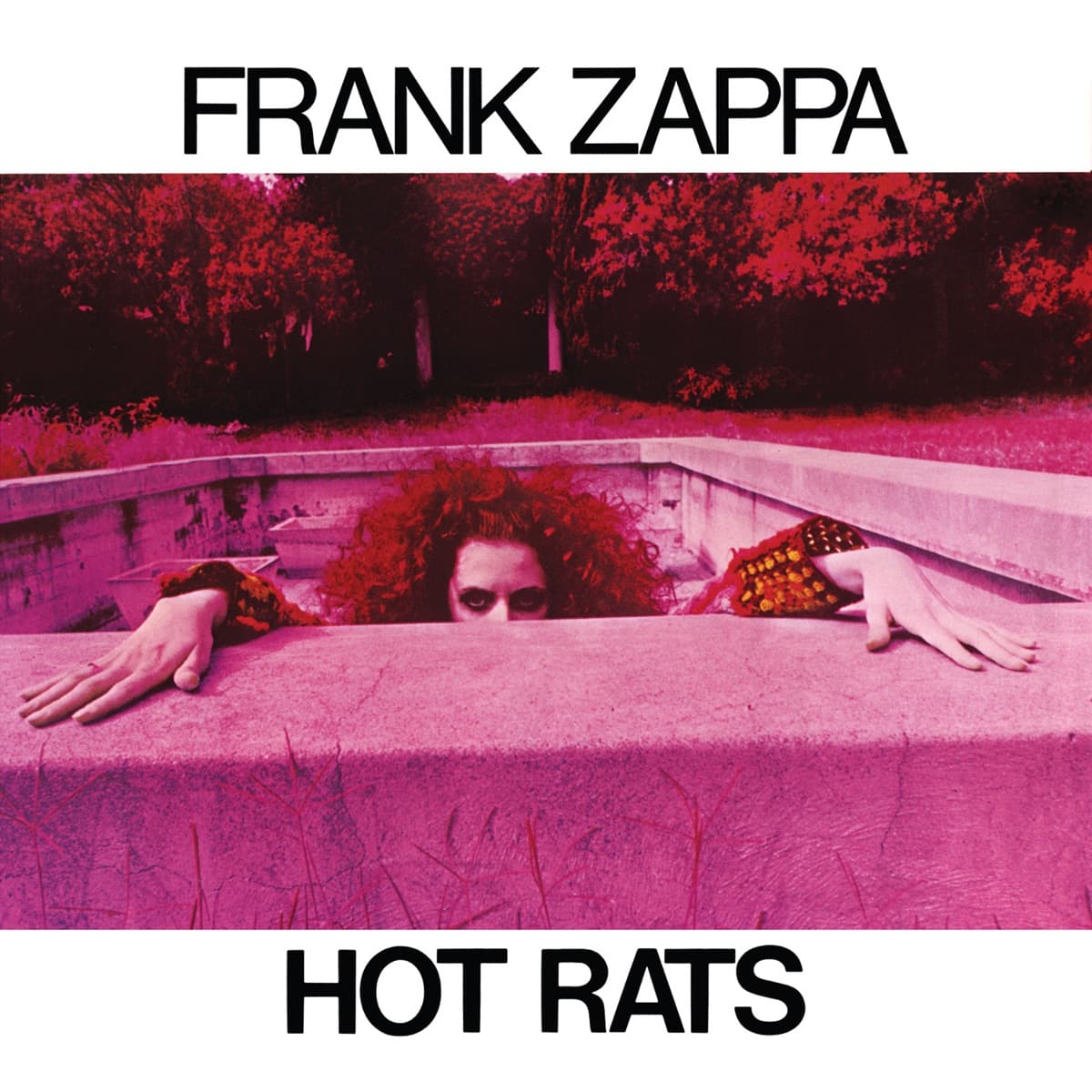
Photographer Andee Nathanson had made the image with Christine Frka—Miss Christine of the GTOs—before Zappa chose it for the album. Nathanson later remembered Frka as quiet and playful and said she wanted the session to combine comedy, nerve and a sense of emerging female power. When Zappa saw the photograph, he wanted to license it.
That origin explains some of the cover's peculiar energy. It does not look as though a musician has been carefully inserted into a concept devised to illustrate an album title. Zappa is nowhere on the front. Instead, Frka rises from a strange recessed space, looking upward through the false-color world of infrared film.
Infrared photography changes familiar surfaces and tones. Cal Schenkel's design pushes the colors further into the uncanny. Frka's face remains human and direct while everything around her feels overheated, alien and slightly comic.
That combination was perfect for Zappa.
Hot Rats arrived in 1969 after the original Mothers of Invention period had fractured. Musically, it was a leap into long-form instrumental writing, jazz improvisation and studio construction. Zappa called the record a movie for your ears. The cover behaves similarly: it gives you a scene without explaining the plot.
For years, the front and back photographs were sometimes credited to Ed Caraeff. Later Zappa archival releases corrected the record and explicitly credited Andee Nathanson for the cover and additional infrared photographs. The official Hot Rats Sessions release now preserves that attribution.
Nathanson's own recollection makes the image more interesting still. She did not describe Frka as a passive model used to decorate a male musician's record. She remembered trying to say something about female power. That intention survives the transformation into album art. Frka is surrounded by visual weirdness, but she controls the center of the image.
The original LP expanded into a gatefold, giving Schenkel more room to build Zappa's visual universe. At a time when elaborate gatefolds were strongly associated with double albums, Hot Rats used the format for a single disc. The packaging made the record feel larger before the music began.
Zappa later traced the title to the sound of Archie Shepp's saxophone on a record he heard in Europe—an image of preheated rats screaming out of the horn. Nathanson's photograph does not literally illustrate that story. It does something better. It creates a world in which a title like Hot Rats seems perfectly reasonable.
The cover became iconic almost by accident: a photographer, a remarkable model, an infrared experiment, and a musician who recognized that the picture already contained the kind of movie he wanted listeners to enter.
Inside the design
The cover of Hot Rats begins with a familiar place made physically wrong.
Andee Nathanson photographed Christine Frka (Miss Christine of the GTOs) inside an empty swimming pool using infrared film. Without water, the pool already loses its expected function. Infrared photography pushes it further away from ordinary perception, altering tones and textures until the concrete basin feels less architectural than geological.
Christine's placement is equally unusual. She does not dominate the square like a conventional album-cover portrait. Her head and shoulders emerge from the pool while large areas of the surrounding structure remain visible. The emptiness becomes part of the subject.
That balance gives the photograph its peculiar mood. Christine is playful and direct, but the landscape around her is inhospitable and strange. The viewer can identify a person and a swimming pool while simultaneously feeling that neither looks entirely normal.
Nathanson later described Christine as possessing a distinctive visual presence—quiet, funny and almost like a figure from silent film. The infrared process amplifies that quality rather than replacing it. Her face remains human enough to anchor the image while the environment seems to mutate around her.
Cal Schenkel's cover design understands when not to compete with a strong photograph. The graphic treatment frames Nathanson's image instead of burying it under the dense illustration associated with some of Schenkel's other Zappa sleeves.
That restraint makes Hot Rats stand apart from psychedelic-cover convention. There are no obligatory swirling letterforms or rainbow explosions. The psychedelia comes from photography itself: a real body, a real pool and a photographic process capable of making both look newly invented.
It is a fitting visual counterpart to a record obsessed with using studio technology to transform recognizable instruments into sounds that could not have existed in quite the same form before.
Historical context
Hot Rats arrived in October 1969 during a major transition in Frank Zappa's career.
The original Mothers of Invention lineup was breaking apart, and Zappa was moving deeper into instrumental composition, extended improvisation and increasingly sophisticated studio construction. Hot Rats became one of the records most associated with his exploration of jazz-rock and with his use of multitrack recording as a compositional tool.
The sleeve came from the same Los Angeles countercultural network, but it avoided presenting that world in a conventional way. Christine Frka was Miss Christine of the GTOs, the all-woman performance group associated with Zappa's Straight Records orbit. Their work mixed music, costume, theater, dance and satire in ways that resisted ordinary band categories.
Cal Schenkel was another central figure in Zappa's visual world. His collaborations with Zappa and the Mothers had already produced sleeves filled with collage, grotesquerie and densely layered humor. The official Zappa credits for Hot Rats identify Zappa with art direction and concept, Schenkel with cover design, Nathanson with the cover photographs and John Williams with interior design.
Infrared photography had scientific and military uses before artists embraced its ability to produce uncanny tonal shifts. In the psychedelic era, that capacity made it attractive to photographers looking for effects that could be produced optically rather than simply drawn around a photograph.
Hot Rats uses the technique without becoming a generic psychedelic artifact. That is significant because Zappa maintained a complicated, often hostile relationship with hippie culture even while his records circulated through the same countercultural marketplace.
The original Bizarre/Reprise gatefold therefore sits at an interesting intersection: technically adventurous music, experimental photography and psychedelic visual language made by artists who were not interested in simply repeating the movement's clichés.
Legacy & influence
The Hot Rats cover acquired two intertwined afterlives: one for Christine Frka and another for Andee Nathanson.
Christine died in 1972, only a few years after the album appeared. That knowledge inevitably changes the way later viewers encounter the photograph, but the picture itself refuses to become solemn. She remains mischievous, strange and vividly present, peering out from the empty pool rather than posing as a memorial subject.
Nathanson's authorship took longer to receive the same visibility. Misattribution of the photograph circulated for years, illustrating how easily album-cover credits can become detached from the images they created. The Zappa archive's current credits and the 50th-anniversary Hot Rats Sessions project helped restore her name to the story.
That anniversary release did something especially valuable: it returned to the original photo session rather than merely reproducing the familiar cover again. Alternate Nathanson images and outtakes revealed that the famous frame belonged to a larger body of work with Christine.
The cover's visual influence is harder to quantify than its recognizability, and it does not need an invented list of imitators to justify its importance. Its endurance is visible in the simplest possible test: the image still looks strange.
Digital manipulation has made surreal photographic effects commonplace, yet Hot Rats retains the physical mystery of an image produced through film, location and process. The pool existed. Christine was inside it. Infrared film changed how the scene recorded.
That material reality gives the photograph an authority many later psychedelic pastiches lack.
More than fifty years later, the cover also stands as a reminder that authorship matters. The woman in the pool had a name. The photographer behind the camera had a name. Recovering both makes the image richer rather than less mysterious.