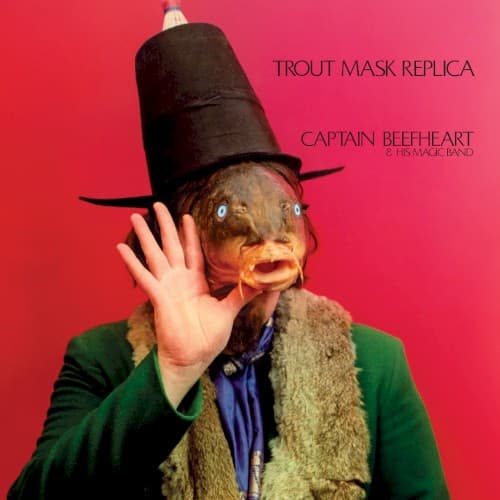

The famous face on Trout Mask Replica was not assembled from separate photographs in a darkroom. It existed in front of the camera. Designer Cal Schenkel later remembered going to a fish market, finding a carp head, taking it back to his studio and hollowing it out. Don Van Vliet — Captain Beefheart — then held the raw fish head over his own face while they worked. Schenkel recalled that the thing smelled terrible and that Van Vliet endured the setup for a couple of hours without much complaint.
That physical fact is the most important correction to the old story. The cover is often described as a surreal photomontage, but Schenkel's account makes it closer to performance photography: a musician literally wearing the object that the viewer assumes must have been fabricated after the shutter clicked. Schenkel even said he had 8mm footage of Van Vliet playing baritone saxophone through the fish head, an animated extension of the same visual gag.
Who first proposed the fish-mask idea is less certain. Schenkel said he did not remember whose idea it originally was and described the concept as collaborative. What he did remember clearly was sourcing the carp, hollowing it out and working with Van Vliet on the image. That is enough to explain the cover without adding an invented story about multiple exposures, careful masking or separate fish and portrait negatives.
The front-cover camera credit is less tidy than the physical setup. Third Man Records, working with the Zappa Family Trust on its archival reissue, says it tracked down the original 'Cal Schenkel cover photo.' MusicBrainz release credits list both Cal Schenkel and Ed Caraeff under photography, and in a later interview Schenkel himself said Ed Caraeff took the photo while Schenkel art-directed it. Rather than turn a conflicting credit trail into a false single-name answer, Behind the Covers retains both names and states the disagreement. What the sources agree on is Schenkel's central role in creating the image and the fact that the fish head was real.
Schenkel was already deeply embedded in Frank Zappa's visual world, designing sleeves and bringing collage, illustration and absurdist fine-art ideas into record packaging. Trout Mask Replica gave that sensibility an unusually direct form. The image is strange before the viewer knows anything about the music: a formally dressed man, a dead fish turned into a mask, and no technical trick needed to make the combination disturbing.
That directness is why the corrected story is better than the mythology. There was no need for 'pre-Photoshop wizardry' to make a hybrid face. The grotesque object, the patient performer and the decision to photograph them were enough. The cover's surrealism was staged in the room, not manufactured afterward.