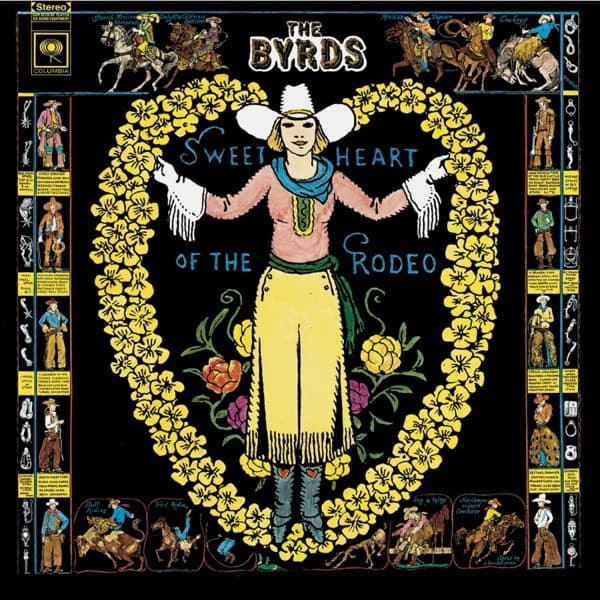
The cowgirl anchors the composition dead center, arms spread in a welcoming stance that makes her the immediate focal point. Her sleeves end in white fringe that dangles like the tassels on a saddle, her pink shirt is trimmed in green, and her blue boots are stitched with little hearts, small touches of warmth in a figure that could otherwise read as flat signage. The poppy garland loops around her from shoulder to boot, its golden yellow broken only by a few red and orange blossoms tucked in at the bottom. Set against a field of deep black, the figure and her floral heart appear lit from within.
The typography behaves unusually. The title is not stamped on top of the art; it lives inside it, the hand-lettered script following the curve of the wreath so the letters thread between petals as though they had always belonged there. The band name, by contrast, sits apart at the top center in bold block capitals, the one modern intrusion, along with the small Columbia Records logo and the word Stereo pinned into the upper left corner, a square of commerce clinging to the edge of something that looks far older.
The real density is at the margins. Run your eye around the borders and an entire rodeo unfolds in miniature. Across the top, above the band name, gallop tiny riders on horseback, each little vignette labeled in small type. Down the left and right sides stand narrow vertical panels, each holding a single cowboy figure with a block of descriptive text beside him, like trading cards stacked into a frame. Along the bottom runs a row of action scenes, small tableaux of bull riding, trick riding, and roping, again each with its own caption. Between these pictures run the tools of the trade rendered as decorative flourishes: coils of rope, spurs, bits, and tack threaded through the margins.
The result is that the picture works on two speeds. The eye lands first on the cowgirl, then wanders outward through the poppies to the galloping horses, the roping scenes, the ranked cowboys, drifting across the sleeve the way it might drift across a hand-drawn map, each figure a story you can stop and read. What presents as a portrait is actually a densely illustrated inventory of an entire event, and the heart of poppies quietly reframes that inventory as something affectionate rather than merely informational.
Read as a whole, the image announces a direction without a word of music. There is no photograph of the band, no psychedelic swirl, no sign of an electric city sound. There is a rodeo poppy heart and a smiling cowgirl in chaps, and the black field, the fringe, the boots, and the roping cowboys in the margins all say the same thing at once. Before a single note plays, the sleeve points home to the ranch, and its warmth and hand-drawn plainness set the tone the listener is meant to expect.