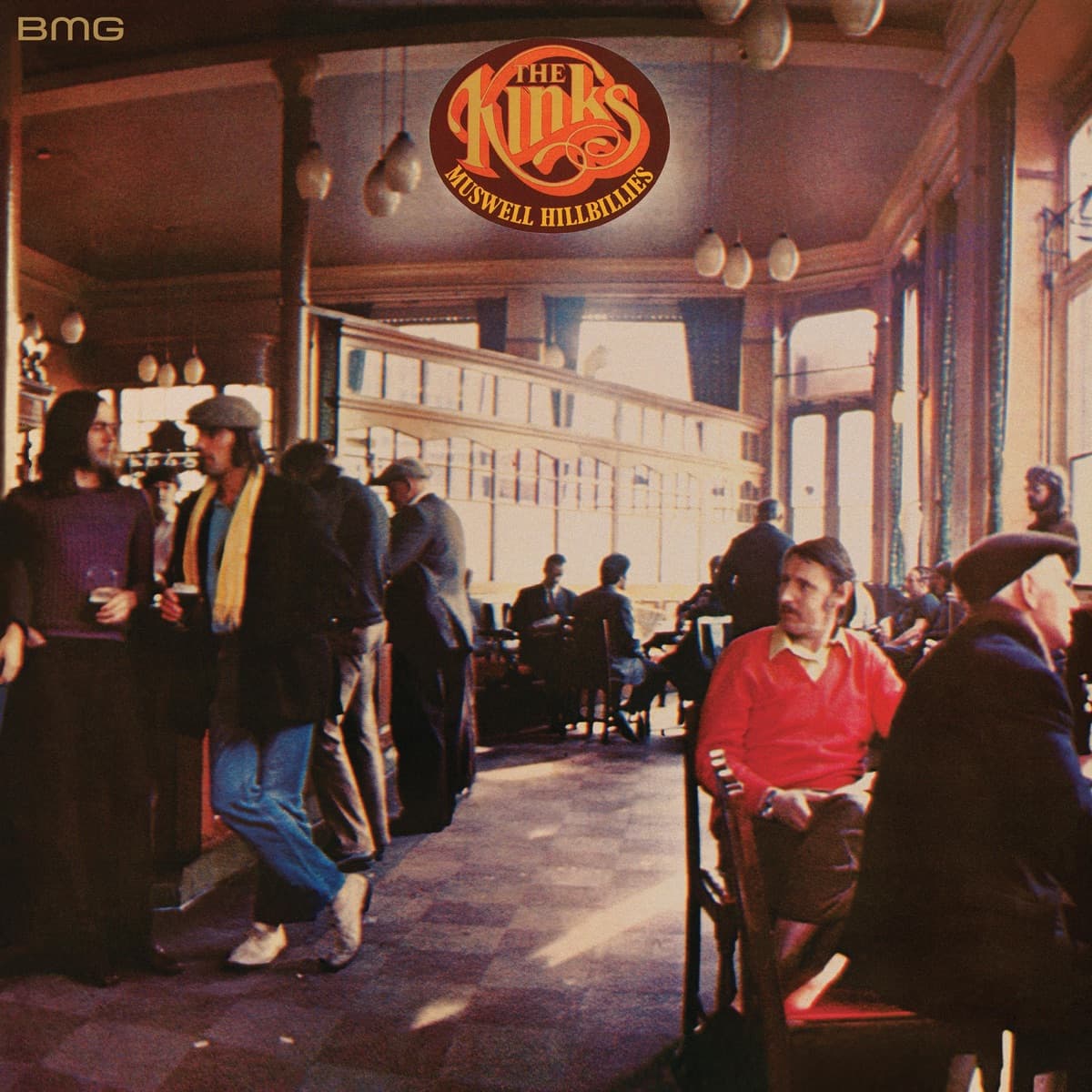
The Kinks called the album Muswell Hillbillies, but the pub on the cover was not in Muswell Hill.
Rod Shone photographed the band inside the Archway Tavern, roughly two miles away in Archway. That small geographical joke suits an album obsessed with place, displacement and the strange ways people carry home with them after the neighborhood changes.
Ray and Dave Davies had grown up in North London. By 1971, Ray was writing about working-class families pushed around by redevelopment, bureaucracy and modern life. The Kinks' official history describes Muswell Hillbillies as looking back toward those London roots even as the music borrowed from American country, blues and music hall. The title itself turns Muswell Hill into an imaginary Appalachia.
The cover does not romanticize that idea with a pastoral scene. It goes to the pub.
Shone's photograph is busy with ordinary life. The band are part of the room rather than elevated above it. Tables, drinkers, lights and the architecture of the tavern matter as much as celebrity. It feels inhabited. That is important for a record whose characters are constantly trying to hold onto some version of community while the modern world rearranges itself around them.
The rest of the original package deepened the geography. A back image showed the band near a road sign pointing toward Muswell Hill, photographed around Highgate. Open the gatefold and the record becomes a small map of Davies territory: not a literal cartographic guide, but a sequence of North London places linked by memory and attitude.
There is also a deliberate clash between Britain and America. The title song imagines a 'Muswell hillbilly' whose heart lies in West Virginia. The music reaches toward American roots forms while the photographs stubbornly remain in London. Instead of pretending the Kinks have become an American country band, the artwork makes the borrowing part of the joke. These are North London hillbillies, and their saloon is an English pub.
That tension had extra weight in 1971. Muswell Hillbillies was the Kinks' first album for RCA after leaving Pye, and the band was entering a new commercial chapter. A more conventional campaign could have polished them for the American market. The sleeve moves the other way, into a local pub full of character.
Fifty years later, the official Kinks campaign still treated that visual geography as central. Anniversary editions recreated the original gatefold artwork, and a deluxe box included a 'London Roots' map of Kinks-related North London locations selected by the band.
The cover lasts because it never tries too hard to become iconic. It looks like somewhere you could walk into. For an album about people trying not to be erased by progress, that ordinariness is the point.
Inside the design
Nothing on the front of Muswell Hillbillies looks remotely like the fantasy of rock stardom.
Rod Shone photographed the Kinks inside the Archway Tavern, gathered around a table in a working London pub. The room supplies the visual vocabulary: pints, furniture, patterned surfaces and the accumulated texture of an ordinary local. The band occupies the space rather than transforming it into a set.
That ordinariness is the point. The title mixes Muswell Hill—Ray and Dave Davies' North London roots—with an American "hillbilly" identity, while the music itself pulls English stories through country, blues and music-hall forms. The pub photograph keeps the album anchored to the London half of that equation.
The picture also resists hierarchy. This is not Ray Davies isolated as a charismatic frontman while the rest of the group falls away. The table and room make the band look social, embedded and almost temporarily anonymous.
The back image makes the geography into a joke. The band is photographed near a sign pointing toward Muswell Hill, emphasizing that even this deeply local album is partly about distance, memory and the idea of home.
Front and back therefore perform different jobs. The tavern supplies lived atmosphere; the road sign names the place toward which the album keeps looking.
Together they behave almost like two documentary frames from the same neighborhood story rather than separate pieces of sleeve decoration.
That documentary quality is what makes the package distinctive. Muswell Hillbillies does not invent an imaginary rustic London for the Kinks. It uses real streets and a real pub, then lets the album's American musical references create the productive mismatch.
Why it matters
Muswell Hillbillies matters because the sleeve trusts a real place to carry the record's identity.
The Kinks had already spent years writing about English streets, houses, class, memory and disappearing ways of life. A glamorous studio portrait would have fought the material. The Archway Tavern gives the songs a believable room.
It is not actually in Muswell Hill, which makes the choice more interesting rather than less. The album is about belonging, displacement and the way people construct home in memory. The back-cover sign pointing toward Muswell Hill quietly turns that distance into part of the package.
The title itself contains a similar displacement. "Muswell" is intensely local to the Davies brothers; "Hillbillies" points toward an imagined America of country music and rural identity. The photographs prevent the American influence from floating free of its North London source.
The result feels closer to social observation than rock iconography. The Kinks are famous people, but the cover allows them to look like men who have simply taken over a table at the local.
That is particularly appropriate for Ray Davies, whose songwriting repeatedly found drama in ordinary rooms and ordinary lives. The sleeve does not need to illustrate individual characters from the songs because it establishes the kind of environment in which those characters might plausibly exist.
It also gives the album a visual authenticity that cannot be manufactured by nostalgia after the fact. This is not a modern recreation of an old London pub. It is the band occupying one in 1971.
Historical context
Muswell Hillbillies arrived in 1971 as the Kinks' first album for RCA Records after their years with Pye.
Ray Davies was looking backward toward the North London environment that shaped him while writing about redevelopment, bureaucracy, anxiety and cultural displacement. The title itself folds Muswell Hill into an imagined American rural identity, matching music that draws on country and blues without abandoning Davies' intensely English perspective.
Those themes had real historical pressure behind them. Postwar London was being reshaped by road projects, redevelopment and the demolition of older housing. For Davies, ideas of neighborhood and home were not simply picturesque nostalgia; they could be threatened by institutions with plans for improvement.
Rod Shone's photographs locate that tension in real geography. The front was made at the Archway Tavern in Archway, a few miles from Muswell Hill. Ray Davies later remembered the pub fondly and spoke about the peculiar feeling of emerging from it into the traffic around Archway.
The back-cover location, with its directional sign toward Muswell Hill, makes the neighborhood reference explicit. The package therefore acts almost like a small map of the album's emotional territory.
The American musical vocabulary adds another layer to that map. Country and blues styles had traveled across the Atlantic and become tools through which Davies could write about London.
That makes the cover's stubborn Englishness important. Without it, "hillbillies" could become costume. The pub, street and sign keep reminding the listener where these particular hillbillies actually come from.
Legacy & influence
The Archway Tavern became inseparable from the visual memory of Muswell Hillbillies.
That is fitting for an album preoccupied with what happens to places when cities, governments and economies change around the people who live there. Buildings alter, pubs close or reopen, neighborhoods become fashionable, but a record sleeve freezes one particular room and moment.
The cover has consequently acquired documentary value beyond band mythology. Fans can identify the real London locations and trace the distance between the title's Muswell Hill and the pub where the photograph was actually made.
That location-hunting afterlife is especially appropriate for the Kinks. So much of Ray Davies' writing is geographically specific that streets, houses, stations and pubs become part of the band's mythology alongside songs and performances.
More importantly, the sleeve helped establish the tone through which later listeners understand the record: affectionate but unsentimental, local without being quaint, and suspicious of any idea of progress that requires people to forget where they came from.
The album's reputation has also grown considerably since its original release. As Muswell Hillbillies came to be treated as one of the key works in the Kinks' catalogue, the unglamorous pub photograph gained stature with it.
It is difficult to imagine the album wearing a more polished cover without losing something essential.
The image's legacy is therefore not a design trick copied by hundreds of later bands. It is a more useful achievement: the sleeve made place inseparable from the music. Once you know the Archway Tavern photograph, the record's London no longer feels abstract.