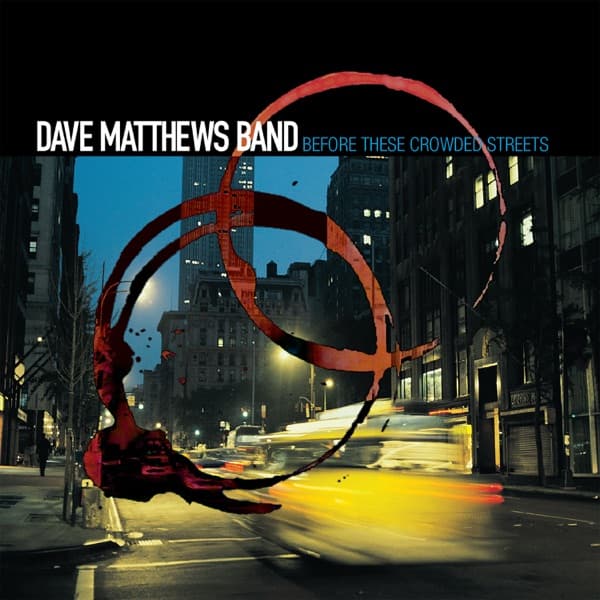
Look past the ring and the scene resolves. You are standing in the middle of a road at that blue hour when the sky has gone deep cobalt but the buildings still hold the memory of daylight on their upper floors. Skyscrapers rise on either side, funneling your gaze down the avenue toward a vanishing point crowded with more towers. Windows glow in scattered gold. The whole left and background of the frame is bathed in that electric dusk-blue, the color of a city that is neither asleep nor fully awake.
And then, motion. A yellow taxi tears across the lower right of the frame, smeared into a long horizontal streak of amber and white by the camera's slow shutter. It is the loudest thing in the picture after the red ring, a slash of pure speed that makes everything around it feel suddenly still. Tiny pedestrians stand frozen on the sidewalk at the edges, dwarfed by the architecture, while the cab blurs past them like a thought you cannot hold onto. The photograph makes the city both monumental and fleeting at once.
The red ring reads, on second glance, like the number nine, or a broken zero, or simply the residue of a drink. Its edges are ragged and translucent in places, darker and clotted in others, with small droplets and splatters flung out beyond the main loop. It hovers in front of the buildings without belonging to them, a hand-made gesture pressed against a machine-made world. That tension, warmth against cold, the organic against the engineered, gives the sleeve its restless mood.
Across the top, the type keeps its distance from the chaos below. Dave Matthews Band sits in clean white capitals at the upper left, and Before These Crowded Streets runs beside it in a lighter, spaced-out lettering tinted the same reddish hue as the ring, tying the words to the stain. There is a slim black band framing the top and bottom of the image, giving the photograph the feel of something glimpsed through a letterbox slot, or through the windshield of a car easing into traffic. The title itself, streets that are crowded, is answered by the picture: here they are, canyons of stone with a lone cab rushing through.
The abstract red mark could be a bandleader's improvised flourish laid over the fixed grid of the city, the painterly against the photographic, the loose against the precise. That incomplete circle, a loop that never quite closes, carries its own quiet suggestion of something left open, a gesture that will not resolve into anything neat.
What lingers, in the end, is the balance the sleeve strikes. It offers a single evocative scene: a city at nightfall, a taxi dissolving into light, and one bold red gesture pressed against the stone. It refuses to hand you a face or a logo and instead makes you work, which is exactly what a cover should do when the music behind it wants to be more than a collection of songs.