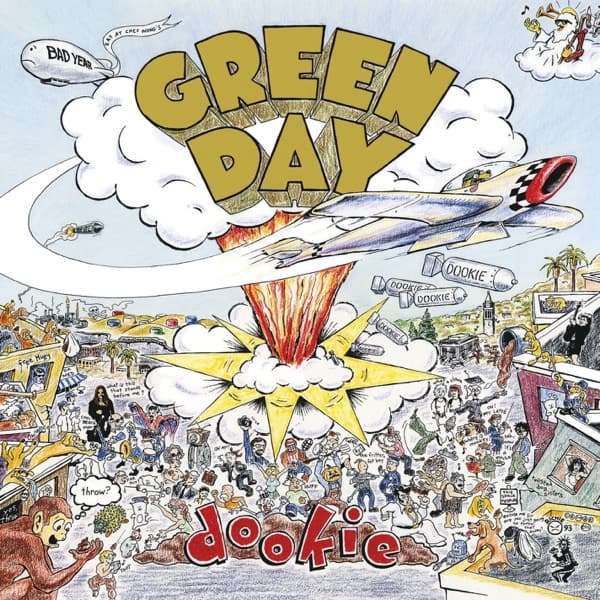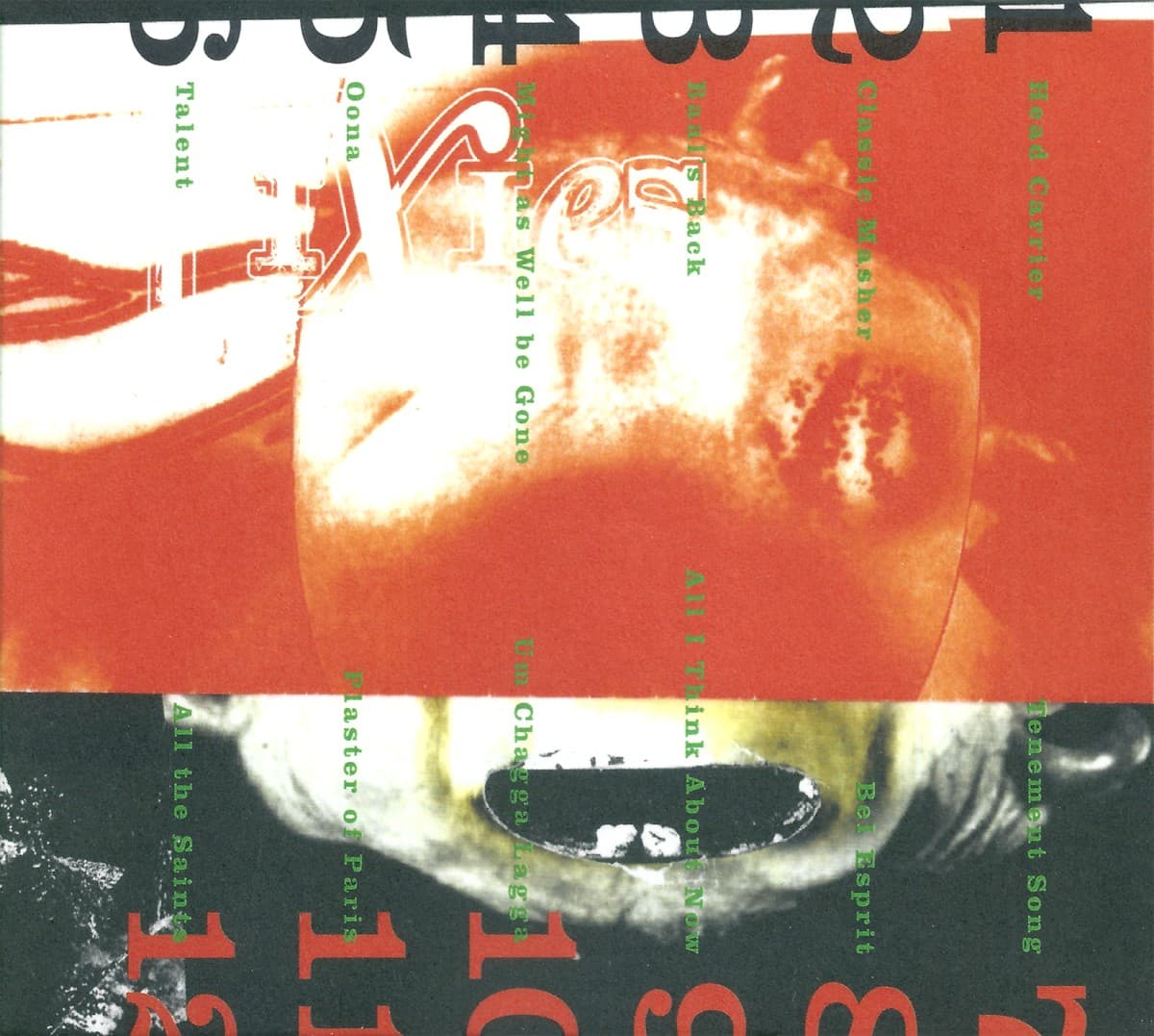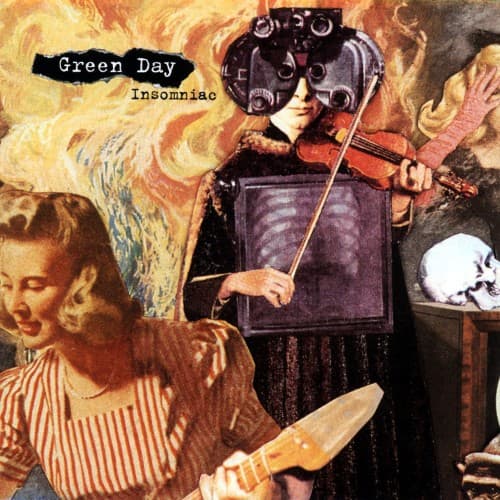


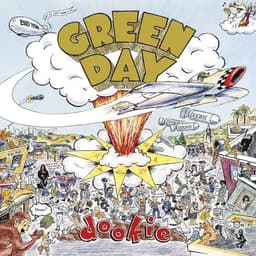
Dookie looks like an entire neighborhood exploding at once. Insomniac looks like the explosion happened inside somebody's head. The sleeve is a collision of faces, bodies, flames, old paintings and fragments that do not belong together until Winston Smith forces them into the same square.
Smith was already one of punk's defining collage artists by 1995. His work with Dead Kennedys and Alternative Tentacles had made found imagery, grotesque juxtaposition and political satire part of his visual language long before Green Day called. The connection came through Tré Cool. Smith later recalled that Billie Joe Armstrong and Cool went through photocopies of his earlier work in the studio, and that a pair of figures derived from Jan van Eyck's fifteenth-century wedding-portrait imagery became the nucleus of the Green Day composition.
Around that nucleus Smith built a much denser montage. The finished piece is titled God Told Me to Skin You Alive. Its title carries Smith's punk history with it: the phrase comes from the spoken opening of the Dead Kennedys song I Kill Children. Another piece of that history is physically present in the collage. The dentist image had appeared in earlier Smith artwork associated with Dead Kennedys' Plastic Surgery Disasters. The Green Day sleeve therefore does more than imitate old punk collage; it literally carries part of that visual vocabulary forward.
The process was physical. Smith's practice centered on cutting, positioning and recombining printed images by hand rather than building a digital composition from infinitely movable layers. He also described an extended sleepless stretch while finishing the work. In one well-known account, Armstrong asked how he could stay awake so long and Smith replied that he was an insomniac. That anecdote belongs in the album's history, but it should not be treated as the only definitive origin of the title. Other Green Day histories connect Insomniac to Armstrong's own sleeplessness, so the honest version is that multiple credible accounts survive.
The cover rewards repeated looking. Faces appear and disappear in the crowding, flames compete with the central figures, and art-historical fragments become part of a new grotesque whole. Published histories of the package also identify three skulls, one associated with each member of Green Day. One is anamorphic, becoming legible only from an angle, and derives from Hans Holbein's The Ambassadors. That use of older art as raw material is central to Smith's method.
The original package credits matter because this was a collaborative sleeve system rather than one image dropped into a template. Winston Smith is credited for the art, Dirk Walter for art direction and David Harlan for typographic design. Keeping those roles separate makes the production history more accurate.
Placed between Dookie and American Idiot, Insomniac also fills a revealing gap in Green Day's visual evolution. Dookie turns the East Bay into a public cartoon spectacle. Insomniac turns found culture and art history into private visual anxiety. American Idiot later reduces the band's image to one instantly legible emblem: the heart grenade. The continuity is not one house style. It is Green Day's willingness to let each era invent a different visual language.